
Medical malpractice lawsuits cost U.S. healthcare providers over $4 billion annually, according to the National Practitioner Data Bank. Doctors in Portland face real exposure to litigation, patient complaints, and regulatory scrutiny that can threaten both their practice and personal assets.
At ABI Insurance, we’ve helped countless medical professionals in Portland secure doctors’ liability insurance that actually matches their specific risks. The right coverage isn’t just about legal compliance — it’s about protecting your income, your reputation, and your ability to practice medicine.
Why Doctors in Portland Actually Need Malpractice Insurance
The Medscape 2021 Surgeon Malpractice Report found that surgeons faced lawsuits during their careers. That’s not a worst-case scenario — that’s the norm. For Portland physicians, the question isn’t whether you’ll face a claim; it’s whether you’re prepared when it happens. Without professional liability insurance, a single malpractice lawsuit wipes out years of income, forces you to liquidate personal assets, and derails your ability to practice medicine. Oregon has no cap on economic or non-economic damages, meaning a jury can award whatever amount it deems appropriate. Defense costs alone reach six figures before any settlement or judgment is paid. A general surgeon defending a surgical negligence claim might spend $50,000 to $200,000 on legal representation alone, regardless of the lawsuit’s outcome. That’s money out of your pocket if you’re uninsured.
State-filed average malpractice premiums in Oregon reflect the real cost of protection: family medicine without surgery runs around $7,684 annually for $1 million per claim and $3 million aggregate coverage, while general surgery costs approximately $29,088 for the same limits.
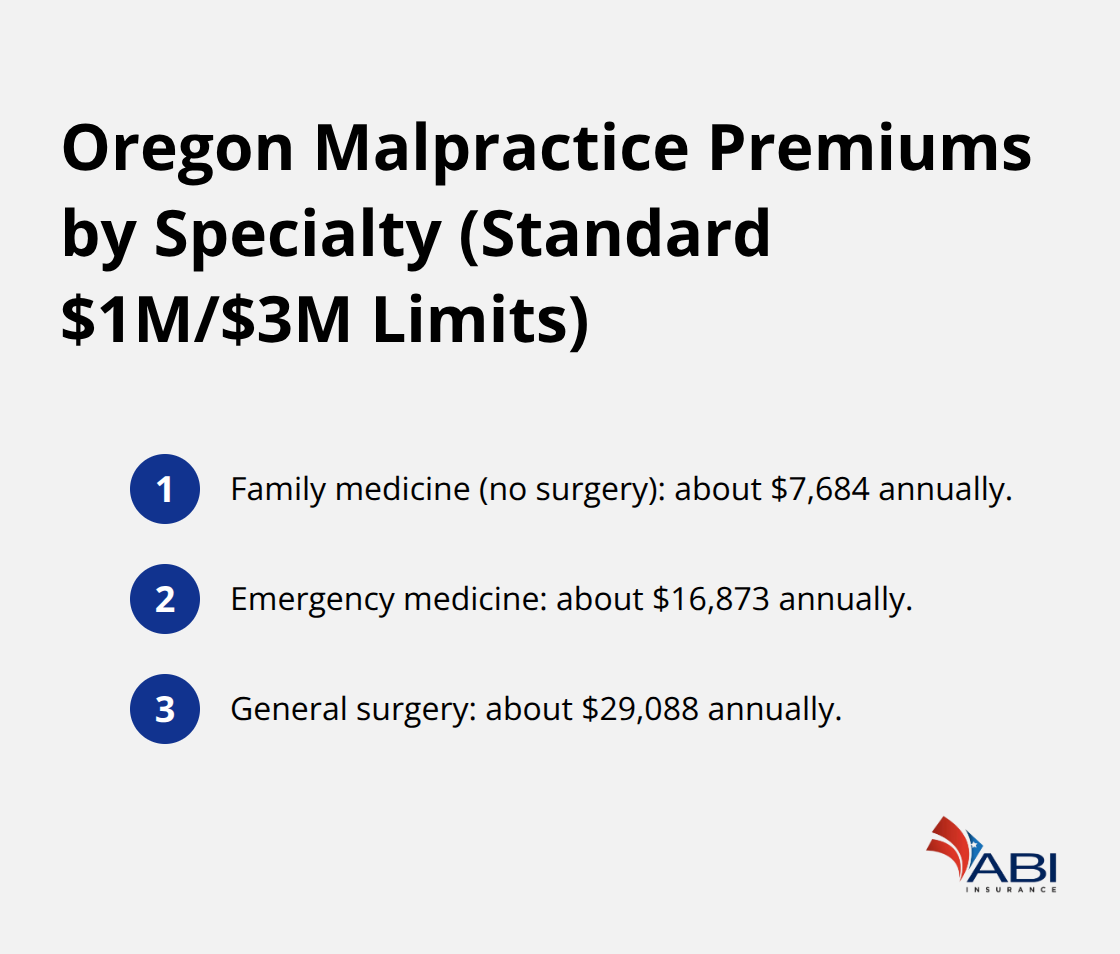
Emergency medicine sits at roughly $16,873. These premiums exist because claims happen regularly. When they do, your insurance covers defense costs, settlements, and judgments — a critical second line of defense that separates financial ruin from manageable risk.
Hospital Privileges Require Proof of Coverage
Most Portland-area hospitals and healthcare facilities require minimum coverage of $1 million per claim and $3 million aggregate before granting privileges or allowing you to practice on their premises. This isn’t optional. Without proof of adequate coverage, you cannot admit patients or perform procedures at major facilities, effectively shutting down your ability to practice. Oregon does not mandate malpractice insurance at the state level, but your credential committee does.
Tail Coverage Protects Against Delayed Claims
Your malpractice statute of limitations — two years from discovery for standard claims and three years for wrongful death — means you need tail coverage extending well beyond your active practice years to protect against delayed claims. Switching carriers, retiring, or closing your practice without tail coverage leaves you exposed to claims filed after your policy expires. Tail coverage typically costs about 200 percent of your annual premium and must be purchased by the last day of your active policy period. Failing to secure it is a costly mistake that leaves you personally liable for claims arising from work you’ve already completed.
Understanding your coverage options becomes the next critical step. Claims-made and occurrence policies offer different protections and price points, and selecting the right structure for your practice determines both your immediate costs and your long-term exposure.
Coverage Options That Fit Your Practice and Budget
Claims-made policies dominate the Portland market because they cost significantly less upfront than occurrence policies. A general surgeon with claims-made coverage of $1 million per claim and $3 million aggregate typically pays around $30,000 annually, whereas occurrence coverage for the same limits cost substantially more. The trade-off is straightforward: claims-made policies only cover claims reported during the active policy period, so you must carry tail coverage when you leave a practice, retire, or switch insurers. Tail coverage can cost approximately 200 percent of your annual premium, transforming that $30,000 annual premium into a $60,000 one-time expense when you stop practicing. Some carriers offer tail coverage for free once you are vested. You must purchase tail coverage by the last day of your active policy period, and most carriers offer a 30-day window to lock in rates before that deadline passes.
Occurrence policies eliminate this tail coverage requirement because they cover any incident that happened during the policy period, regardless of when the claim is filed. The higher annual cost of occurrence policies — often 40 to 60 percent more than claims-made — appeals primarily to physicians planning long careers without job transitions. For most Portland doctors, especially those early in their careers or considering practice changes, claims-made policies make financial sense if you plan ahead for tail coverage costs.
How Your Specialty Determines Coverage Limits and Costs
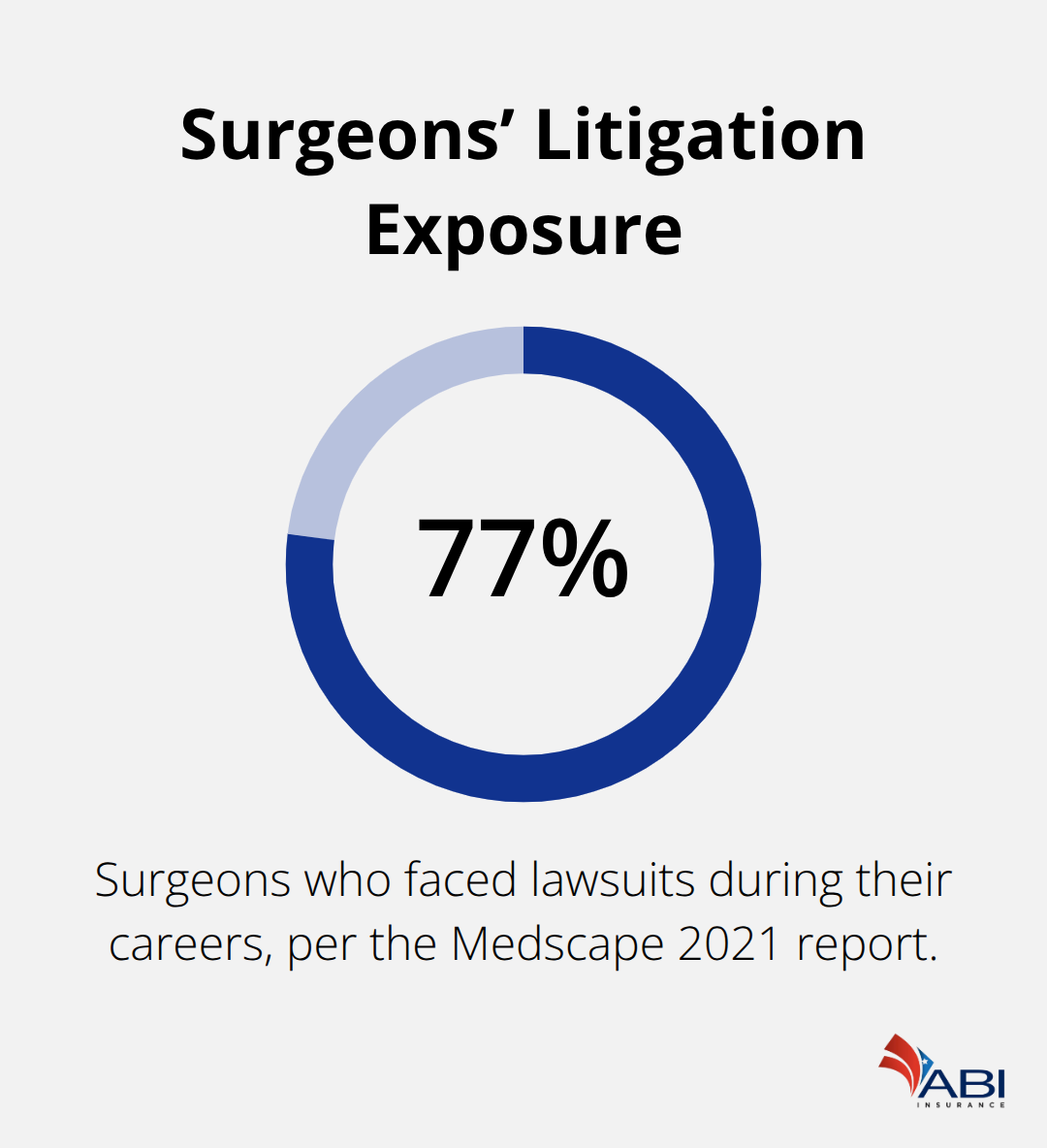
A dermatologist performing non-surgical work needs far different coverage than a general surgeon performing complex procedures. State-filed average rates in Oregon show dermatology at roughly $8,000 annually for standard limits, while general surgery runs approximately $29,088 for identical coverage, and obstetrics with major surgery reaches $39,881. These differences reflect genuine risk exposure: the Medscape 2021 Surgeon Malpractice Report documented that 77 percent of surgeons faced lawsuits during their careers, compared to lower rates among non-surgical specialties.
Portland hospitals typically require $1 million per claim and $3 million aggregate minimums, but your actual needs depend on your procedures and patient volume. Raising coverage limits from $1 million to $2 million per claim increases your annual premium by roughly 40 percent or more, creating a cost-benefit calculation you should revisit annually as your practice scope evolves. Higher deductibles reduce premiums but shift more risk onto you if a claim materializes.
Shopping Across Carriers Saves Thousands
Shopping across multiple carriers yields 30 to 50 percent savings in Portland’s competitive market, making broker access to all active Oregon insurers especially valuable for tailoring both coverage limits and pricing to your specialty and practice size. The major carriers operating in Oregon — including The Doctors Company, Physicians Insurance, Continental Casualty, Medical Protective, Admiral Insurance, NCMIC, NORCAL Mutual, ProAssURANCE, ProSelect, and Coverys Specialty Insurance — each offer different rate structures and underwriting approaches. When you request quotes, specify your exact procedures, patient volume, and facility requirements to receive accurate pricing. Verify that quotes include the required limits (often $1 million/$3 million) and confirm whether the policy is claims-made or occurrence. Check carrier financial strength with AM Best ratings (A or higher) and assess service quality, including responsiveness and claims handling experience in your specialty.
The right policy structure and carrier selection protect your practice today, but additional protections address risks that standard E&O coverage does not fully cover.
How to Reduce Claims Before They Happen
Insurance protects you after a claim materializes, but the most effective strategy prevents claims from occurring in the first place. Portland medical practices that implement concrete risk reduction measures demonstrably lower claim frequency and severity. Documentation stands as your first and most powerful defense against litigation.
Documentation as Your Legal Foundation
Courts and insurers evaluate claims based on what your medical records show, not what you remember doing months or years later. The Coverys analysis of practitioners’ performance documentation in surgical claims revealed that inadequate documentation created ambiguity about what actually happened. When your notes lack specificity — missing timestamps, vague descriptions of findings, or incomplete reasoning for clinical decisions — you hand opposing counsel a roadmap to challenge your judgment.
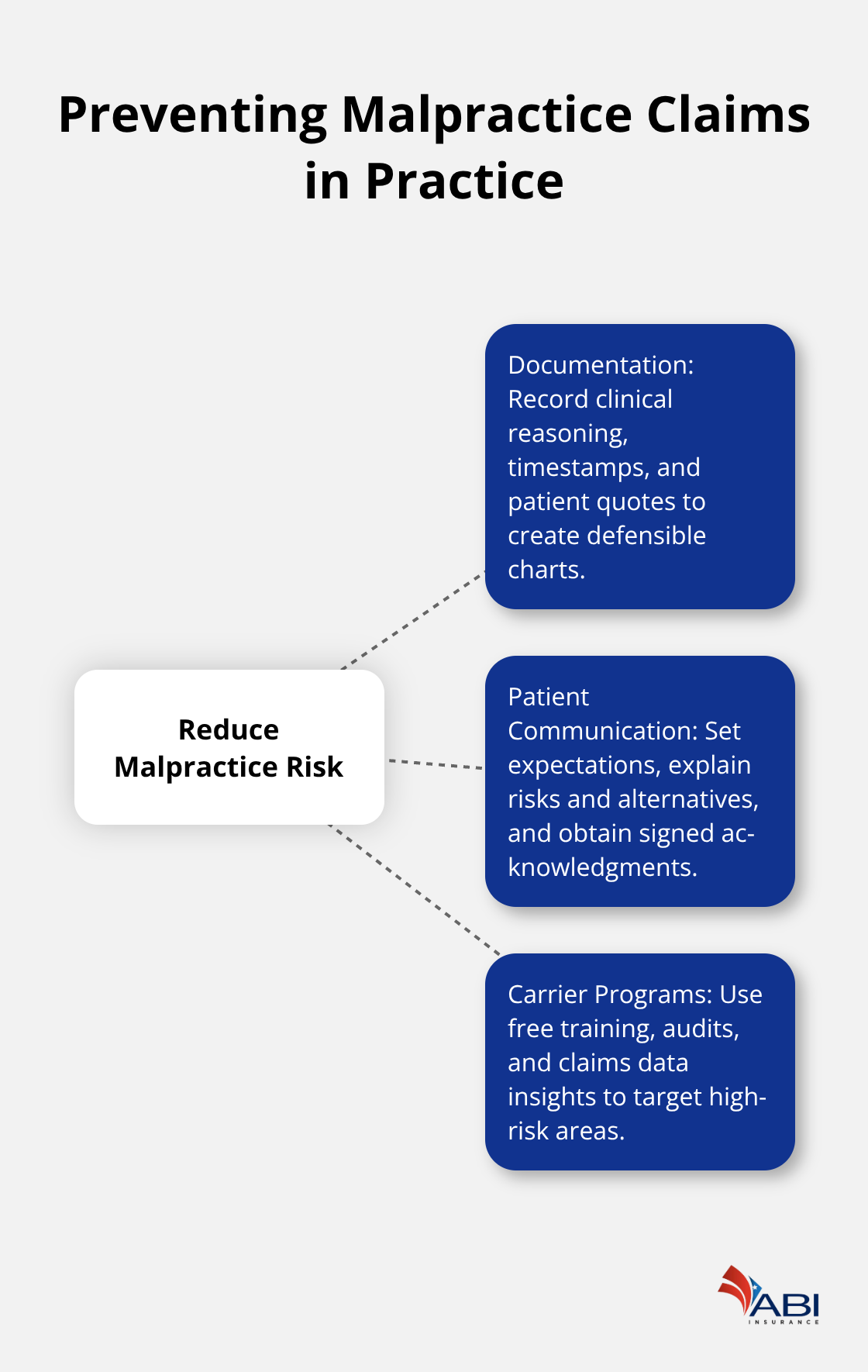
Document your clinical reasoning, not just your actions. Write why you chose treatment A over treatment B, what patient presentations concerned you, and what you explained to the patient about risks and alternatives. Time-stamp entries when they occur rather than hours later when memory fades. Include direct patient quotes about symptoms or concerns. This level of detail transforms your records from a liability vulnerability into powerful evidence of sound clinical judgment. Your documentation reflects the standard of care you provided, making it nearly impossible for opposing counsel to argue you acted recklessly or negligently.
Patient Communication Prevents Escalation
Many malpractice suits arise not from genuine medical errors but from patients feeling dismissed, unheard, or surprised by outcomes. When patients believe you failed to explain risks adequately or didn’t listen to their concerns, they pursue litigation to gain acknowledgment of their experience. Establish protocols requiring written summaries of major discussions — treatment plans, procedure risks, alternative options, and expected timelines. Have patients sign acknowledgments that they received and understood this information.
When complications occur, communicate promptly and transparently rather than hoping the patient doesn’t notice. A surgeon who calls a patient within 24 hours of an unexpected finding, explains what happened, outlines next steps, and documents the conversation creates a record of professionalism that dramatically reduces litigation likelihood. Conversely, silence breeds resentment. Patients sue doctors they perceive as evasive far more often than doctors they perceive as honest about complications.
Leverage Carrier Risk Management Programs
Your insurance carrier maintains risk management programs specifically designed for healthcare providers, offering training modules on high-risk procedures, documentation audits, and peer review processes. These resources come at no additional cost. Your carrier’s claims data reveals patterns in your specialty — which procedures generate the most litigation, what documentation gaps appear repeatedly in closed claims, which patient populations file claims at higher rates.
Use this intelligence to refine your protocols. If orthopedic surgeons in your region face elevated claims for retained foreign bodies, implement a surgical count protocol with two independent verifications before closure. If your specialty shows claims clustering around informed consent disputes, audit your consent processes quarterly. This data-driven approach transforms insurance from a passive safety net into an active risk management partnership that strengthens your practice’s defenses.
Final Thoughts
Professional liability insurance forms the backbone of financial protection for Portland medical practices. Without it, a single malpractice claim liquidates years of savings, damages your reputation, and ends your career. Oregon’s uncapped damages, hospital credentialing requirements, and the statistical reality that most physicians face litigation at some point make doctors liability insurance in Portland a non-negotiable business decision.
We at ABI Insurance understand the specific risks Portland healthcare providers face. Our team has spent over 40 years helping medical professionals across the Portland metro area navigate complex coverage decisions, compare carrier options, and secure policies that match their practice scope and budget. We work with major carriers including CNA, The Doctors Company, and Medical Protective to access competitive rates and tailored terms that single-carrier options cannot match.
Contact ABI Insurance to request a free, personalized quote for your practice. Specify your procedures, patient volume, and facility requirements so we can deliver accurate pricing across multiple carriers. The cost of securing proper coverage today is infinitely smaller than the financial devastation of facing a claim uninsured.











 Hospital Medical Liability Portland: Navigating Complex Risk