Picking the right auto insurance deductible is one of the most overlooked decisions drivers make. Many people either choose too low a deductible and overpay on premiums or pick one that’s too high and risk financial hardship after an accident.
At ABI Insurance, we’ve seen firsthand how the wrong deductible choice can hurt your wallet. This guide walks you through the numbers so you can deci that actually fits your situation.
What a Deductible Actually Costs You
A deductible is the amount you pay out of pocket when you file a claim before your insurer covers the rest. If you hit another car and the damage costs $3,000 with a $500 deductible, you pay $500 and your insurer pays $2,500. Most drivers don’t understand how deductibles apply across different coverages or how they affect what you pay year after year. Deductibles typically apply to collision coverage (damage you cause), comprehensive coverage (theft, weather, vandalism), and sometimes to uninsured motorist protection. You pay the deductible per claim, not once per year. If you file two separate claims in one year, you pay the deductible twice.
The Real Numbers Behind Deductible Choices
Most drivers choose a $500 deductible, but 26% now carry $1,000 or higher according to JD Power’s 2025 U.S. Auto Claims Satisfaction Study. Higher deductibles lower your monthly premium, and the savings aren’t linear. Moving from a $500 to a $1,000 deductible often saves significantly more on your annual premium.
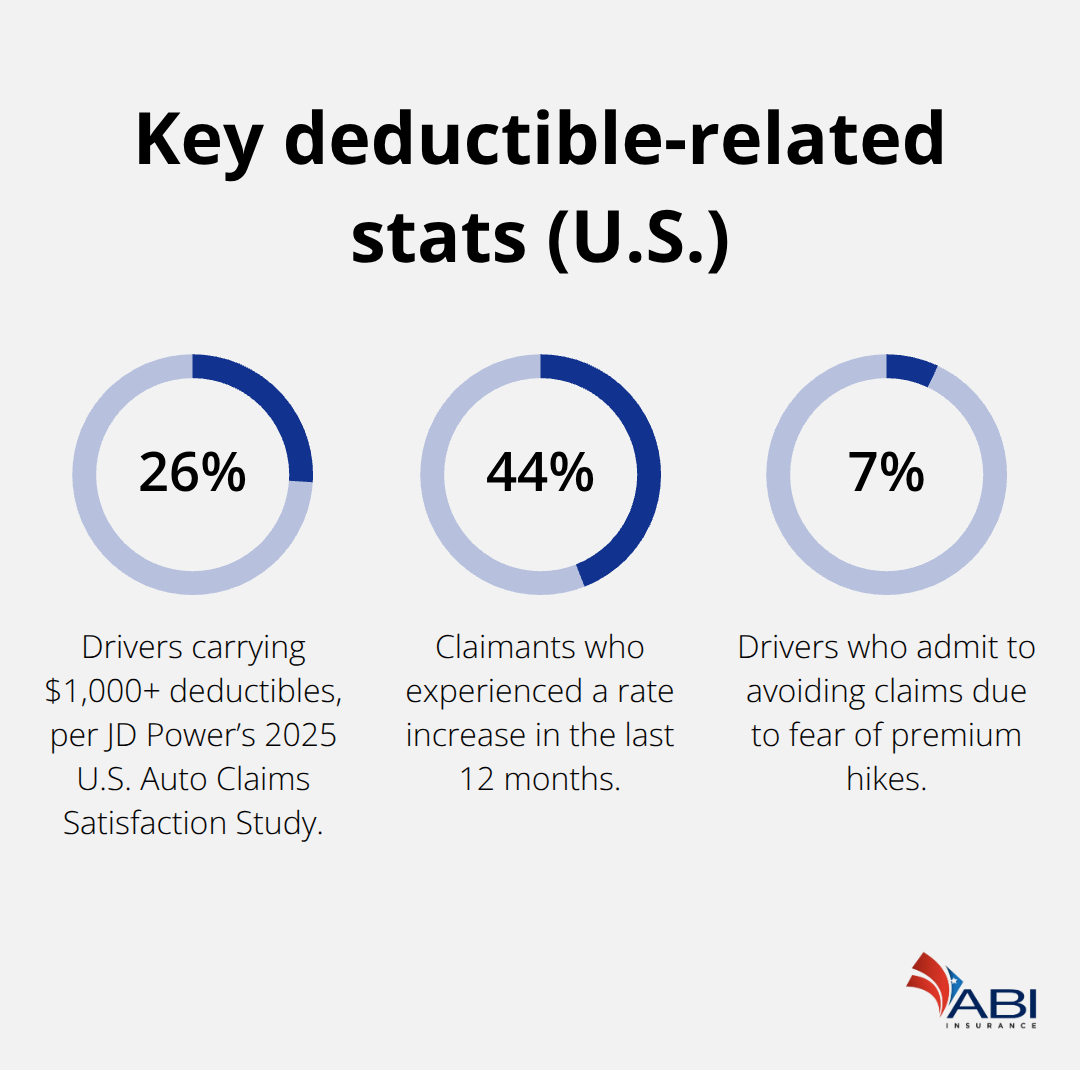
The trade-off matters because raising your deductible from $100 to $250 cuts your premium, but you need enough cash on hand to cover that amount if something happens tomorrow. Most drivers make a critical mistake: they pick a high deductible to save money, then can’t actually pay it when a claim occurs. This creates stress and sometimes leads to avoiding claims altogether and 7% of drivers admit to doing this out of fear their rates will rise. That fear has merit. In the last 12 months, 44% of claimants experienced a rate increase, and satisfaction drops 104 points for those customers compared to those who didn’t see increases.
How Deductibles Shape Your Total Insurance Cost
Your deductible and your premium work in opposite directions, and the math is personal to your situation. A younger driver or someone new to insurance should start with a $500 deductible and request quotes at $750 and $1,000 to see the actual savings. This removes guesswork. For older vehicles worth less than $5,000, the premium savings from a higher deductible might be negligible, making a lower deductible more sensible. If your car is financed or leased, many lenders cap your deductible at around $1,000, so check your loan documents before you choose higher. You’re not just comparing deductibles, you’re comparing total out-of-pocket costs over time. A $1,000 deductible saves you $200 per year but costs you $1,000 if a claim happens. That break-even point matters, especially when repair costs are rising (particularly for electric vehicles and newer cars with advanced safety features that cost more to repair).
Why Your Emergency Fund Determines Your Real Deductible
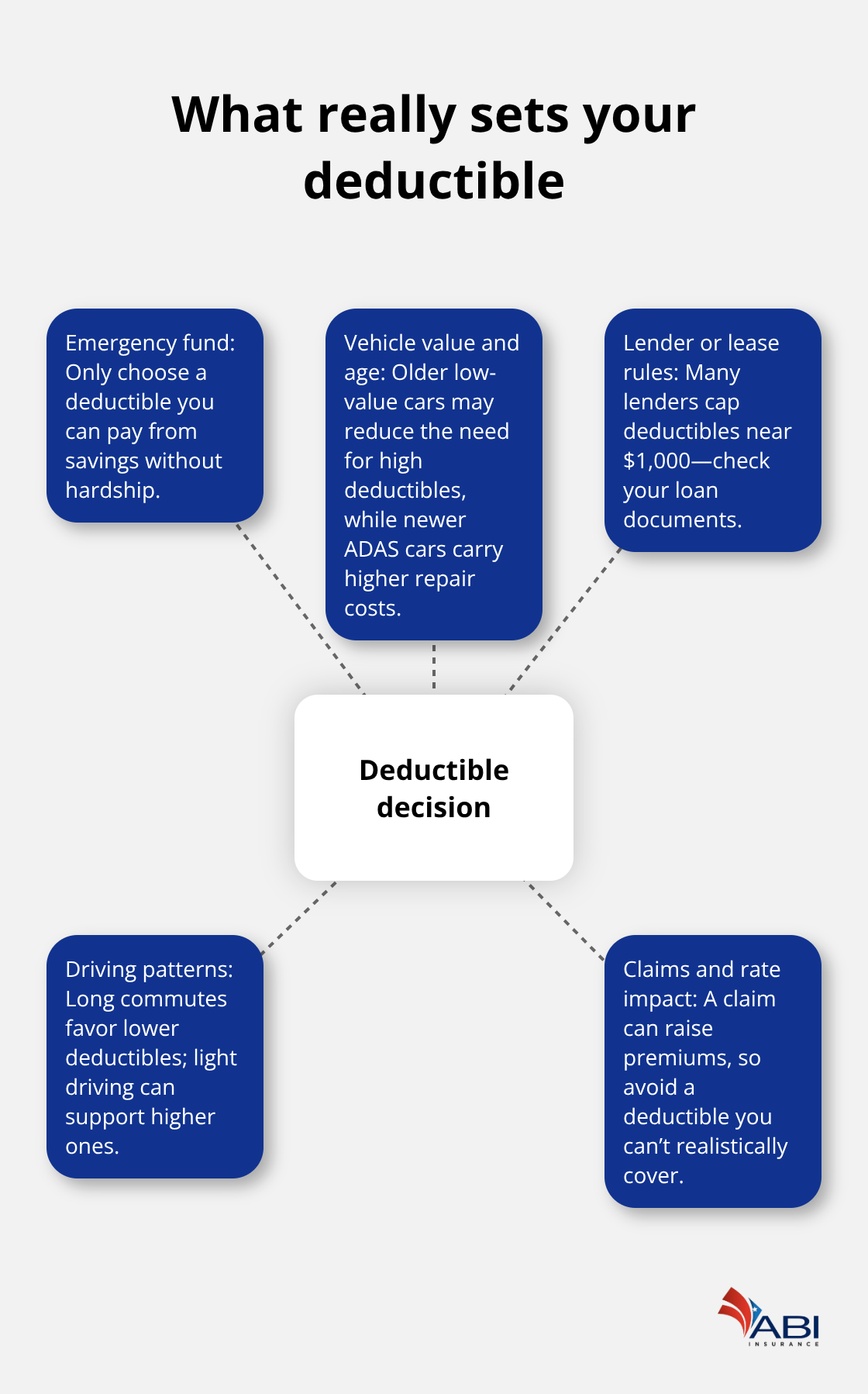
The deductible you can afford and the deductible you should choose are two different things. You should only select a deductible you can pay from your emergency fund without hardship. If you have $2,000 in savings and pick a $1,500 deductible, a single claim wipes out your financial cushion. This is where many drivers fail. They optimize for the lowest premium instead of the lowest total risk. Your emergency fund acts as your self-insurance layer. The higher your fund, the higher a deductible you can comfortably carry. If you lack an emergency fund, a lower deductible protects you from unexpected costs that could spiral into debt. Building this fund should come before you raise your deductible to chase premium savings.
When Deductible Choices Change Your Coverage Strategy
Your vehicle’s age and value shift how deductibles work for you. Newer cars with advanced safety features (ADAS) cost more to repair, which means the gap between your deductible and actual repair costs widens. Older vehicles present the opposite problem. Repair costs may fall below your deductible, making collision or comprehensive coverage less valuable. You also need to account for how often you file claims. Drivers with long commutes or high annual mileage face greater accident exposure, which favors a lower deductible for more predictable costs. Drivers who rarely drive and maintain clean records can absorb a higher deductible without much risk. The decision hinges on your actual driving patterns and financial resilience, not on what your neighbor chose or what sounds reasonable in theory. Understanding these variables prepares you to evaluate your current coverage and identify gaps or inefficiencies that affect both your premium and your protection.
Factors to Consider When Choosing a Deductible
Your Financial Cushion Comes First
Your financial cushion, not insurance theory, should decide your deductible. If you have savings or an emergency fund, you can consider a higher deductible. If you lack savings, a lower deductible may be the safer choice, even if it means slightly higher premiums. Too many drivers reverse this logic and choose high deductibles first, then scramble to find the cash when a claim hits.
Start by calculating your actual monthly expenses, multiply by three, and that’s your baseline emergency fund target. Once you hit that number, you can consider raising your deductible. If you’re still building that fund, stick with a lower deductible even if the premium is higher. The peace of mind costs less than financial chaos after an accident.
Your Driving Patterns Shape Your Risk Exposure
Drivers with long commutes or high annual mileage live in a different risk world than someone who works from home. A person driving 30,000 miles yearly has roughly six times the accident exposure of someone driving 5,000 miles. According to repair data, newer vehicles with advanced safety features (ADAS) now average 21.5 days in the repair cycle compared to 17.9 days for older vehicles without those systems. This matters because repairs take longer, costs climb, and your out-of-pocket exposure increases if you’ve chosen a high deductible. If you commute daily on congested roads, a $500 deductible gives you predictable costs and reduces stress. If you drive occasionally on low-traffic routes with a clean record over five years, a $1,000 deductible makes financial sense. The break-even calculation is simple: divide your annual premium savings by the deductible amount. If raising your deductible saves you $300 per year but costs $1,000 out of pocket per claim, you need at least three claim-free years to justify it. Track your actual claims history not your perception of it. Many drivers overestimate their safety and underestimate their accident probability.
Modern Vehicles Demand Different Protection Strategies
A 2024 vehicle with collision detection and lane-keeping assist costs $4,000 to $6,000 more to repair than an equivalent 2015 model after the same accident. Total losses now represent 27% of all claims, up from 16% in 2022, according to JD Power. This shift means your repair costs have become less predictable and often higher than expected. For financed or leased vehicles, your lender likely caps your deductible at $1,000 anyway, so check your loan documents before making any choice. For owned newer cars, a $500 deductible protects you from the inflated repair costs that come with modern technology. For vehicles worth less than $5,000, collision and comprehensive coverage may not even make financial sense once you account for the deductible. If your car is worth $4,000 and you carry a $1,000 deductible, you’re essentially self-insuring for 25% of the vehicle’s value. Calculate your vehicle’s current market value using a tool like Kelley Blue Book, subtract your coverage limits and deductible to match your actual exposure, and ask yourself if that gap is worth paying premiums to cover. These calculations reveal whether your coverage actually protects you or simply drains your budget without real benefit.
Finding Your Break-Even Deductible
The Math That Most Drivers Ignore
The math behind your deductible choice is straightforward, but most drivers skip it entirely. Take your annual premium savings from raising your deductible and divide it by the deductible amount itself. If jumping from a $500 to a $1,000 deductible saves you $300 per year, you need at least 3.3 claim-free years to break even. That’s not theoretical, that’s the actual payoff period you need to justify the higher out-of-pocket risk.
Most drivers stay with the same car for five to seven years, which means a $300 annual savings could work out over time, but only if you don’t file a claim. The problem surfaces when you do file one. According to JD Power’s 2025 study, 44% of claimants experienced rate increases in the last 12 months. If your rates jump 15% after a claim, your three-year savings vanishes instantly.
Request Quotes at Multiple Deductible Levels
You cannot optimize for premium alone. Request quotes at three different deductible levels — $500, $1,000, and $1,500 — from the same insurer and write down the exact annual cost for each. Then calculate the difference between deductibles.
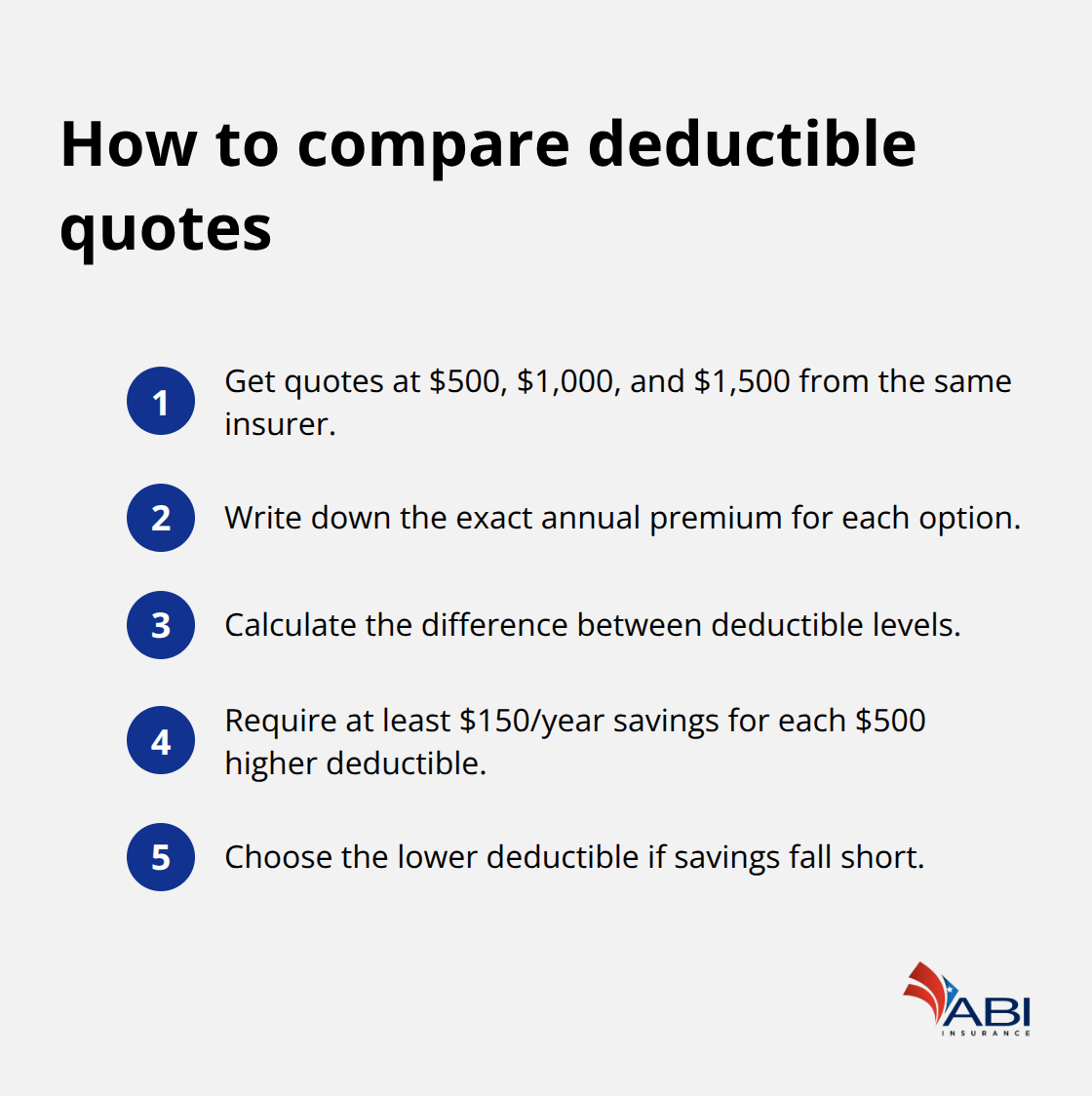
A $500 difference in out-of-pocket cost should justify at least $150 in annual premium savings for the trade to make sense. If the savings fall short, stick with the lower deductible. Your comfort level matters more than chasing percentage points.
Your Emergency Fund Sets the Real Limit
Your emergency fund is the actual guardrail that determines whether a high deductible works for you or destroys your finances. Most financial advisors recommend three to six months of expenses saved before you raise insurance deductibles. If your monthly expenses total $4,000, you need $12,000 to $24,000 in liquid savings before a $1,000 deductible becomes reasonable.
Many drivers reverse this sequence. They raise the deductible first to lower premiums, then wonder why a single claim creates financial stress. This choice cascades into worse decisions. Seven percent of drivers admit they avoid filing claims out of fear their rates will rise, according to JD Power. That’s not smart risk management; that’s financial paralysis. If you cannot comfortably pay your deductible without liquidating savings meant for emergencies, you’ve chosen wrong. It’s best to discuss specifics with your agent before finalizing your deductible level.
Reassess Your Deductible Every Year
Annual reassessment forces you to recalibrate as your life changes. Your job may shift from a long commute to remote work, lowering your accident exposure significantly. Your vehicle ages and depreciates, changing whether collision coverage makes financial sense. Your savings grow, potentially allowing a higher deductible. Your income drops after a job loss, requiring a lower deductible for stability.
Set a calendar reminder each year around your policy renewal date to run quotes at your current deductible and one level higher. Spending 30 minutes on this task catches misalignments before they cost you. If your circumstances haven’t shifted, your current deductible likely still fits. If they have, adjust accordingly rather than assuming last year’s choice still works.
Final Thoughts
Your deductible choice comes down to three factors: what you can afford, what your driving patterns demand, and whether your emergency fund supports the decision. Run quotes at multiple deductible levels and calculate your break-even point. The math reveals whether a higher deductible actually saves you money over time. Resist the temptation to chase the lowest premium without considering what you’ll pay out of pocket when a claim happens.
Build an emergency fund covering three to six months of expenses before you raise your deductible. Once that fund exists, you have the financial cushion to absorb a higher deductible without risking hardship after an accident. Track your actual driving patterns and claims history rather than guessing at your risk level and reassess your deductible annually when your policy renews since your job, vehicle, savings, or income may have shifted.
At ABI Insurance, we help clients across the Western U.S. navigate these decisions with personalized guidance backed by over 40 years of experience. Our team understands that auto insurance deductibles explained clearly help you balance premium savings against realistic out-of-pocket costs so your coverage fits your life. Contact us at abipdx.com to review your current policy and confirm your deductible matches your financial situation and driving patterns.






 How a Rental Cap Can Stabilize Your Association’s Insurance