
Small business owners often buy a Business Owners Policy thinking they’re fully protected. The reality is that many policies fall short of actual needs, leaving gaps that could cost thousands when claims happen.
At ABI Insurance, we’ve seen too many businesses discover coverage problems only after a loss occurs. Understanding your BOP coverage requirements now means you won’t face surprises later.
What’s Actually Inside a Business Owners Policy
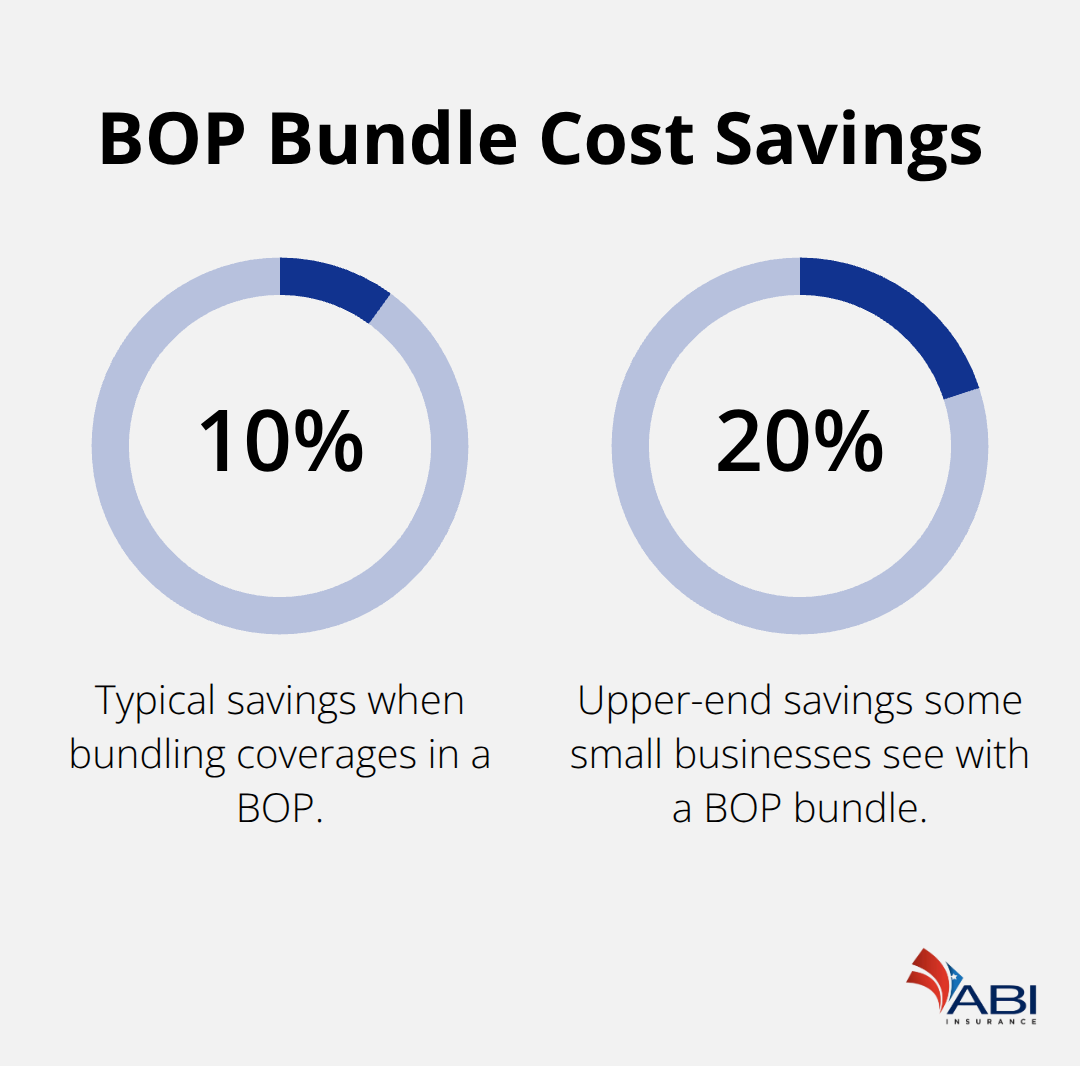
A Business Owners Policy bundles three core coverages into one package: General Liability, Commercial Property, and Business Interruption. General Liability protects you when someone gets hurt on your premises or claims you damaged their property, covering medical expenses, legal defense, and settlement costs. Commercial Property covers your building, equipment, inventory, and business personal property against fire, smoke, wind, hail, and vandalism. Business Interruption reimburses lost income and ongoing expenses like payroll and rent if a covered event forces you to shut down temporarily. The average Hartford customer paid around $1,687 per year for a BOP — roughly $141 monthly — though your actual cost depends entirely on your industry risk, location, building construction, safety systems, and claims history. This bundled approach costs 10 to 20 percent less than buying each coverage separately, which is why BOPs appeal to small and mid-sized businesses with fewer than 100 employees and annual revenue under $5 million.
What a BOP Deliberately Excludes
Here’s what trips up most business owners. A BOP does not include Workers’ Compensation or Commercial Auto Insurance. In most cases it does not include Professional Liability, Cyber Liability, or Employment Practices Liability Insurance. If you have employees, your state likely requires Workers’ Compensation coverage as a separate policy with serious penalties for non-compliance. If you own or operate vehicles for business, you need a separate Commercial Auto policy because BOP auto coverage typically applies only to hired or borrowed vehicles, not ones you own. If you provide professional services like consulting, accounting, legal work, or medical care, a standard BOP leaves you completely unprotected against negligence claims.
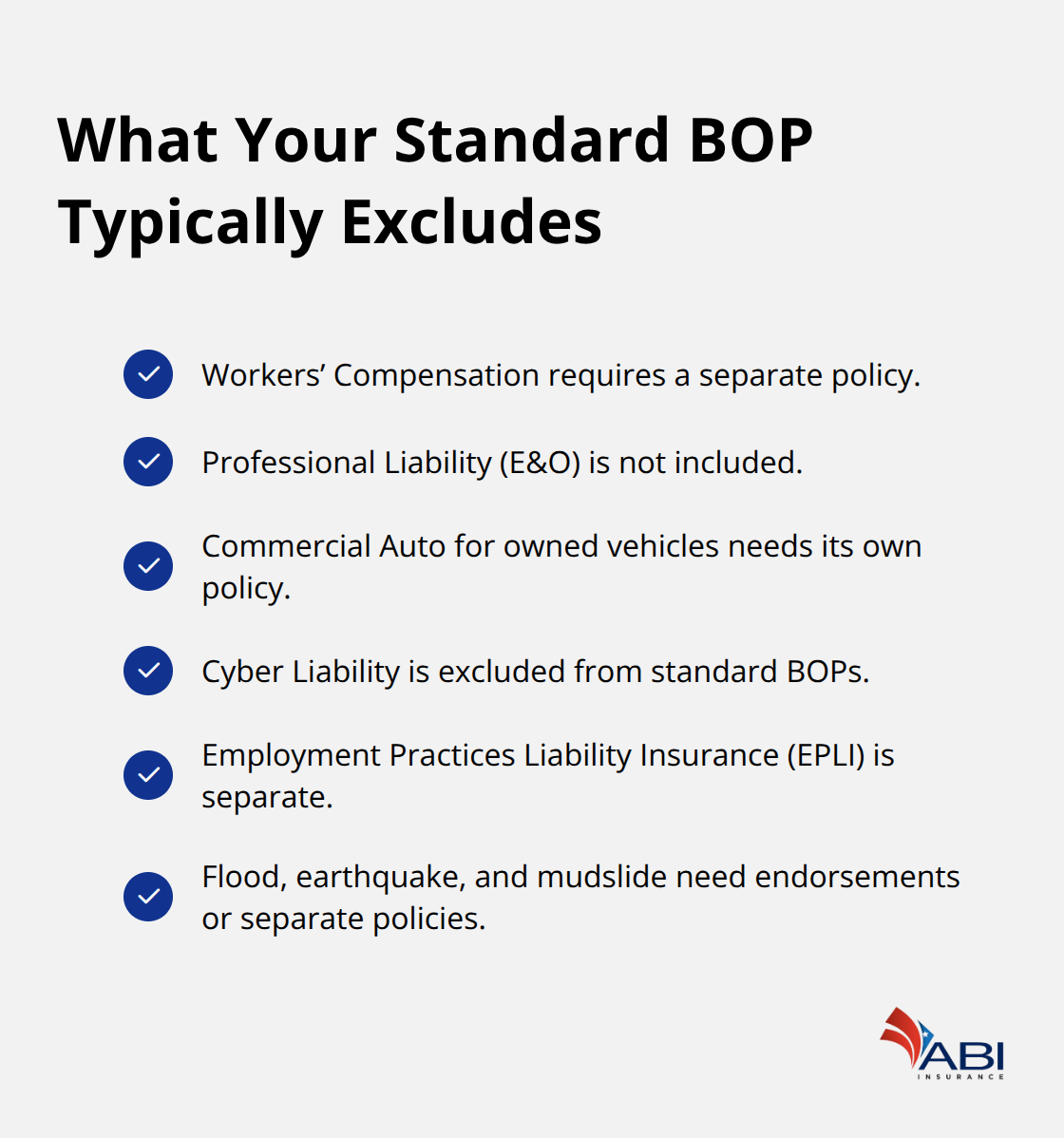
Data breaches and cyber attacks are excluded too, yet the average small business faces breach costs around $170,000 according to Corvus Insurance. Employment-related claims like discrimination, harassment, or wrongful termination are not covered. Floods, earthquakes, and mudslides are also excluded from standard property coverage and require separate endorsements or policies. This gap between what you think you have and what you actually have is exactly where claims fall through.
Why BOP Gaps Matter More Than You Think
FEMA reports that 40 percent of small businesses do not reopen after a major disaster, making Business Interruption coverage essential. Yet many owners underestimate their liability limits or fail to account for industry-specific exposures. A retail business faces product liability risks a service business does not. A contractor working at client locations needs different coverage than an office-based operation. The National Fire Protection Association documents over 100,000 non-residential fires annually in the U.S., underscoring why robust property protection matters. The real problem is that a BOP serves as a foundation, not a complete solution. You need to layer on endorsements and separate policies to match your actual risk profile. Without this deliberate assessment, you’re gambling that nothing catastrophic happens before you discover what your policy won’t pay for.
Moving Forward with Your Coverage Assessment
The next step requires you to evaluate your specific business operations and identify which gaps apply to you. Your industry, location, and business model determine which additional coverages you actually need.
Matching Your Coverage to Real Business Risks
Identify Your Industry-Specific Exposures
Your industry determines what actually threatens your operation, and your BOP baseline only covers generic exposures. A retail clothing store faces product liability if a customer claims an item caused injury, but a consulting firm doesn’t. A contractor working at client sites needs protection against accidents at those locations, while an office-based accountant operates in a controlled environment. There were 110,000 non-residential fires annually in the U.S., but a restaurant with open flames faces dramatically different property risk than a software company.
Start by listing the three biggest operational risks specific to your business, not theoretical ones, but actual scenarios that could cost you money. If you operate a salon, chemical exposure and slip-and-fall claims are primary concerns. If you run a construction business, equipment damage and on-site injuries dominate. If you handle customer data, cyber breaches become your critical exposure.
Account for Location-Based Coverage Gaps
Your location matters equally: a business in a flood zone needs separate flood coverage because standard BOP property exclusions eliminate it, while a business in an earthquake zone faces similar gaps. Once you’ve identified your top three risks, compare them against your current BOP coverage and note which ones fall into the exclusions we outlined earlier.
Evaluate Your Liability Limits Carefully
Liability limits deserve scrutiny because many business owners set them too low to save premium dollars. The standard BOP offers $1 million in general liability coverage, which sounds substantial until a serious injury or property damage claim arrives. A single lawsuit from a customer injured on your premises can easily exceed $500,000 when medical bills, lost wages, and legal fees accumulate.
If you operate a higher-risk business like construction, food service, or health services, you should evaluate $2 million limits or higher. Your industry peers likely carry higher limits than you think. Ask them directly what they carry. Additionally, review any client contracts you’ve signed, because many require you to name them as additional insureds and carry minimum liability limits, they specify. If you missed those contract requirements, your current coverage might not satisfy your customers’ demands.
Calculate Your Actual Property Values
For property coverage, calculate your actual replacement cost by inventorying equipment, inventory, and improvements you’ve made to leased spaces. Most business owners underestimate this number significantly. If you’ve invested $200,000 in equipment but your BOP limits are set at $100,000, you’re automatically short by half.
Take Action on Your Coverage Assessment
The gap analysis requires three actions: contact your current agent and request a detailed coverage summary showing limits and exclusions, list your specific operational exposures alongside what the policy excludes, and identify which gaps require endorsements versus separate policies. With this information in hand, you’ll know exactly which additional coverages your business actually needs.
Three Mistakes That Drain Your Coverage
Mistake One: Setting Limits Based on Budget, Not Exposure
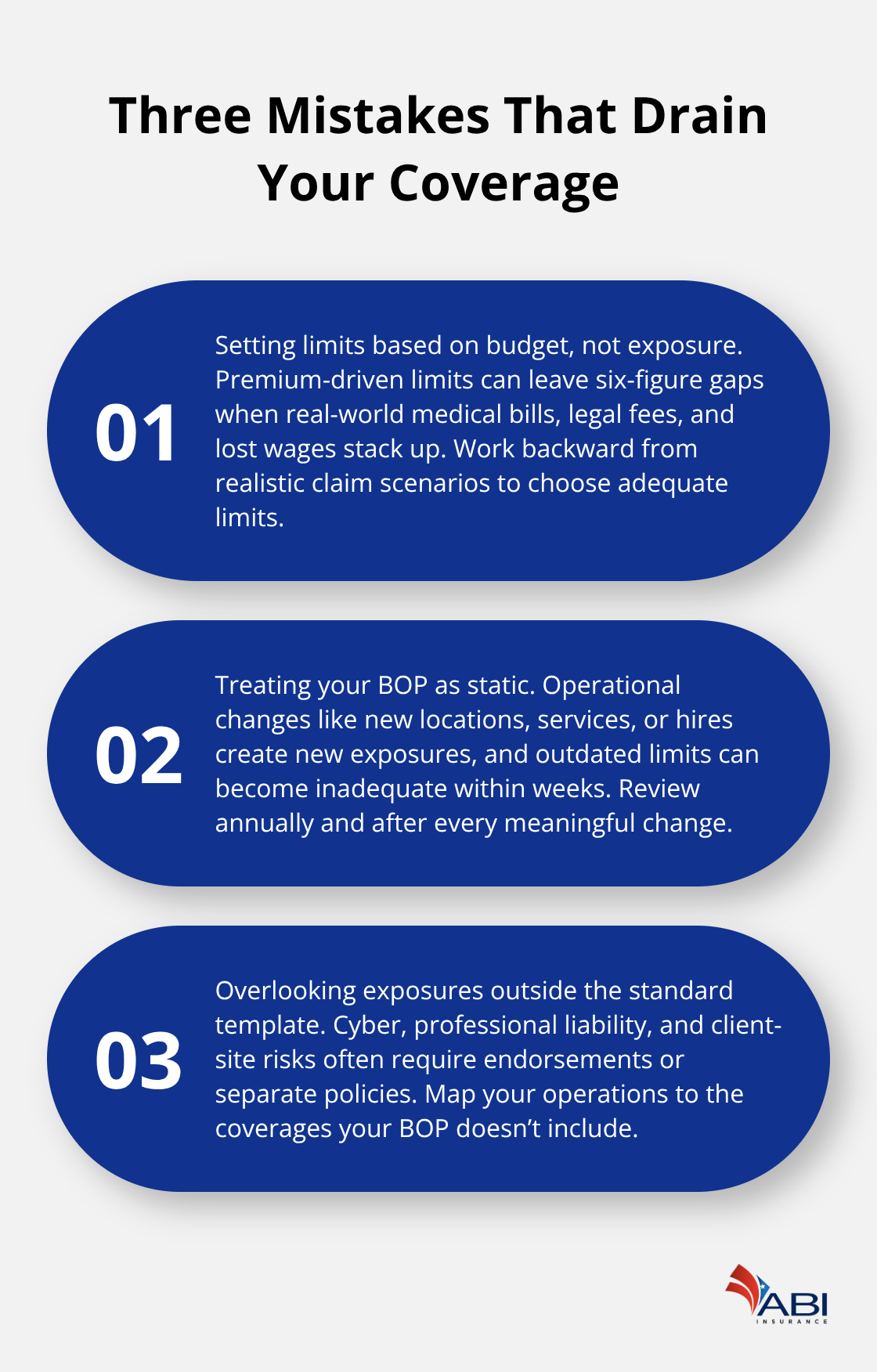
The gap between what you think your BOP covers and what it actually pays for comes down to three concrete mistakes business owners make repeatedly. The first mistake is setting liability and property limits based on cost rather than actual exposure.
You might carry $500,000 in general liability because the premium felt manageable, but a single customer injury claim with hospitalization and ongoing medical care reaches $750,000 in total damages within months. The median verdict in bodily injury cases exceeds $1 million in many jurisdictions, yet most small business owners set limits at or below $1 million and call it adequate.
Your property limits matter equally because underestimating replacement costs leaves you partially uninsured. If you own $300,000 in equipment and inventory but your BOP property limit caps at $150,000, you absorb the other half out of pocket after a covered loss. Many owners skip the inventory step entirely, guessing at values instead of calculating actual replacement cost. The solution requires you to work backward from your real exposure rather than forward from your budget. Calculate what a serious claim would actually cost your business, then set limits that cover that amount, not the amount that fits your preferred premium.
Mistake Two: Treating Your BOP as a Static Document
The second mistake is treating your BOP as static rather than reviewing it annually and after operational changes. A business that adds a second location, hires its first employee, or starts offering a new service faces different exposures than it did last year, but most owners never notify their agent of these shifts. If you add equipment, expand into a new service line, or move to a higher-risk location, your existing limits become inadequate within weeks of that change.
Your policy reflects your business as it existed when you purchased it. The moment your operations shift, that snapshot becomes outdated. A contractor who takes on larger projects, a retailer who adds online sales, or a service firm that expands its team all face new exposures that the original BOP doesn’t address. Failing to update your agent means your coverage drifts further from your actual risk profile with each operational change.
Mistake Three: Overlooking Exposures Outside the Standard Template
The third mistake is overlooking exposures that don’t fit the standard BOP template. A contractor who works at client sites needs coverage for accidents at those locations, which a standard BOP may not adequately address without specific endorsements. A business that holds customer data online faces cyber liability exposure that standard property and liability won’t touch. A professional service firm providing advice faces errors and omissions exposure that requires a separate policy entirely.
These gaps exist because the BOP was designed as a one-size-fits-most solution for basic risks. Your specific business model likely creates exposures that fall outside that template. The pattern across all three mistakes is identical: owners set coverage based on assumptions rather than facts, then fail to update when circumstances shift.
Taking Action on Coverage Accuracy
Schedule a coverage review with an agent at least annually, notify them immediately when your business operations change, and demand a detailed explanation of what your current limits actually cover in dollar terms, not just in policy language. This discipline prevents the costly discovery that your coverage falls short exactly when you need it most.
Final Thoughts
Your BOP coverage requirements depend entirely on your actual business operations, not on what feels affordable or what a standard policy template suggests. Set your liability and property limits based on real exposure calculations, not budget constraints, and notify your agent immediately when your business changes — new locations, additional employees, expanded services, or equipment purchases all shift your risk profile. Identify which gaps require endorsements versus separate policies, then close them before a loss occurs.
Request a detailed coverage summary from your current agent that lists your specific limits, exclusions, and what each section actually pays for in dollar terms. Compare that summary against your actual business operations and the three industry-specific risks you identified earlier, noting which exposures fall into the BOP exclusions we outlined. This gap analysis takes a few hours but prevents thousands in unexpected out-of-pocket costs.
We at ABI Insurance have spent over 40 years helping Portland-area businesses and those across the Western U.S. align their coverage with their actual risk profiles. Contact ABI Insurance to review your current policy and identify the gaps that could cost you most.








 BOP and Workers Comp: Integrated Coverage for Small Businesses