
Nurse practitioner liability is a real concern for advanced practitioners working across different states and practice settings. The rules governing what you can and cannot do vary significantly depending on where you practice, and understanding these differences is the first step toward protecting yourself.
At ABI Insurance, we’ve seen firsthand how gaps in coverage or risk management can create serious problems for NPs. This guide walks you through the liability landscape, insurance options, and practical strategies to keep your practice secure.
Where NP Liability Actually Comes From
Your State Determines What You Can Do
Your scope of practice determines your liability exposure more than almost anything else. As an NP, what you can diagnose, treat, and prescribe depends entirely on your state, and this variation creates real financial risk. More than half of U.S. states grant full-practice authority, allowing NPs to evaluate patients, diagnose conditions, order and interpret tests, and initiate treatment, including controlled substances, without physician supervision. The National Academy of Medicine and the National Council of State Boards of Nursing endorse this model. But in reduced-practice states, you need ongoing collaborative agreements with another provider, and in restricted-practice states, you need career-long supervision. These limitations matter for liability because scope violations-practicing outside what your state and your employer allow-create indefensible claims. The AANP Practice Environment map shows exactly what applies in your state, including signature authority and continuing education requirements. If your hospital policy requires collaboration but your state allows independent practice, that gap becomes a liability exposure you must manage actively.
Diagnostic Errors Drive Most Claims
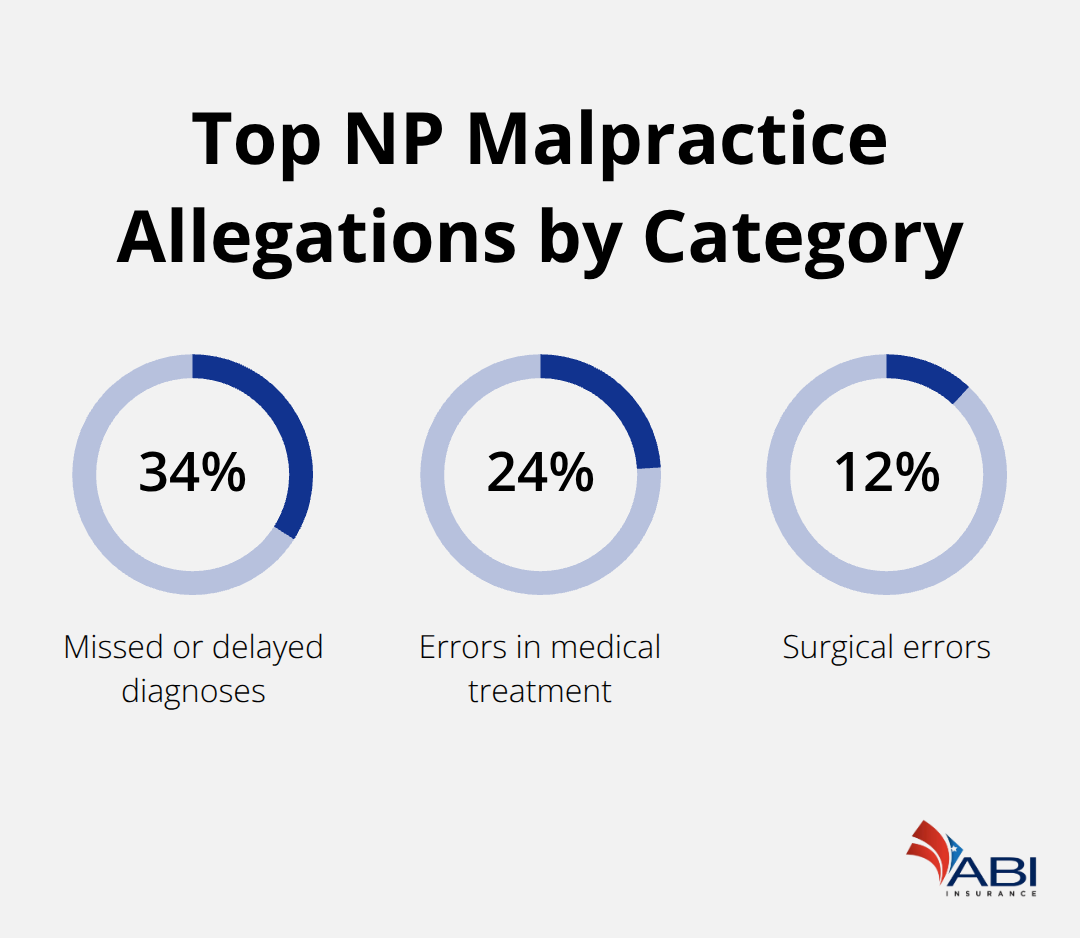
Missed or delayed diagnoses account for 34% of NP malpractice claims, according to the most recent national claims data covering over 65,000 cases from 2012 to 2021. Errors in medical treatment follow at 24%, with surgical errors at 12%.
The underlying causes are specific: failure to recognize relevant signs, symptoms, or test results causes 35% of NP claims, failure to order necessary diagnostic tests causes 25%, and miscommunication between providers causes 22%. Accurate information gathering and follow-up is essential in helping to prevent a claim.
Your Specialty and Employment Status Shape Risk
General medicine accounts for 27% of NP claims, with pediatrics, emergency medicine, and behavioral health following. Your specialty matters because neonatal nurse practitioners face the highest average claim costs at roughly $627,000, while pediatrics averages $408,000 and behavioral health $381,000. Employment status also shapes your risk differently. Employed NPs typically have institutional coverage, but gaps exist when you moonlight, volunteer, or work outside your primary job. Self-employed NPs carry individual liability entirely. The portable coverage you need must follow you across all settings where you practice, including telehealth and on-call support, because a claim can arise from care you provided anywhere, anytime.
Understanding these liability sources prepares you to select the right insurance protection and implement the risk management practices that actually prevent claims.
Medical Malpractice Insurance for Nurse Practitioners
Occurrence-Based vs. Claims-Made Policies
Medical malpractice insurance for nurse practitioners comes in two fundamental structures, and the difference between them determines whether you have protection when you need it most. Occurrence-based policies cover incidents that happen during your policy period, regardless of when you file the claim, giving you permanent protection for work you did while insured. Claims-made policies only cover claims filed while your policy is active, which means you need tail coverage when you leave a job or retire to protect yourself against claims filed years after you stopped practicing.
Tail coverage extends your claims-made protection indefinitely for incidents that occurred while you were employed, and it typically costs 150 to 300 percent of your annual premium, depending on your specialty and claims history. This matters enormously because malpractice claims often surface years after the care occurred. A patient with a neonatal injury might not recognize the harm until the child enters school, potentially five to ten years after delivery. If you switched to a claims-made policy without tail coverage, that claim would fall outside your protection entirely.
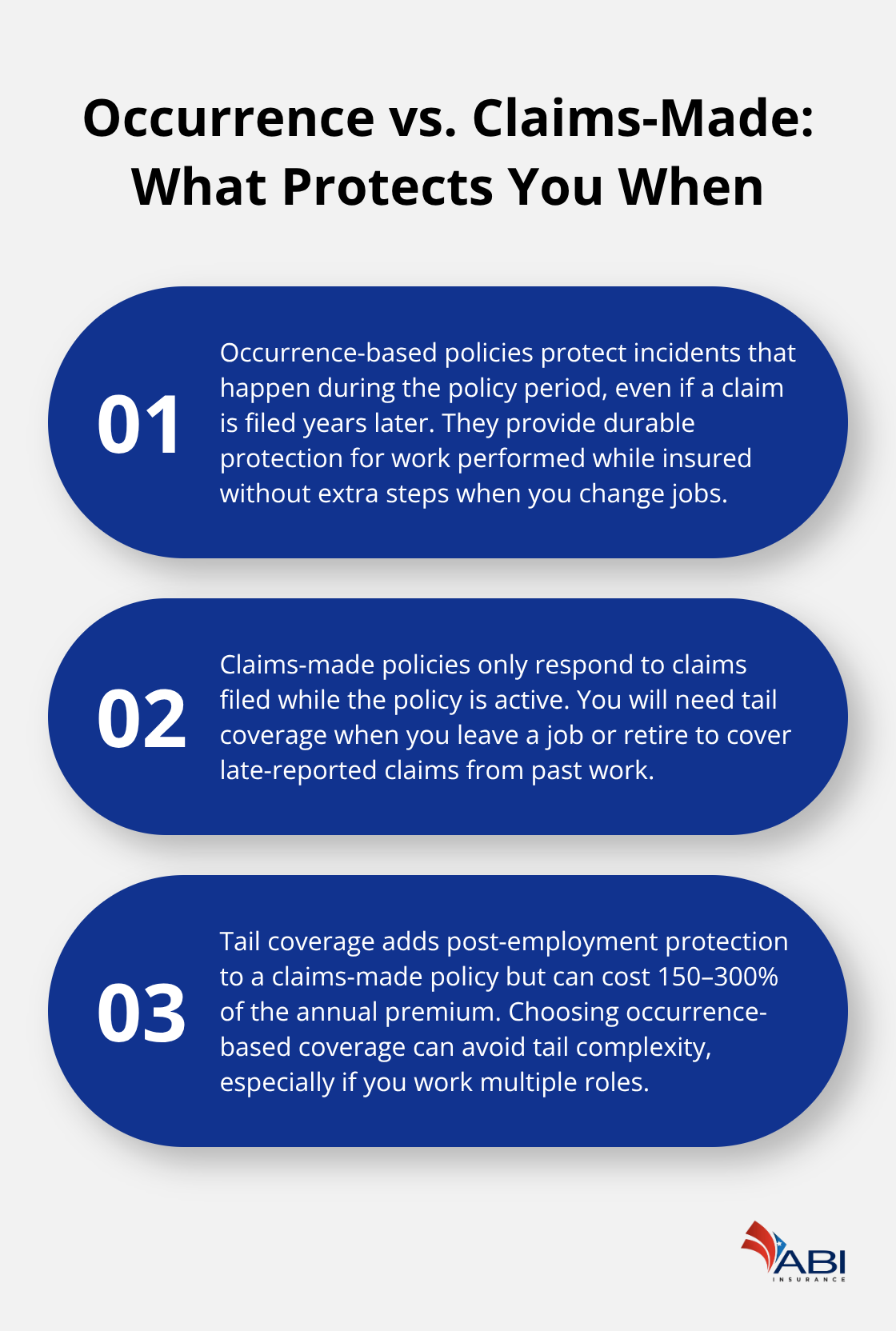
Occurrence-based coverage eliminates this gap because the policy in effect when you provided care covers you forever, no matter when the claim arrives. For employed NPs, your institution typically carries occurrence-based coverage that protects you as long as you stay within your job duties. Self-employed NPs and those who moonlight should strongly consider occurrence-based individual policies to avoid the administrative burden and expense of managing tail coverage across multiple jobs.
Setting Your Coverage Limits to Match Your Risk
Your coverage limits need to match your actual risk, not your budget. Employed NPs in general medicine typically operate under institutional policies with $1 million per occurrence and $3 million aggregate limits, which aligns with physician coverage in most hospitals. Neonatal and pediatric NPs face significantly higher risk because average claim costs reach $627,333 and higher, making greater limits necessary to avoid underinsurance.
Self-employed NPs should carry at least $1 million per occurrence because a single serious claim can exhaust lower limits quickly, leaving you personally liable for the excess. The cost difference between $1 million and $2 million coverage is often modest relative to the protection it provides, especially in high-risk specialties. Medical professional liability insurance tailored to your practice setting ensures adequate protection without overpaying for unnecessary coverage.
Portable Coverage Across All Practice Settings
Portable coverage that follows you across jobs, including telehealth and volunteer work, matters increasingly because you may practice in multiple settings simultaneously. A claim arising from telehealth care or weekend volunteering must fall within your policy scope, which many standard employment policies exclude. Verify your institutional coverage explicitly includes all settings where you practice, and if gaps exist, purchase individual supplemental coverage to fill them rather than assuming your employer’s policy covers everything you do.
Your coverage must travel with you because liability exposure exists wherever you provide patient care. On-call support and telehealth services create claims just as readily as in-office visits, yet many policies written before telehealth became standard may not address these settings adequately. The right insurance structure protects you across your entire professional life, not just your primary employment.
How to Build Documentation That Protects You
The medical record you create during patient care becomes your primary defense in a malpractice claim, and this is where most NPs fail. Your documentation must reflect the clinical reasoning behind your decisions and prove you followed the standard of care. Vague entries like patient tolerated visit well or discussed treatment options tell a jury nothing about what you actually assessed or why you chose your approach. When a claim arises years later, your notes are the only evidence of what happened.
A neonatal NP who documents failed to appreciate signs of fetal distress during labor faces an indefensible claim, whereas one who documents assessed fetal heart rate variability, noted accelerations present, and reviewed cardiotocography with the attending physician demonstrates systematic evaluation. The specificity matters enormously because diagnosis-related errors account for the greatest proportion of NP malpractice claims, and failure to document your diagnostic reasoning accounts for much of that exposure.
Write What You Observed and Why
Write exactly what you observed, what tests you ordered and why, what results you received, and what clinical decision you made based on that information. Include the time you took action because delays in diagnosis often trigger claims. If you ordered imaging but the patient did not follow up, document that you communicated the importance of the test and that the patient declined or delayed. If you consulted another provider, document the specific conversation, what they advised, and whether you agreed or disagreed. This level of specificity transforms your record from a liability vulnerability into evidence of competent care.
Manage Test Results and Referrals Systematically
Test results that arrive after the patient leaves your clinic represent one of the highest-risk scenarios in modern practice. A pathology report showing cancer, an imaging study revealing a mass, or a lab value indicating organ dysfunction can sit in the electronic health record without action, and by the time you notice it weeks later, the patient’s condition has deteriorated. Implement a system where every test you order gets flagged for your review, and you document the date you reviewed it and the action you took.
If the result is abnormal and requires treatment, document that you notified the patient of the result and the next step. If the patient is unreachable, document your attempts to contact them. If you referred the patient to a specialist, document the referral details and follow up within two weeks to confirm that the patient scheduled the appointment. Provider-to-provider miscommunication causes a significant portion of NP claims, often because the referring provider assumes the specialist received the referral and the specialist never got it. A one-sentence note in the chart stating contacted orthopedic clinic on 5/10 and confirmed patient has appointment 5/17 eliminates this gap.
Your electronic health record should have a dashboard showing all pending results and referrals, and you should review it daily before leaving the clinic. If your EHR lacks this functionality, create a simple spreadsheet and check it every morning. This single practice prevents a substantial portion of diagnostic error claims.
Communicate Directly with Collaborating Physicians
Communication failures account for a significant portion of NP malpractice claims, and most occur because you documented a decision but never actually spoke to the other provider involved in the patient’s care. If you practice in a reduced-practice or restricted-practice state requiring physician collaboration, that conversation must happen before you initiate treatment, not after. Call the collaborating physician directly rather than sending an electronic message and assuming they read it.
State the patient’s presentation, your assessment, your proposed treatment, and ask for their input. Document the date, time, and substance of that conversation in the medical record. If the physician disagrees with your plan, document their recommendation and your response. If you follow their guidance, write that you implemented their recommendation. If you decline their advice, document your clinical reasoning for the alternative approach. This documentation protects you because it shows you sought input from an appropriate authority and made a reasoned decision. Many NPs avoid these conversations because they fear confrontation, but that avoidance creates claims. A difficult conversation with a physician today prevents a lawsuit years later.
Inform Patients About Risks and Document Their Agreement
With patients, the same principle applies. Do not assume patients understand their diagnosis, treatment, or the risks involved. Explain the condition in plain language, describe your proposed treatment and why you chose it, and discuss alternatives if they exist. Document that you discussed risks and benefits and that the patient agreed to proceed.
If a patient refuses a recommended test or treatment, document their refusal and your advice about the consequences. A patient who later claims they were not informed about risks faces a much weaker case if your note states the risk of stroke was discussed if blood pressure is uncontrolled, and the patient stated they prefer to manage with lifestyle changes alone. This documentation transforms the patient from an adversary into someone who participated in decisions about their own care.
Final Thoughts
Nurse practitioner liability exposure becomes manageable when you address three core areas systematically: understanding your scope of practice, carrying adequate insurance, and implementing documentation practices that protect you. Your state determines what you can do, your specialty influences your risk level, and your employment setting shapes whether you need individual coverage. Gaps in any of these areas create vulnerability that claims will exploit.
The insurance you carry must match your actual practice across all settings where you work. Occurrence-based policies protect you permanently for work you performed while insured, eliminating the complexity of tail coverage when you change jobs. Your coverage limits should reflect your specialty risk rather than your budget constraints, and supplemental coverages for HIPAA violations, licensing board defense, and wage loss cost little but prevent catastrophic personal liability in specific scenarios.
Documentation determines whether claims succeed or fail, and your medical record must show what you observed, what you ordered and why, what results you received, and what decision you made based on that information. Test results require systematic tracking and documented review, conversations with collaborating physicians must happen before you act and receive documentation with specifics, and patients need clear explanations of their diagnosis, your treatment plan, and the risks involved. Contact ABI Insurance to review your current coverage and identify gaps before they become claims.











 Auto Insurance Deductibles Explained: How to Choose the Right Level