


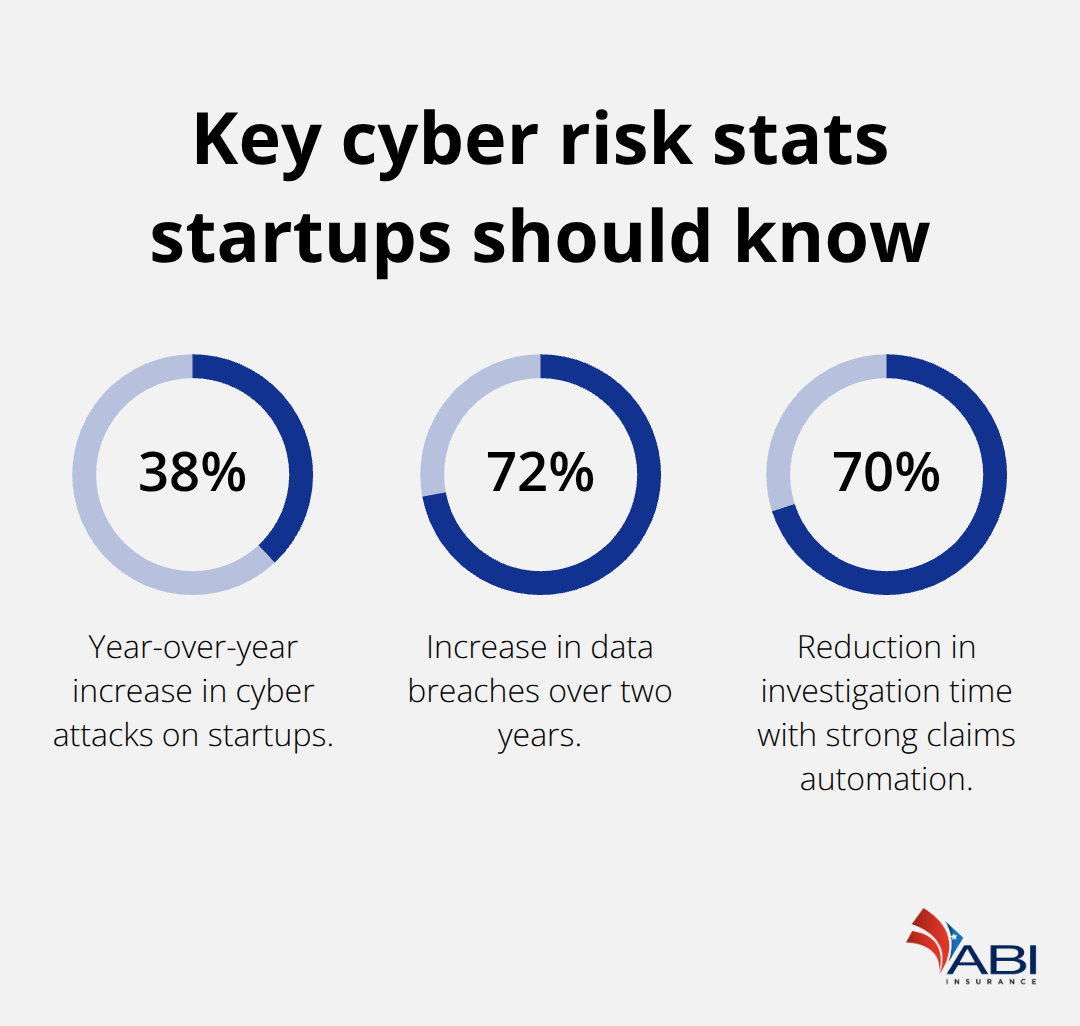
Cyberattacks on startups have increased 38% year-over-year, with the average breach costing small businesses $200,000 in recovery expenses. Most founders focus on product development and growth, leaving their digital infrastructure vulnerable to threats that could shut down operations overnight.
At ABI Insurance, we’ve seen firsthand how cyber insurance protects businesses when attacks happen. The right coverage transforms a potential catastrophe into a manageable incident with proper support and financial protection.
Why a Business Needs Cyber Insurance
The Escalating Threat to Your Operations
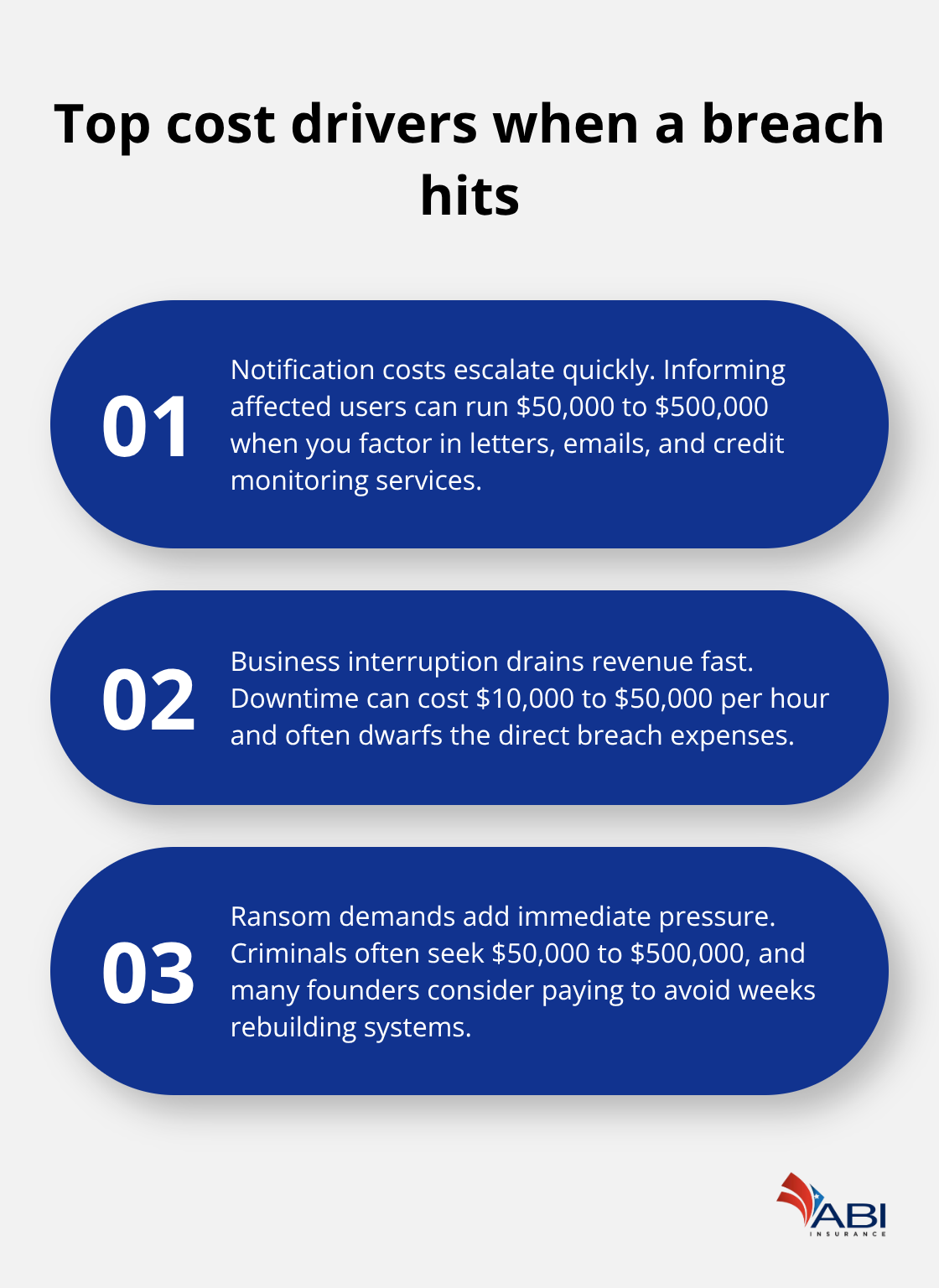
Data breaches increased by 72% over two years, and the financial consequences extend far beyond the immediate breach. A data breach costs small businesses an average of $200,000 in recovery expenses, but that number only tells part of the story. When ransomware takes your operations offline, your revenue stops immediately. Notification costs pile up fast. Informing customers of a breach can run from $50,000 to $500,000 depending on the number of affected users. Business interruption losses often dwarf the direct breach costs, with some startups losing $10,000 to $50,000 per hour of downtime.
State-level privacy laws like California’s CCPA impose penalties of $100 to $750 per consumer per incident. Most startup founders operate without insurance that covers these scenarios, betting they won’t become targets. That’s not a strategy; it’s financial recklessness.
Why Your Data Attracts Attackers
A business’s data is valuable precisely because it contains information attackers want. Customer records, payment information, intellectual property, and proprietary algorithms attract criminals, nation-state actors, and competitors. A compromised contractor can enable attackers to move laterally across your network undetected. The average time to identify a data breach is around 277 days, meaning attackers can operate within your systems for months before detection. During that window, they exfiltrate data, deploy ransomware, or sabotage operations.
Without cyber insurance, you absorb the forensic investigation costs, legal fees, notification expenses, credit monitoring services, and business interruption losses entirely from your cash reserves. For a business operating on thin margins, this single incident can trigger bankruptcy.
Compliance Creates Additional Liability
Compliance obligations compound the risk significantly. If your startup processes payments, you must meet PCI DSS standards. If you handle health data, HIPAA applies. If you serve EU customers, GDPR mandates specific security controls and incident response procedures. Failing to meet these standards creates liability exposure that extends beyond the breach itself. Regulatory bodies impose fines for negligence, and customers sue for damages.
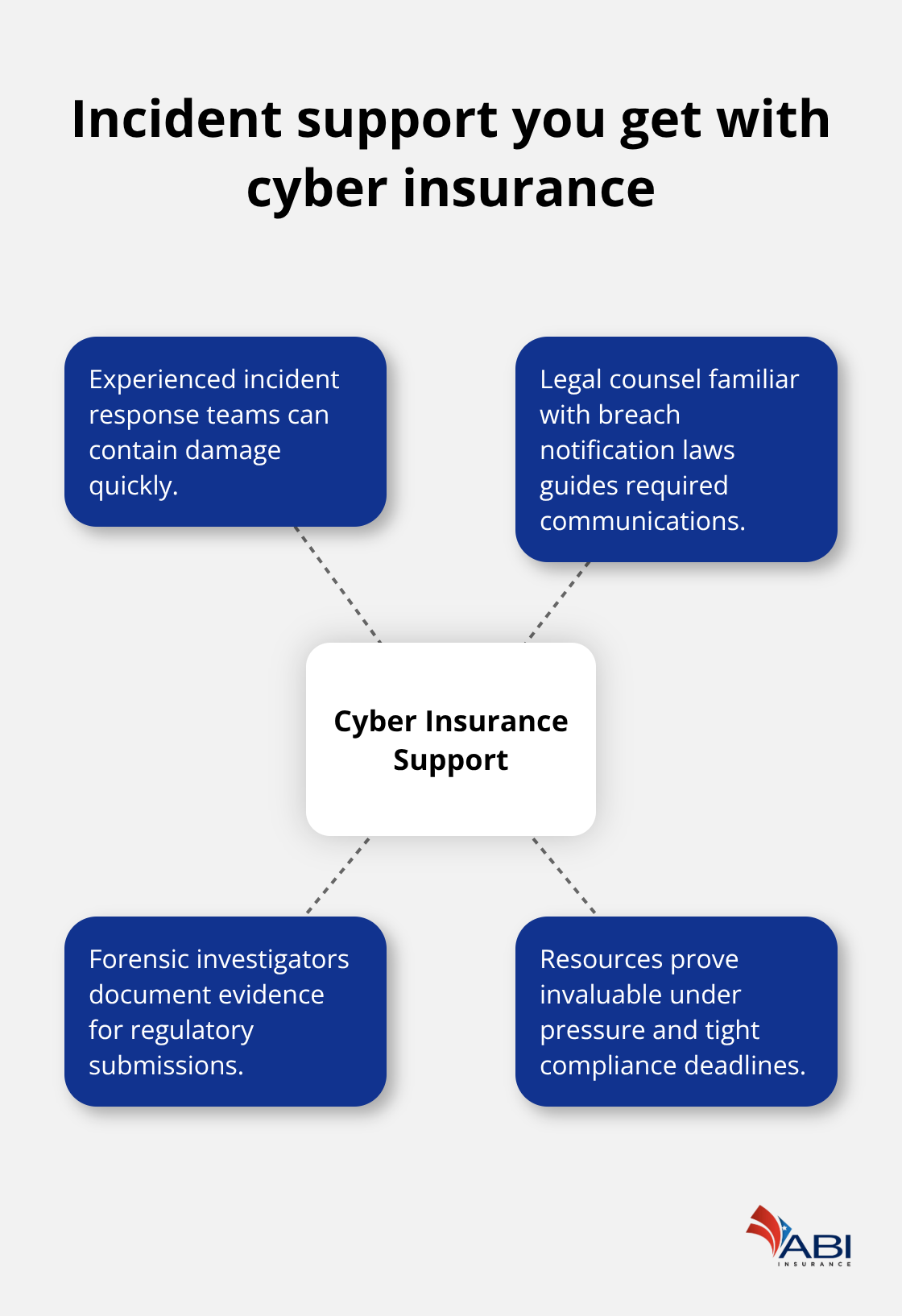
Cyber insurance provides access to experienced incident response teams, legal counsel familiar with breach notification laws, and forensic investigators who can contain damage quickly and document everything for regulatory submissions. These resources prove invaluable when you face the pressure of a live incident and tight compliance deadlines.
What Happens When You’re Unprepared
The real cost of staying unprotected reveals itself only after an attack strikes. Your team scrambles to respond while your business hemorrhages money. You lack the specialized expertise to navigate complex breach notification requirements across multiple jurisdictions. You cannot afford the forensic investigation that regulators demand. You have no legal defense against customer lawsuits. The incident spirals from a technical problem into an existential threat to your company.
This is precisely why startups and small businesses need coverage that addresses the full scope of cyber risk; not just the breach itself, but the operational, financial, and legal consequences that follow. The right insurance partner understands these interconnected risks and structures coverage accordingly.
Key Coverage Areas for Cyber Insurance
Immediate Response and Investigation Costs
When a breach strikes, your expenses spike before you can even assess the damage. Forensic investigators and incident response teams work to determine what attackers accessed and how they gained access to your systems. Notification costs run from $50,000 to $500,000 depending on how many customers you affected, with each notification letter, email, and credit monitoring service adding to the bill. Legal counsel experienced in breach notification laws across multiple states and countries becomes essential. Hiring attorneys during a crisis means paying premium rates for reactive advice instead of proactive strategy.
Quality cyber insurance covers these response costs upfront, preventing you from depleting your operating capital when you need it most. The policy activates immediately, connecting you with experienced incident response teams who contain damage while you focus on keeping your business running.
Ransomware and Extortion Protection
Ransomware attacks create a distinct financial trap that most founders underestimate. When criminals encrypt your files and demand payment, they’re betting you’ll pay rather than lose weeks rebuilding systems. The ransom itself might reach $50,000 to $500,000, but the real damage comes from business interruption. If your SaaS (Software as a Service) platform goes offline, you stop generating revenue immediately. Depending on your business model, that means losing $10,000 to $50,000 per hour of downtime.
A 48-hour outage becomes a $500,000 to $2.4 million disaster before you even consider the ransom demand. Comprehensive cyber policies cover both the extortion costs and the income losses during recovery, protecting your cash runway while your technical team rebuilds. Without this coverage, many startups choose to pay ransoms they cannot afford or watch their business collapse during recovery.
Business Interruption Beyond Ransomware
Even without ransomware, a breach can force you offline while you comply with regulatory requirements, notify customers, and secure your systems. Your employees cannot work. Your customers cannot access your service. Revenue evaporates. Some policies limit business interruption coverage to 30 or 60 days, which sounds reasonable until your incident response takes four months.
The difference between adequate and inadequate coverage reveals itself in how long your policy protects you. A policy that covers the full duration of your recovery period keeps you solvent through the entire crisis, while arbitrary time limits leave you exposed halfway through. This distinction separates startups that survive incidents from those that don’t.
Selecting Coverage That Matches Your Risk Profile
Your startup’s specific operations determine which coverage areas matter most. A SaaS company prioritizes business interruption protection because every hour offline costs revenue. A fintech startup handling payment data needs robust notification and regulatory defense coverage. A healthcare startup processing patient records requires HIPAA-specific incident response support. The right policy aligns with your actual risk exposure, not a generic template that leaves gaps in critical areas.
When you evaluate policies, examine what each coverage area actually protects and what it excludes. The lowest premium often hides the largest gaps. Your next step involves understanding how insurance partners respond when you actually need them-because the quality of claims support determines whether coverage translates into real protection.
How to Spot Insurance Partners Who Actually Deliver
Coverage Limits That Match Your Real Exposure
Finding an insurance partner who understands startup cyber risk requires looking beyond premium quotes and policy documents. Most founders treat cyber insurance like commodity coverage, comparing prices without examining what happens when you actually file a claim. The difference between adequate protection and worthless coverage often comes down to three factors that most policies obscure: how much the insurer actually pays before hitting limits, what specific situations they refuse to cover, and whether their claims team mobilizes incident response within hours instead of days.
Start by stress-testing the coverage limits against realistic scenarios for your business. If you process customer payments, a breach affecting 50,000 users could generate $2.5 million in notification costs alone at the higher end of industry averages. A policy with a $1 million limit for breach response sounds reasonable until you realize it covers maybe 40 percent of your actual exposure. Ransomware demands frequently exceed $500,000 for companies with substantial data, and business interruption losses can reach $10,000 to $50,000 per hour of downtime.
Request detailed quotes that break down coverage by category, then model what your startup would actually owe out of pocket if each coverage area hit its limit.
Exclusions That Create Hidden Gaps
The insurer’s exclusions matter just as much as their limits. Read the fine print around third-party liability, cloud infrastructure breaches, and employee negligence. Many policies exclude breaches caused by contractor negligence or poor vendor security, yet these represent some of your highest-risk attack vectors. Ask directly whether the policy covers incidents involving your cloud provider’s infrastructure failures or whether you absorb that loss yourself. The answers separate comprehensive protection from policies full of hidden gaps.
Claims Response Speed and Incident Support
The real test arrives when you need to file a claim. Insurers offering 24/7 incident response hotlines with direct access to forensic teams and legal counsel provide substantially more value than those requiring you to submit claims through standard channels. Ask whether the insurer has pre-negotiated relationships with incident response firms or whether you select your own team and submit receipts for reimbursement. Pre-negotiated relationships mean faster mobilization and cost controls that protect both you and the insurer.
Request references from other startups they’ve insured and ask specifically about claims processing speed. Industry data shows that companies with strong automation in claims workflows achieve roughly a 70 percent reduction in investigation time for security incidents. This metric reveals whether your insurer invests in operational efficiency or treats claims as administrative overhead.
Industry-Specific Expertise and Underwriting Knowledge
Underwriting expertise in your specific industry matters more than general cyber insurance knowledge. A partner familiar with SaaS architecture understands your actual vulnerabilities and can structure coverage accordingly. A partner experienced with fintech knows the regulatory landscape and can connect you with legal counsel who specialize in payment processor breach notification. An insurer who treats all startups identically likely misses critical exposures unique to your business model.
Your startup’s operations determine which coverage areas matter most and which exclusions create real risk. A SaaS company prioritizes business interruption protection because every hour offline costs revenue. A fintech startup handling payment data needs robust notification and regulatory defense coverage. A healthcare startup processing patient records requires HIPAA-specific incident response support. The right partner aligns coverage with your actual risk exposure, not a generic template that leaves gaps in critical areas.
Final Thoughts
Cyber risk startups insurance protects your business when attacks strike, and attacks will strike. The statistics prove this reality: breaches happen frequently, recovery costs spiral fast, and regulatory penalties compound the damage. A single incident drains your cash reserves, triggers customer lawsuits, and forces you to shut down operations while you scramble to respond. Without proper coverage, you bet your company’s survival on the false assumption that attackers will skip your startup and target someone else instead.
Evaluate policies based on what they actually pay when incidents occur, not just the premium amount. Request detailed scenarios that match your specific business model, then stress-test the coverage limits against realistic breach costs for your industry. Ask hard questions about exclusions, claims response speed, and whether the insurer has pre-negotiated relationships with incident response teams. The difference between adequate protection and worthless coverage often comes down to whether your insurer mobilizes support within hours or days.
Select a partner who understands startup and business operations and the specific vulnerabilities in your industry. Generic cyber insurance policies miss critical exposures unique to your business, and your insurer should demonstrate expertise in your sector and structure coverage accordingly. We at ABI Insurance understand the specific risks startups face and help businesses protect their assets and manage cyber risk effectively. Contact ABI Insurance to discuss coverage that matches your actual exposure and keeps your company protected.


 Wildfires and Grills and Fireworks, Oh My!









