
Running a small business means juggling multiple responsibilities. One decision that shouldn’t be complicated is choosing the right insurance to protect your business.
A Business Owners Policy, or BOP, for small businesses bundles essential coverage into one straightforward package. We at ABI Insurance have seen firsthand how the right BOP removes guesswork and gives owners peace of mind.
What a BOP Actually Covers
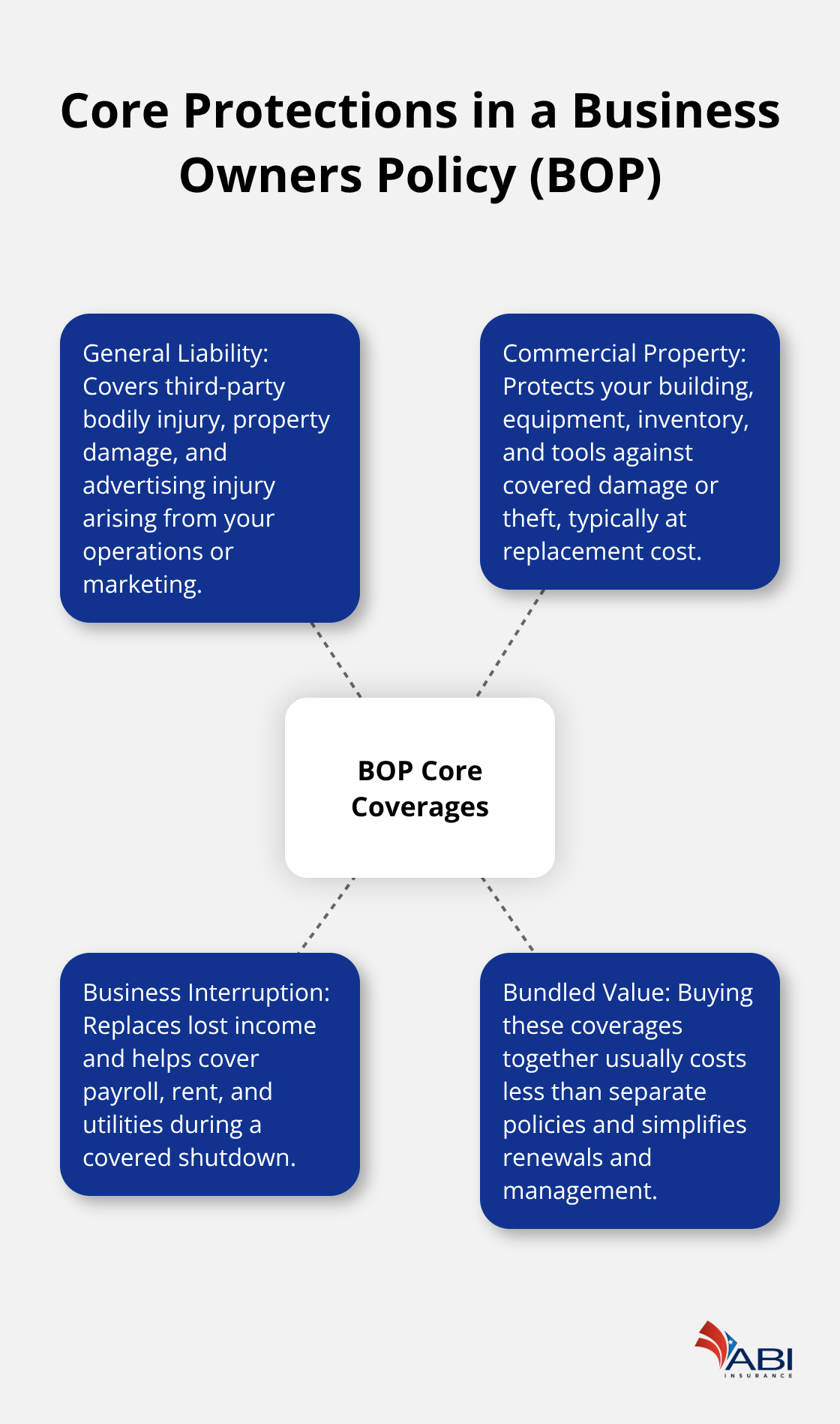
A Business Owners Policy packages three essential protections into one policy: general liability, commercial property coverage, and business interruption insurance. General liability covers third-party claims when someone gets injured at your location or because of your products. For example, a customer slips on your floor or claims that your marketing infringed on someone’s copyright. Commercial property protection covers your building, equipment, inventory, and tools if they’re damaged or stolen. Business interruption insurance can help replace income you lose if you can’t open temporarily after a covered loss, like property damage. The Hartford reports that small businesses pay an average of $1,687 annually for a BOP, roughly $141 per month, though costs vary significantly by industry and location. This bundled approach costs substantially less than purchasing each coverage separately, which is why many owners view it as the smarter financial choice.
Why bundling makes financial sense
Purchasing general liability, property insurance, and business interruption as individual policies typically costs more than a combined BOP. The bundling discount reflects insurance company efficiency: one underwriting process, one renewal cycle, one policy to manage. A BOP becomes especially attractive if your business has fewer than 100 employees, revenue under $5 million, and a physical location with tangible assets. Retailers, professional offices, small manufacturers, and service providers fit this profile well. Some businesses, like gas stations or bars, face exclusions due to their risk profile and won’t qualify for standard BOPs, but most small operations do. The real advantage isn’t just the lower price tag; it’s the simplification. One renewal date, one insurer contact, one set of documents to review annually. As your business grows or faces new risks, you can add endorsements such as cyber liability, equipment breakdown, or inland marine coverage without having to shop for entirely new policies.
Coverage limits matter more than you think
Standard BOP coverage limits run lower than standalone policies, which means you need to match them to your actual exposure. A retail store with $500,000 in inventory needs different property limits than a consulting firm with minimal physical assets. Your industry determines baseline risk; a contractor handling power tools faces different exposures than an accountant. Location affects pricing, too; businesses in areas with higher crime rates or severe weather typically pay more. When comparing quotes, don’t just chase the lowest premium. Request quotes from multiple carriers, understand exactly what each covers, and verify that limits align with your assets and liability exposure.
Finding the right fit for your business
The next step involves assessing your specific industry risks and determining what coverage limits actually protect your operation. Your business type, location, and asset value all shape which BOP features matter most to your bottom line.
Key Coverage Areas in a BOP
General liability protects your business against third-party lawsuits and is where most small business owners face real exposure. This coverage pays for bodily injury claims — a customer slips in your store and breaks an arm — and property damage claims where your operations damage someone else’s property. It also covers advertising injury, which includes claims of slander, libel, or copyright infringement in your marketing materials. A contractor posts before-and-after photos without permission, a salon makes false claims about hair treatments, or a consultant faces accusations of defamation in a client email, all fall under this protection. General liability limits typically range from $300,000 to $1 million in a standard BOP, and that’s where your actual exposure matters. A retail store with heavy foot traffic needs higher limits than a home-based consulting business.
Commercial Property Coverage Protects Your Physical Assets
Commercial property coverage protects the physical assets that keep your business running: your building or rented space, equipment, inventory, furniture, and laptops and mobile devices for remote teams. This coverage pays to repair or replace items at replacement cost, not depreciated value, which means you receive what it actually costs to replace equipment today, not what you paid five years ago. Property claims represent a significant portion of small business insurance costs, so getting this right prevents underinsurance disasters. A retail store with $400,000 in seasonal inventory needs vastly different property limits than a professional office with $50,000 in furniture and equipment. Your property schedule is a detailed list of what’s covered and its value. It becomes your most important document. You should review it annually and update values when you purchase new equipment or expand inventory. Missing items or undervalued assets create coverage gaps that hurt when loss happens.
Business Interruption Insurance Bridges Your Income Gap
Business interruption insurance is the coverage most small business owners underestimate until they need it. This protection replaces lost income and covers fixed expenses when a covered event forces temporary closure: a fire damages your retail location, a water main break floods your office, or equipment breakdown shuts down production. Business interruption coverage helps replace payroll, rent, utilities, loan payments, and other ongoing costs during downtime. A restaurant closed for three weeks after a kitchen fire still owes payroll, rent, and loan payments, even though revenue dropped to zero. Business interruption coverage bridges that gap. Coverage limits depend on your monthly operating expenses and typical recovery time. A service business with $15,000 monthly expenses needs different coverage than one with $50,000 in monthly fixed costs.
Matching Coverage Limits to Your Actual Needs
When you request quotes, ask carriers or your agent specifically about waiting periods. The coverage period typically starts after a waiting period of 48 to 72 hours. You should not settle for limits that sound reasonable without doing the math. Calculate your true monthly fixed costs, add a buffer for unexpected expenses, and verify that your coverage reflects that number. This calculation determines whether your BOP actually protects your business or leaves you exposed when you need it most. The next step involves working with an insurance professional who understands your industry and can help you translate these coverage areas into specific dollar amounts that fit your operation.
How to Select the Right BOP for Your Business
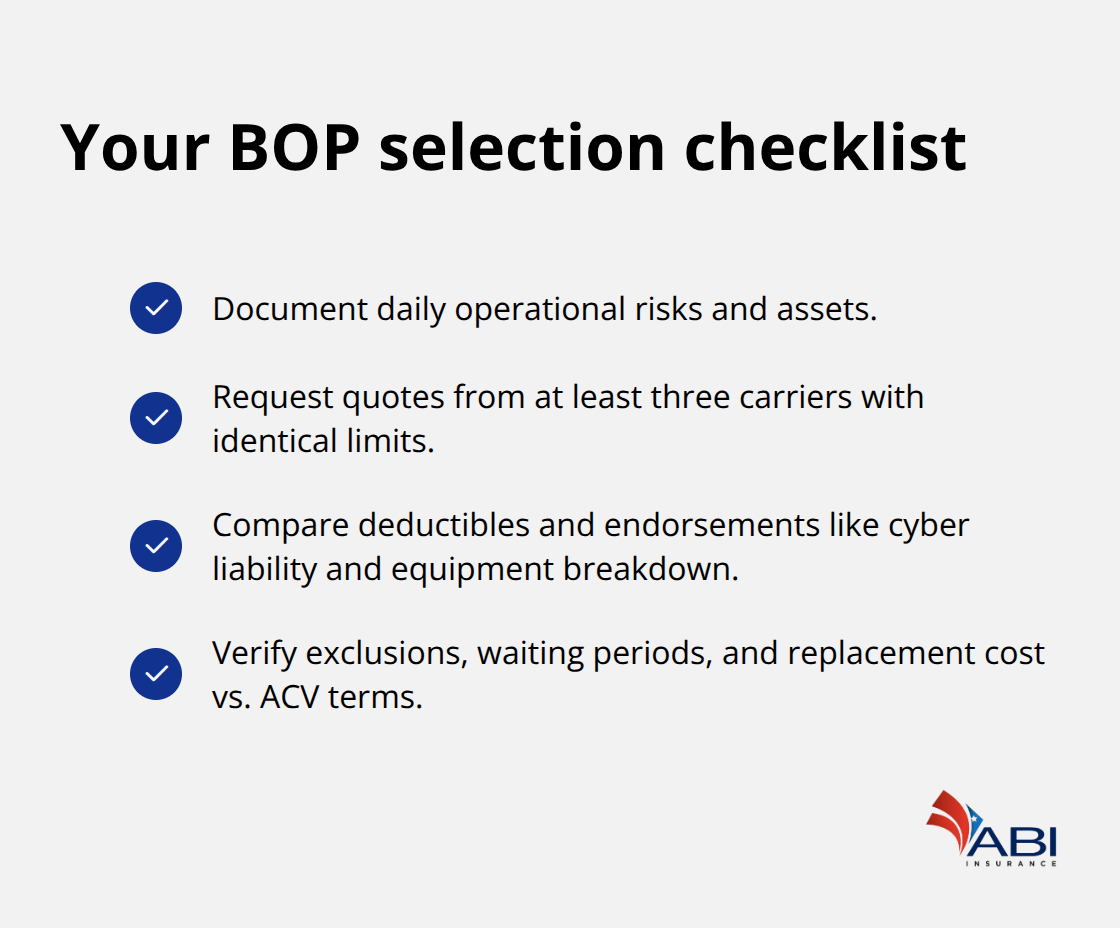
Your industry determines which risks matter most, and that assessment should drive every decision you make about coverage. A contractor’s exposure looks nothing like a salon’s, and a manufacturing operation faces entirely different hazards than a consulting firm. Start by documenting exactly what could go wrong in your daily operations. A retail store needs protection against customer injuries and theft; a home-based service business needs different liability exposure. Your location amplifies certain risks, too. A business in an area with high crime rates or severe weather pays more because those risks are real and measurable.
Assess Your Industry and Risk Factors
When you request quotes, tell the agent specifically what your business does, where you operate, and what assets you own. Generic descriptions lead to generic quotes that miss your actual exposure. Major carriers adjust pricing based on these specifics, so the more detailed information you provide upfront, the more accurate your quote becomes. Don’t accept a quote without understanding why the carrier chose those particular coverage limits and deductibles. Push back if something doesn’t align with your operation. A carrier might suggest $500,000 in property coverage when your inventory typically runs $200,000. That’s wasted premium you shouldn’t pay.
Compare Quotes Across Multiple Carriers
Comparing quotes means looking beyond the monthly price and examining what actually changes between policies. Request quotes from at least three carriers, and make sure each quote includes the same coverage limits so you’re comparing apples to apples.
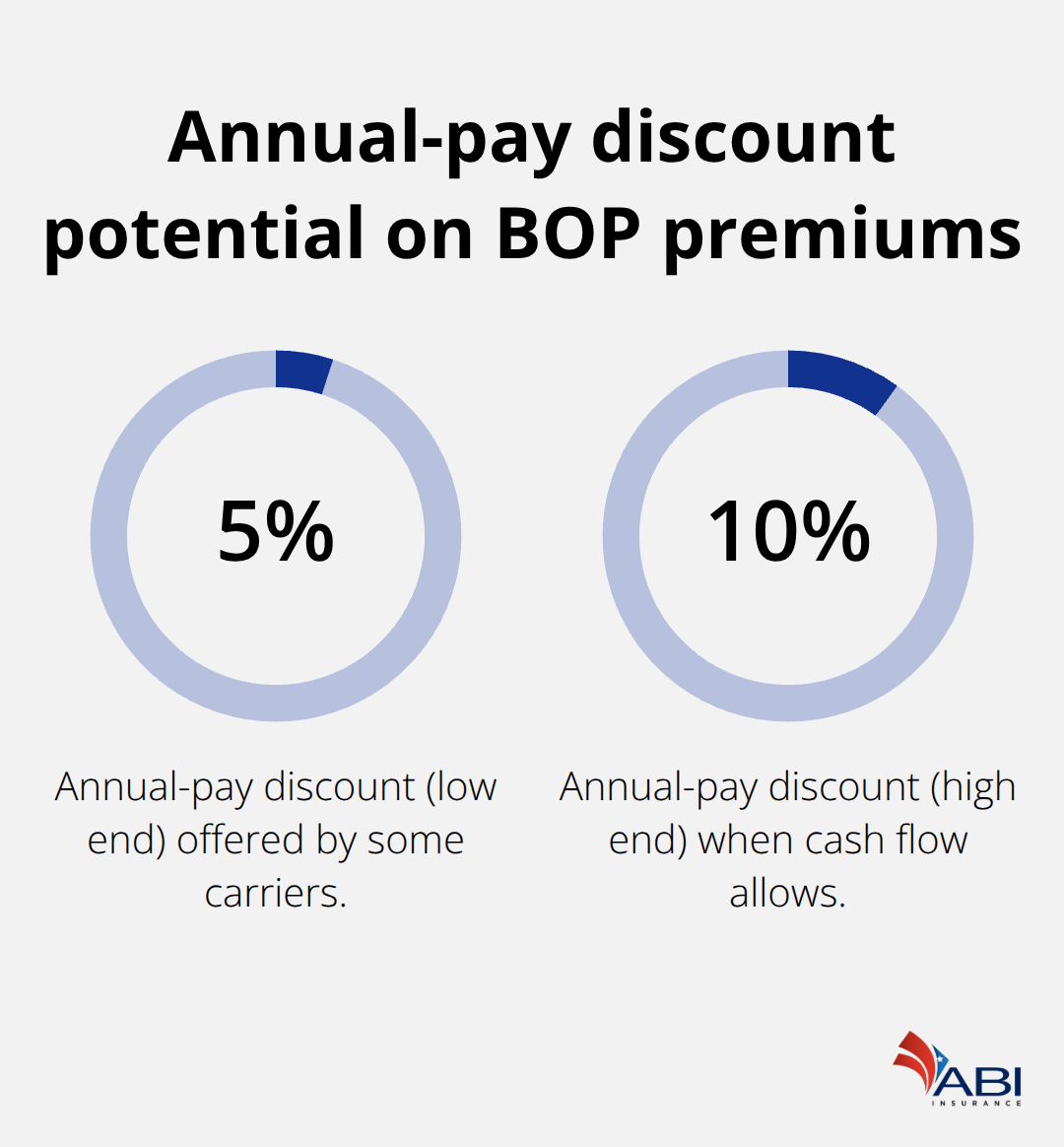
Some carriers offer discounts for paying annually instead of monthly, which can save you 5 to 10 percent if you have the cash flow to manage it. Others discount for safety measures like alarm systems or sprinklers, or for claims-free histories. Ask every carrier about these discounts explicitly because they don’t volunteer them.
Evaluate Deductibles and Add-On Coverage
Request quotes that include cyber liability and equipment breakdown endorsements so you understand the true cost to add protection as your business evolves. Don’t just compare premium prices; compare deductibles too. A $1,500 deductible versus a $2,500 deductible shifts your out-of-pocket exposure during a claim. Higher deductibles lower premiums, but only choose that route if you actually have reserves to cover that amount when something happens.
Verify Policy Details Before You Commit
Finally, verify that each quote specifies waiting periods for business interruption coverage, replacement cost versus actual cash value for property claims, and any exclusions unique to your industry (these details determine whether your BOP actually protects you or leaves gaps when you need coverage most). Request quotes that spell out exactly what each carrier covers and what falls outside the policy. The more specific your questions, the clearer your comparison becomes, and the better your final decision will be.
Final Thoughts
A Business Owners Policy for small businesses delivers straightforward protection without the complexity of managing multiple policies. You get general liability, commercial property coverage, and business interruption insurance bundled into one package at a cost that typically runs $1,687 annually, according to The Hartford. That efficiency matters when you run a business and juggle competing priorities.
The real value emerges when you match your BOP to your actual operation rather than accepting generic coverage. Your industry determines which risks matter most, your location shapes your exposure, and your assets dictate the coverage limits you genuinely need. A retail store with seasonal inventory faces entirely different exposures than a consulting firm working from a small office, so spending time upfront to assess these specifics prevents underinsurance gaps that hurt when claims happen.
Multiple carriers reveal meaningful differences in pricing and coverage options when you request quotes with identical limits. Ask about discounts for safety measures, annual payments, or claims-free histories, and don’t chase the lowest premium without understanding what you actually receive. Contact ABI Insurance to discuss how a customized BOP for small businesses can fit your operation and your budget.









 Nurse Practitioner Liability: Navigating Medical Liability for Advanced Practitioners