Oregon homeowners face unique insurance challenges that go beyond standard coverage. At ABI Insurance, we’ve helped thousands of homeowners understand what protection they actually need.
This guide breaks down the essential Oregon homeowners insurance coverages you should know about. We’ll cover dwelling protection, liability, and the special considerations that matter most in our state.
What Does Dwelling Coverage Protect
Dwelling coverage forms the foundation of your Oregon homeowners policy. It pays to repair or rebuild your home’s structure after damage from fire, wind, hail, lightning, vandalism, or explosions. This protection covers the walls, roof, siding, windows, flooring, and permanently attached systems like electrical wiring and plumbing.
Understanding What Dwelling Coverage Includes
Detached structures on your property receive separate protection. A detached garage, shed, or fence typically falls under other structures coverage, which usually caps out at 10 to 20 percent of your dwelling limit. This distinction matters because you need to know exactly what your policy protects if multiple buildings sit on your property.
The Replacement Cost Problem
Oregon homeowners often make a critical mistake: they set their dwelling limit based on what they paid for the house rather than what it would actually cost to rebuild today. Reconstruction costs have climbed significantly due to rising labor, lumber, and material prices. If your home was built before you purchased it, the original construction cost is irrelevant. What matters is the current replacement cost in your area.
Replacement Cost Versus Actual Cash Value
Two main valuation methods exist when you review your policy. Replacement cost coverage rebuilds your home with materials of like kind and quality at current market prices, substantially more expensive than actual cash value but far superior protection. Actual cash value subtracts depreciation from the replacement cost, meaning a 15-year-old roof or siding gets valued at a fraction of what new materials cost. You end up significantly short when you need to rebuild.
Most insurers in Oregon offer replacement cost as standard or optional coverage, though some carriers may charge more for it or decline to offer it. We strongly recommend replacement cost coverage for dwelling protection. The difference in premium is typically modest compared to the financial gap you’d face with actual cash value after a major loss.
Deductibles and Your Out-of-Pocket Costs
Your deductible also matters considerably. Most Oregon homeowners choose between $500, $1,000, $2,500 or higher. A higher deductible reduces your premium, but you need to confirm you can actually pay that amount out-of-pocket when a claim happens. Some insurers apply a percentage-based deductible for wind or hail damage in certain areas, which could mean you’re responsible for 2 to 5 percent of your dwelling limit instead of a flat dollar amount.
Understanding your dwelling limit and deductible structure prepares you for the next layer of protection, the additional coverages that safeguard your personal belongings and protect you from liability claims.
Beyond Your Home’s Structure
Personal Property Coverage Protects What You Own
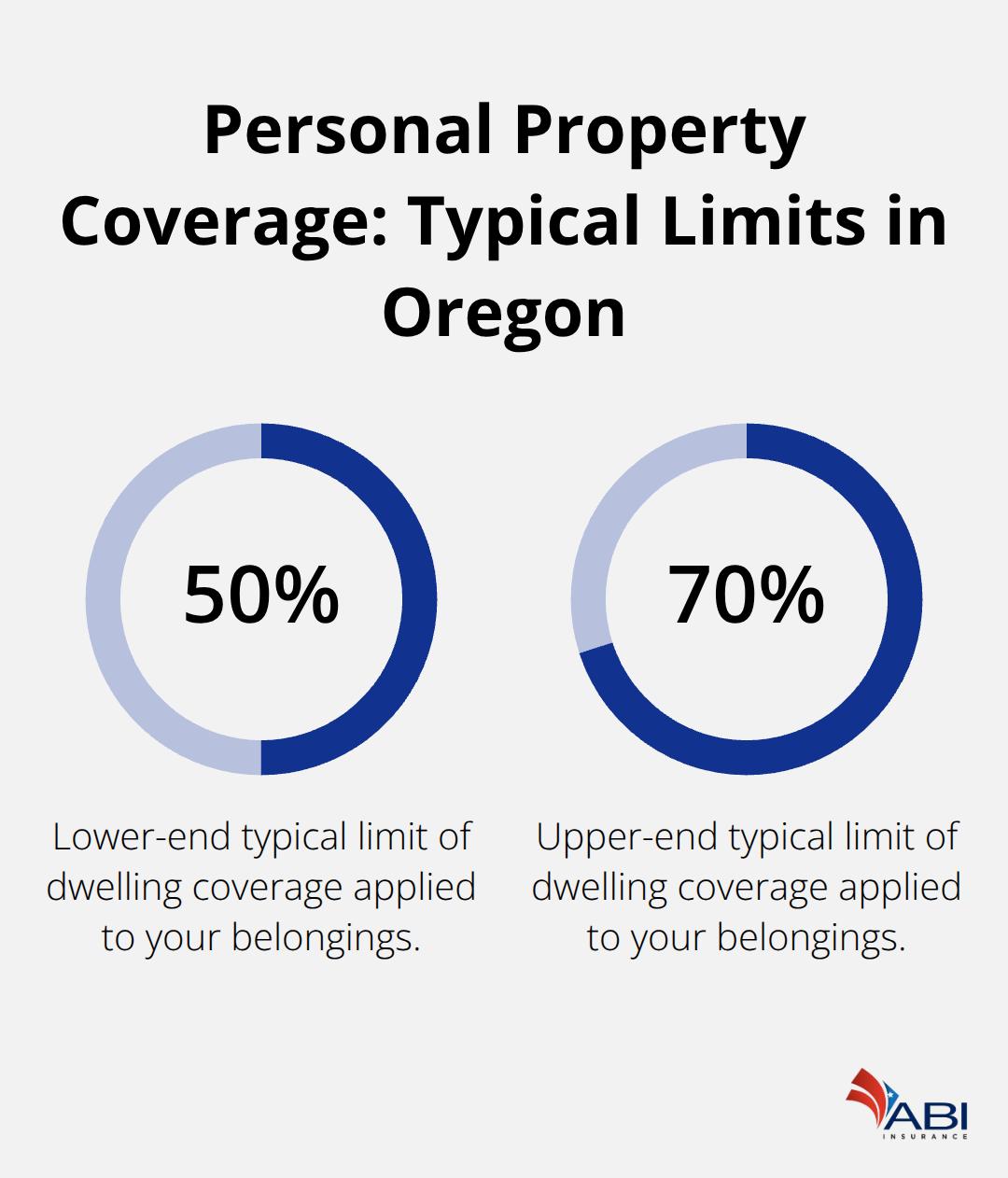
Personal property coverage protects the contents inside your home including furniture, electronics, clothing, appliances, and everything else you own. Standard policies typically cover personal property at 50 to 70 percent of your dwelling limit, which means if your home is insured for $400,000, your belongings might only be covered up to $280,000. Oregon homeowners frequently underestimate the value of their possessions. A single kitchen renovation with new appliances, a bedroom full of electronics, and a garage of tools can easily exceed $50,000.
Most policies cap coverage for high-value items like jewelry, watches, firearms, and collectibles at around $1,000 per loss, which is inadequate if you own even moderately valuable pieces. You need endorsements to increase these limits. Off-premises coverage extends protection worldwide, meaning your laptop, luggage, or clothing damaged while traveling receives coverage. This matters for Oregon families who travel frequently or maintain property elsewhere.
Liability Coverage Protects You From Financial Ruin
Liability coverage protects you financially when someone is injured on your property or you accidentally damage someone else’s property. Standard policies typically include $100,000 in liability protection, but Oregon homeowners should strongly consider higher limits. A single serious injury claim can easily exceed $100,000 in medical costs alone, and jury awards in Oregon often run substantially higher.
If a guest falls down your stairs and requires surgery, or your dog injures a neighbor, you become personally responsible for damages beyond your policy limit. Umbrella policies extend liability protection to $1 million or more once your standard homeowners limit is exhausted. Umbrella insurance remains an excellent value, delivering broad liability coverage at a reasonable annual cost. This additional layer of protection shields your assets from catastrophic liability claims.
Loss of Use Coverage Covers Your Living Expenses
Loss of use coverage pays for temporary living expenses if your home becomes uninhabitable after a covered loss. This includes hotel bills, meals, and other reasonable costs while repairs happen. Oregon homeowners should understand that loss of use may also apply during wildfire evacuations, though this varies by policy and insurer.
If you face evacuation due to a wildfire threat, your policy may cover lodging and meals during the evacuation period. Keeping receipts for all temporary housing and meal expenses is essential for claim reimbursement. Most Oregon homeowners significantly underestimate how quickly temporary living costs accumulate. Hotel rooms average $120 to $200 nightly in the Portland metro area, and meal expenses add another $50 or more daily for a family.
These three coverages form the backbone of protection for your belongings and financial security, but Oregon’s unique risks demand additional specialized coverage that standard policies simply don’t address.
What Coverage Gaps Exist in Oregon Homes
Earthquake Coverage Fills a Critical Void
Earthquake damage ranks among the most misunderstood coverage gaps for Oregon homeowners. Your standard homeowners policy excludes earthquake damage entirely, yet Oregon sits along active fault lines where seismic events pose genuine risk. The Cascadia Subduction Zone poses a seismic threat to Oregon residents. Earthquake coverage requires a separate endorsement or standalone policy, and insurers in Oregon offer this protection with varying terms and pricing.
Most policies cap earthquake coverage at actual cash value rather than replacement cost, meaning you receive depreciated payouts instead of funds to fully rebuild. The cost typically ranges from $300 and up annually depending on your home’s age, construction type, and location, with deductibles frequently set at 15 to 20 percent of your dwelling limit. Homes built before modern seismic codes became standard face higher premiums, but retrofitting your foundation can lower rates substantially. Obtain earthquake quotes during your initial policy purchase rather than waiting until after tremors occur.
Flood Insurance Protects Against Water Damage
Flood damage presents an equally critical gap that catches Oregon homeowners off guard. Standard policies exclude all flood damage regardless of cause, and this exclusion applies whether water enters from heavy rain, overflowing rivers, or storm surge. The National Flood Insurance Program administers flood coverage through licensed agents, and Oregon homeowners in flood-prone areas should obtain quotes immediately rather than assuming they don’t need protection.
Premiums vary dramatically based on flood zone designation, with properties in high-risk zones paying $1,500 to $3,000 annually while moderate-risk properties might pay $300 to $800. Even homeowners outside designated flood zones can purchase coverage, which proves smart for those near drainage patterns or elevation changes that create localized flooding. Maintain detailed home inventory documentation and keep receipts to accelerate claim processing if flood damage occurs.
Umbrella Policies Extend Your Liability Protection
Umbrella policies deserve serious consideration as your final protection layer, extending liability coverage beyond standard homeowners limits once your base coverage exhausts. If you carry $300,000 in homeowners liability and face a $500,000 judgment from a serious injury claim, your umbrella policy bridges that $200,000 gap and protects personal assets from garnishment.
Umbrella coverage remains an excellent value at a reasonable cost, making it one of the highest-value insurance purchases available. Oregon courts award substantial damages in personal injury cases, and a single catastrophic event can devastate finances without this protection. Your umbrella policy also covers liability gaps that homeowners policies contain, such as certain dog-bite scenarios or rental property incidents (depending on your specific situation and endorsements).
Final Thoughts
Your Oregon homeowners insurance coverages only protect you when they match your actual situation and risks. Review your declarations page today to confirm your dwelling limit reflects current reconstruction costs, your personal property coverage reaches 70 percent of that limit, and your liability protection sits at $300,000 or higher. Document your home’s contents with photographs and purchase information so you can verify whether your coverage limits are truly adequate.
The coverage gaps we discussed — earthquake, flood, and umbrella policies — represent real financial exposure in Oregon’s environment. Many homeowners discover they’re significantly underinsured only after a loss occurs, which is far too late to add protection. Take action now to identify which specialized coverages you need and obtain quotes from multiple insurers.
Our team at ABI Insurance has spent over 40 years helping families across the Portland metro area build protection strategies tailored to their homes and budgets. Contact us to review your current policy and discuss whether your Oregon homeowners insurance coverages truly protect what matters most to you.