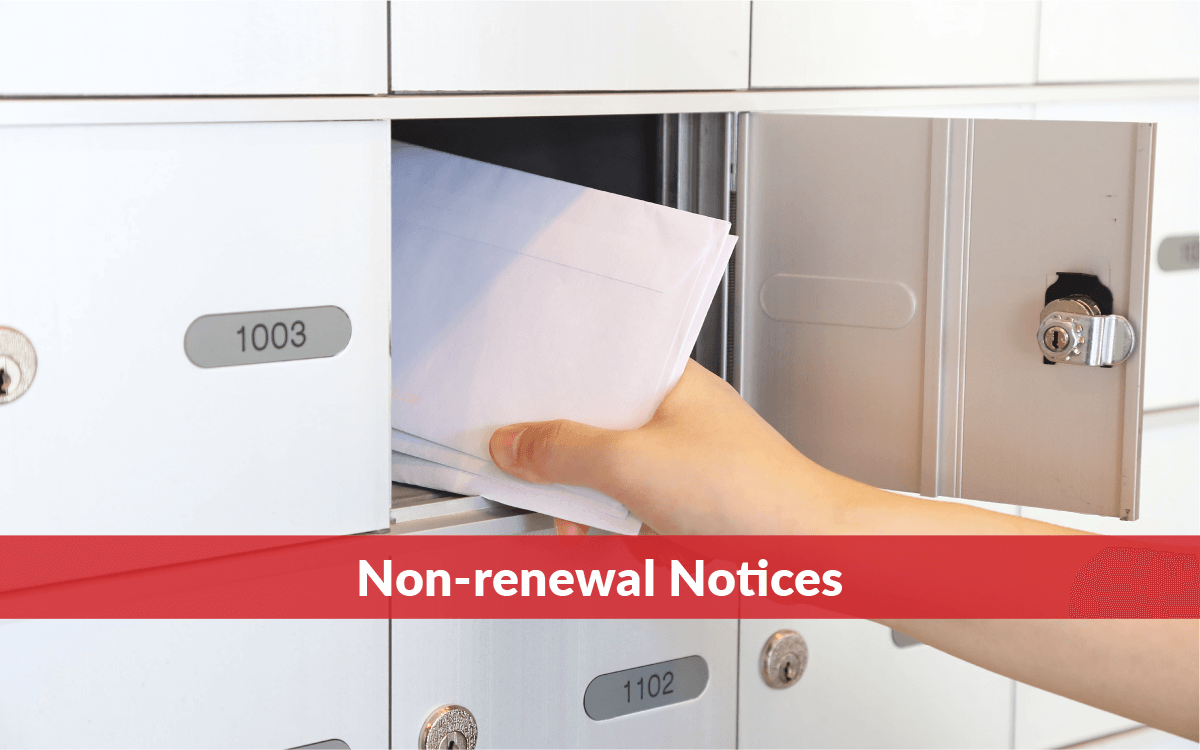
First, the good news. Not all non-renewal notices mean bad news for a community association. Now, the bad news. Some non-renewal notices associations receive could negatively impact their upcoming insurance renewal process. A non-renewal is a legal notice sent by an insurance company notifying the client that the insurance company will not be offering terms when the policy expires. The notice provides protection to the insurance company. Once this notice is issued, the company is not required to offer terms after the policy expiration date or to modify the policy terms for the upcoming renewal. When applying for new insurance, all-non renewals should be disclosed to a future carrier with an explanation when asked on an application. (Most carriers include this question in their application.)
Non-renewal notices are sent for various reasons. Some reasons are understandable and other reasons could be driven by factors the insured controls. Common non-renewals that occur frequently but are less concerning include:
- Earthquake carriers who send non-renewals annually to modify offered coverages and terms. Most non-renewals by earthquake carriers are a formality and the carrier provides terms for the renewal.
- Insurance companies no longer write the business and have exited the market. Typically, this is acceptable for a future insurance carrier. In the last three years, our industry has seen multiple insurance carriers no longer continue business in various states.
- Eligibility changes can impact a community if an insurance company can no longer offer terms. For example, buildings over a certain height and construction type have become difficult to insure. Owners of large and tall framed buildings may find the buildings are no longer eligible. If the eligibility reason is life-safety driven, such as non-sprinklered buildings or horizontal railings, these features could impact future coverage in the standard market and could bring the same concerns to a new insurance carrier. Eligibility is changing for many carriers and the standard market may not always be available.
The most impactful non-renewal a community could receive is usually within the community’s control. Some examples include:
- Unfavorable loss history. The community could have a claim pattern related to plumbing failures, systemic issues within all buildings, or a large loss. Insurance companies want to see the Board and owners take proactive measures to reduce the risk of future claim occurrences.
- Lack of response and loss control requirements are not completed. A community is greatly impacted by this because to a new carrier, this implies the Board is unwilling to mitigate risk.
- Cancellations for non-payment. This is unfavorable for any insured. The insurance company wants to know if they will be paid for the coverages they offer. Cancellations due to nonpayment can be reasons for a future insurance company not to provide terms.
The most important part to any non-renewal is that it must be disclosed to a future insurance carrier. Almost all insurance applications, no matter the coverage, ask about non-renewals in the last five years. Not disclosing information or answering the application incorrectly can be considered material misrepresentation and potentially cause coverage issues for the insured. Be transparent about any non-renewal and provide accurate information on all applications.






 Preparing for Winter