Most homeowners pay for coverage they don’t need while missing endorsements that cut their premiums. At ABI Insurance, we’ve seen countless policies that could save hundreds annually with the right adjustments.
Homeowners insurance endorsements aren’t just add-ons-they’re your toolkit for matching coverage to your real situation and your budget. This guide shows you which ones deliver genuine savings and how to spot them in your policy.
What Endorsements Actually Impact Your Premium
Personal Property Replacement Cost Coverage Pays Full Value
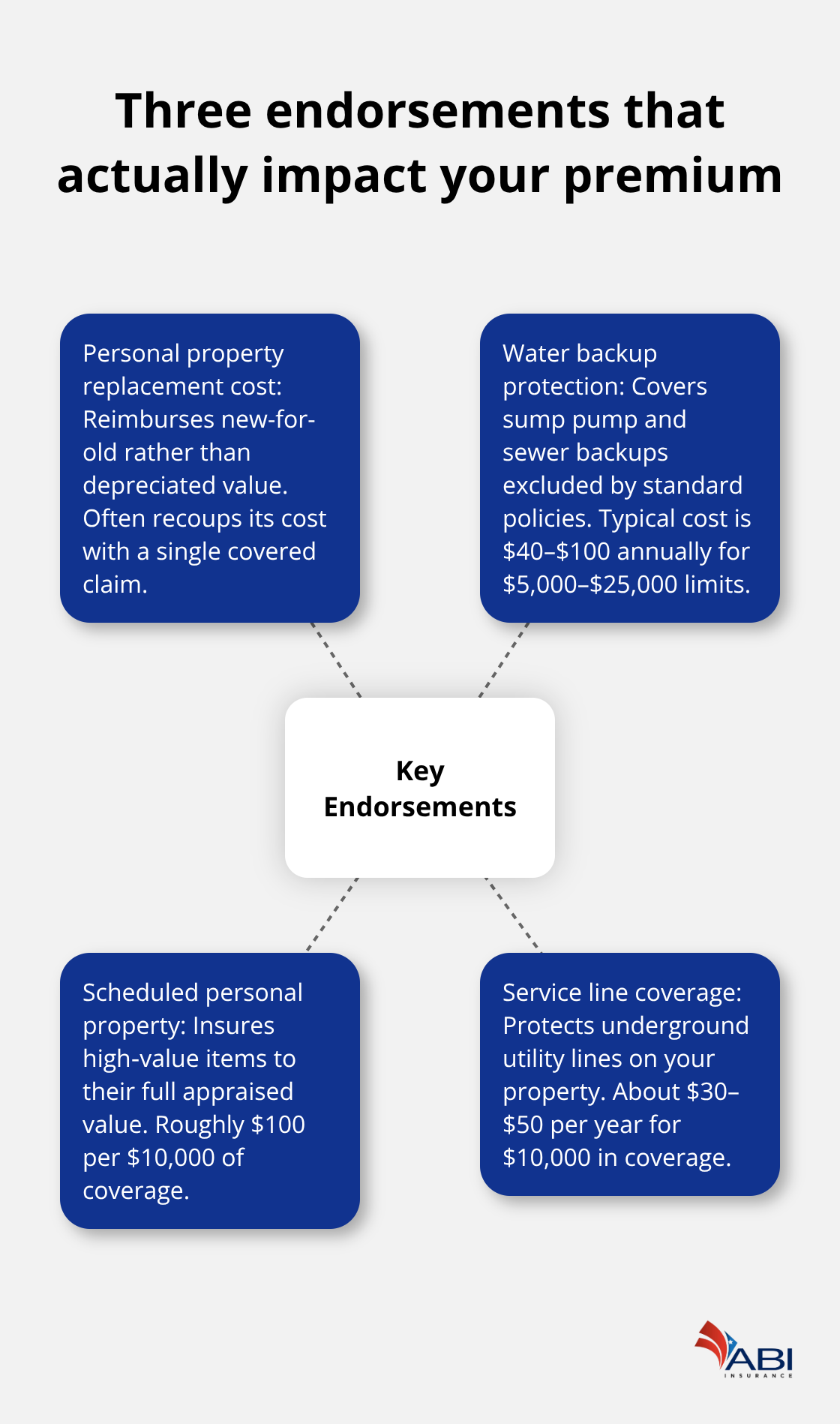
Personal property replacement cost coverage pays to replace belongings with new items of similar type and quality instead of accepting depreciated value. This matters because standard homeowners policies typically pay actual cash value, which means a five-year-old television worth $800 new gets replaced for $200. According to data from the Insurance Information Institute, most homeowners underestimate replacement costs by 20-30%, leaving significant gaps after a loss. The cost to add personal property replacement coverage varies by policy, but the difference between cash value and replacement cost often pays for itself after a single claim. If you own electronics, furniture, or appliances purchased within the last decade, this endorsement typically delivers measurable savings compared to replacing items at depreciated rates out of pocket.
Water Backup Protection Fills a Gap Standard Policies Leave Open
Standard homeowners policies exclude sewer backups and water damage from sump pump failures, yet these events cost homeowners an average of $10,000 to $25,000 in repairs according to the Insurance Information Institute. Water backup coverage typically costs $40-$100 annually for $5,000-$25,000 of protection. In areas with aging municipal infrastructure or homes in low-lying zones, this endorsement prevents catastrophic financial exposure. Service line coverage protects underground utility lines on your property and adds another layer at roughly $30-$50 per year for $10,000 in coverage. Many homeowners skip these because they seem redundant, but they address different failure points-one covers what backs up into your home, the other covers what breaks underground. Together, they cost under $150 annually but can prevent claims exceeding $15,000.
Scheduled Personal Property Endorsements Protect High-Value Items at Full Replacement Cost
Jewelry, fine art, electronics, and collectibles hit policy limits quickly on standard homeowners coverage. Scheduled personal property endorsements insure specific high-value items at their full appraised value without the standard policy cap. Adding $10,000 of scheduled coverage costs roughly $100 annually. Without this endorsement, a $3,000 diamond ring or $5,000 camera equipment gets replaced at the standard personal property limit, often $2,500 or less. The endorsement requires an appraisal upfront, but that one-time expense protects irreplaceable items at full replacement cost.
For professionals with expensive equipment or anyone with inherited jewelry or artwork, this endorsement eliminates the gap between what your standard policy covers and what you actually need to replace. These three endorsements form the foundation of tailored protection-but they represent only part of what you can customize. The next section reveals endorsements that most homeowners overlook, even though they directly reduce what you pay each year.
Where Real Savings Hide in Your Policy
Home Security Systems Deliver Fast Returns on Investment
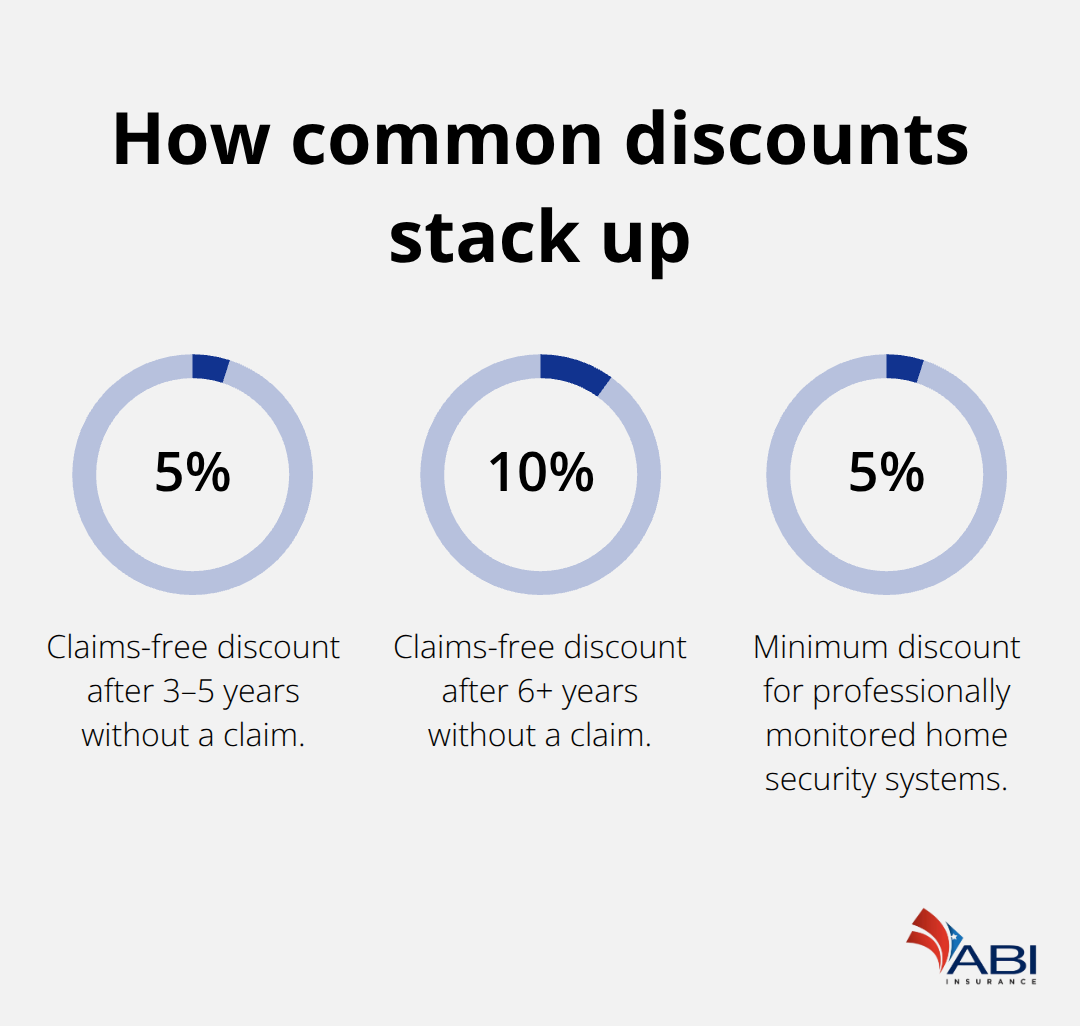
Most homeowners focus on what endorsements cost rather than what they earn back through discounts. Home security systems deliver one of the fastest returns-insurers offer discounts for monitored systems, with some carriers reaching higher percentages depending on the system type and monitoring service. The catch matters: your system must connect to a professional monitoring center, not just your phone. Confirm your carrier’s exact specifications before purchasing, because a DIY system that alerts only you won’t qualify for the discount. Verify these details upfront so the discount applies immediately when you activate your policy.
Multi-Policy Bundling Requires Comparison Shopping to Work
Multi-policy bundling works differently than most people assume-it’s not automatic savings. When you combine homeowners and auto policies with the same carrier, discounts typically range from 5-15%, but the actual savings depend on how each insurer structures the discount and what rate you qualified for independently. Some carriers apply the discount to your lowest premium line; others split it across both. The only way to know if bundling saves money is to compare a bundled quote against separate quotes from different carriers. Many homeowners bundle out of convenience and miss 10-20% savings elsewhere.
Claims-Free Status and Loyalty Discounts Have Real Limits
Claims-free discounts reward loyalty differently than you might expect. After three to five years without claims, many insurers offer around 5% off; after six or more years, discounts can reach 10% according to the Insurance Information Institute. However, these discounts often disappear if your rate increases due to claims history or market conditions, so don’t rely on them as permanent savings.
Stack Discounts Strategically to Cut Your Annual Bill
The real money-saving move combines all three: secure a home security discount, verify bundling saves more than separate policies (5-15%), and ask your agent whether your current claims-free status qualifies for additional loyalty discounts (5-10%). For a $1,500 annual homeowners premium, stacking these legitimately cuts your bill to roughly $1,050-$1,200. The process requires comparison shopping and verification, not assumptions. Most homeowners never ask their agent to walk through available discounts or run bundled versus separate quotes, leaving hundreds on the table annually. These discount strategies form your first line of defense against overpaying-but your home’s specific risks demand a more targeted approach. The next section shows you how to assess what endorsements actually fit your situation rather than what sounds good in marketing materials.
Matching Endorsements to What Your Home Actually Needs
Identify Your Home’s Specific Risks Before Adding Coverage
Your zip code, roof age, and whether trees hang over your house matter far more than generic endorsement checklists. Start by identifying the specific risks your property faces rather than purchasing coverage because an article mentioned it. Earthquake coverage makes sense in California or the Pacific Northwest, but it’s unnecessary in stable geological areas.
Check your property’s flood zone status through FEMA’s flood maps and contact your local fire department about historical claims in your neighborhood. Aging roofs increase weather damage risk, so windstorm endorsements matter more for homes with roofs over fifteen years old. If your home sits in a historic district with strict renovation codes, ordinance or law coverage helps protect you from increased costs due to these regulations.
Calculate Your Actual Replacement Cost
The Insurance Information Institute reports that 47 percent of homeowners lack adequate coverage for rising rebuild costs, but that gap exists because they added random endorsements instead of targeting actual exposure. Start with a replacement cost estimate specific to your home, not national averages. Local contractors can quote rebuild expenses based on your square footage, materials, and current labor rates in your region. That number becomes your benchmark for dwelling coverage.
A $300,000 rebuild cost requires different endorsements than a $500,000 home in an area with stricter building codes. Once you know your replacement cost and identified location-specific risks, compare what each endorsement costs against the potential claim amount.
Weigh Endorsement Costs Against Potential Claim Expenses
Water backup coverage runs $40 to $100 annually but prevents $10,000 to $25,000 in sewer line repairs according to the Insurance Information Institute. Service line coverage costs $30 to $50 per year and covers $10,000 in utility line damage that standard policies exclude entirely. Those endorsements pay for themselves in a single claim, making them practical choices for most homeowners.
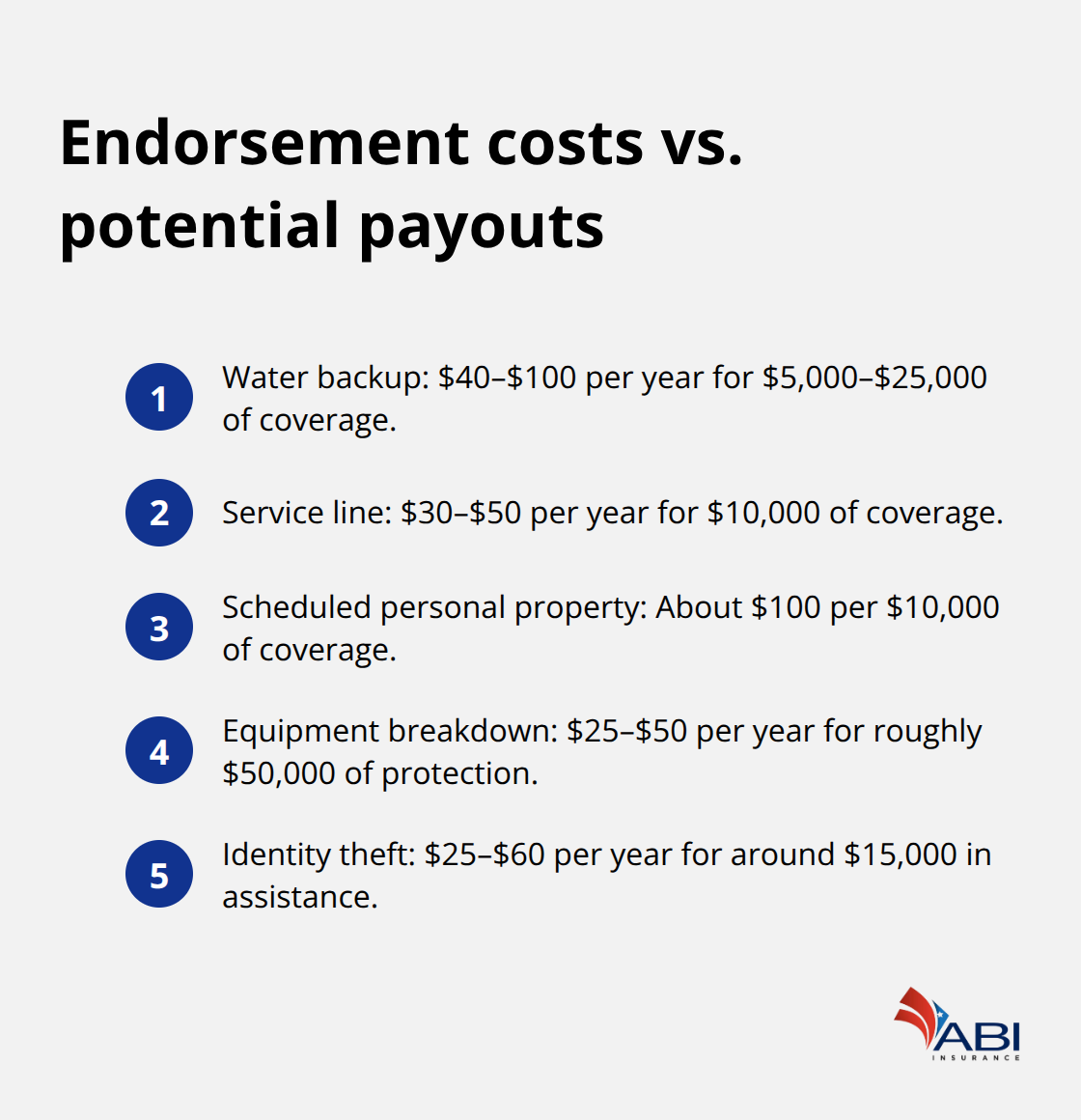
Scheduled personal property coverage costs roughly $100 per $10,000 of coverage but eliminates the gap between standard policy limits and actual replacement value for jewelry or electronics. Equipment breakdown coverage runs $25 to $50 annually for roughly $50,000 in protection against HVAC and appliance failures. Identity theft coverage typically costs $25 to $60 per year for around $15,000 in recovery assistance.
Work With Your Agent to Close Coverage Gaps
Your agent should walk through your current declarations page and highlight what you already have, then show exactly what gaps exist. Many homeowners discover they’re paying for duplicate coverage or missing essential protection that costs only dollars monthly. Ask your agent to provide a side-by-side comparison showing your current limits, what claims would cost out of pocket under your existing policy, and how each endorsement closes that gap.
That comparison transforms endorsements from optional upgrades into strategic decisions based on actual numbers rather than fear or marketing. Your agent should explain why each endorsement matters for your specific situation, not recite a standard pitch applied to every client. Request detailed information about your home’s actual risks and let that assessment drive your endorsement selections rather than purchasing coverage based on what sounds important.
Final Thoughts
The endorsements that deliver real savings address specific gaps in your standard policy rather than theoretical risks. Water backup coverage, service line protection, and scheduled personal property endorsements cost under $200 annually combined but prevent claims exceeding $15,000. Home security discounts, bundling verification, and loyalty rewards stack to cut your premium by $300–$500 yearly when applied strategically.
Start your optimization by pulling your current declarations page and identifying what you already have. Compare that against the specific risks your home faces based on location, age, and contents value. Calculate your actual replacement cost through local contractor quotes, then assess which homeowners insurance endorsements close the gaps between that number and your current coverage. Skip endorsements that don’t match your situation, even if they sound important.
Contact ABI Insurance to review your current policy and identify where real savings hide in your endorsement options.







 Portland BOP Coverage Options: What Local Business Owners Should Know