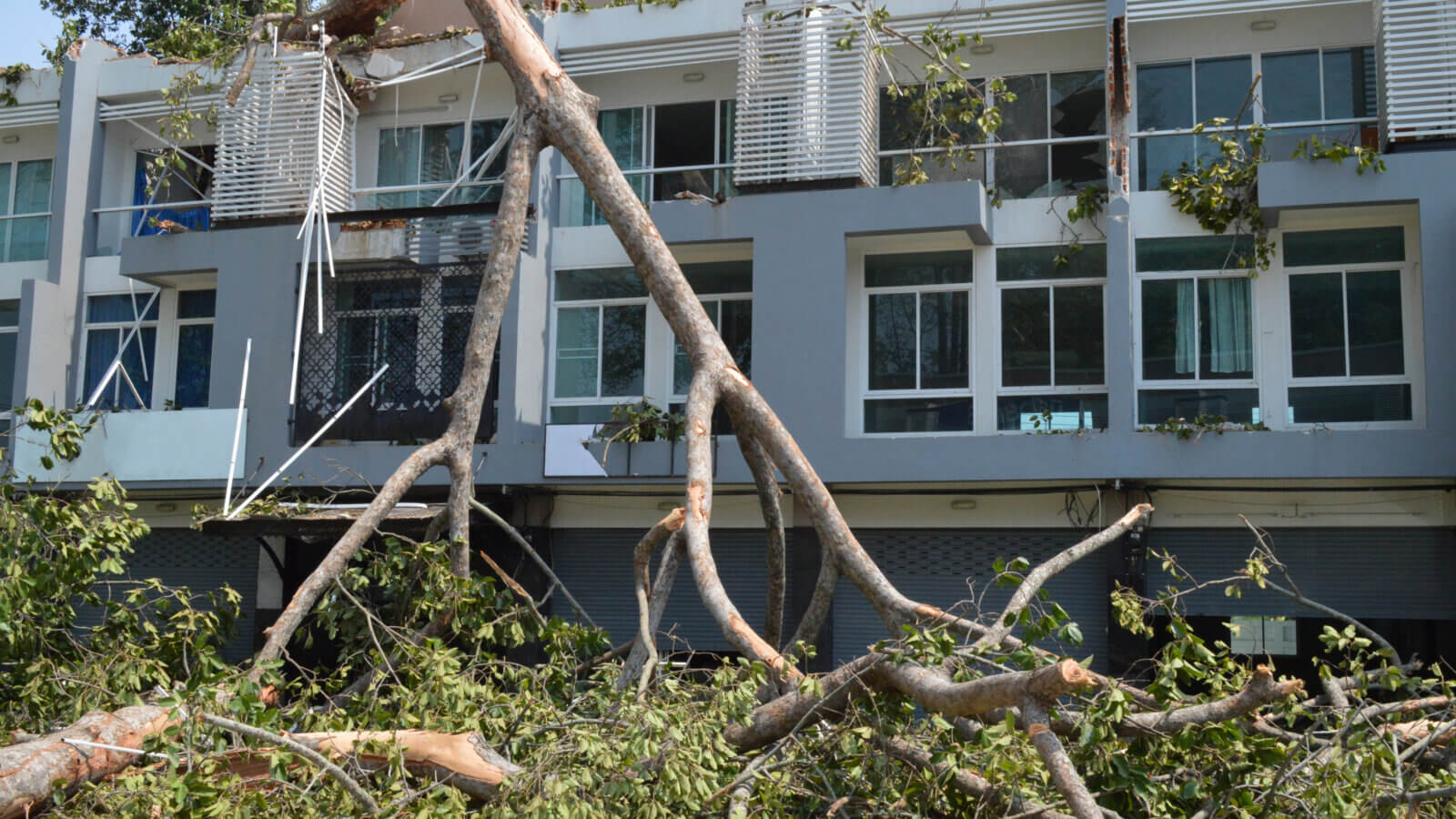
It can be difficult to understand who is responsible when a tree falls and damages a building. Below are some common questions related to insurance coverage for fallen trees.
Is building damage caused by a fallen tree covered by insurance?
Typically, property policies cover building damage caused by a fallen tree if it fell due to a covered peril. Usually, covered perils include storms, wind, etc. Property policies may not cover building damage caused by a fallen tree if it fell due to negligence or a maintenance-related issue.
If a tree belonging to a neighbor or the association falls on my building and damages my unit, whose insurance would cover the loss?
Since the damage occurred to your unit, your insurance policy would respond to a claim regardless of whose tree fell. Your HO6 policy may cover the repair costs up to the association’s deductible. If damages exceed the association’s deductible, the association’s policy may cover the rest.
What if a fallen tree only damages the exterior of the building?
If your association’s governing documents state that the association is responsible for insuring the exterior of the building, the association would be responsible for the repairs and would likely file a claim to cover the costs. If the governing documents state that unit owners are responsible for insuring certain exterior elements, you would be responsible for those repairs and could file a claim on your HO6 policy to cover the costs.
What if negligence is involved?
If your unit is damaged, your insurance policy pays for the damage after you file a claim and coverage is determined. During the claim adjustment process, the adjuster may try to subrogate to a responsible party to recoup their loss if negligence is discovered. The insurance company needs to find proof that the owner of the fallen tree had prior knowledge that the tree was dead, diseased, or damaged in such a way that it was at risk of falling.
Is there coverage for the fallen tree to be removed?
Many property policies include a sublimit for tree removal if connected to a covered claim. For example, the policy may include a $1,000 sublimit for tree removal. To clarify, this sublimit would only be available as part of a covered claim related to a fallen tree. However, the policy will not pay for any tree to be removed that did not cause any damage to property.
Regular tree maintenance by a licensed and insured professional is critical to avoid property damage caused by fallen trees or branches. If your arborist alerts you to a potential hazard connected to a tree, heed their advice and have them eliminate the hazard right away.
It is important to note that there may be differences in maintenance and insuring responsibility on the part of unit owners and the association based on your governing documents. Contact your attorney or your insurance broker for more information.




 Essential Strategies for Crafting an Association’s Insurance Budget