
One lawsuit can devastate your medical practice. A single claim can drain your savings, damage your reputation, and force you to close your doors.
That’s why physician professional liability insurance in Oregon isn’t optional, it’s essential. We at ABI Insurance help Oregon doctors protect what they’ve built by securing the right coverage before a crisis hits.
What Physician Professional Liability Insurance Actually Covers
Physician professional liability insurance protects you when a patient alleges that your care fell below the standard of care expected of careful physicians in similar circumstances. This coverage pays legal defense costs and damages if you face liability for negligence, injury, or wrongful death. In Oregon, the standard of care is defined by ORS 677.095(1) and requires expert testimony to establish breach. The policy covers economic damages such as additional medical costs, home care, and lost wages, plus non-economic damages for pain, suffering, and loss of quality of life. Defense costs may be included within your policy limits or paid separately, depending on your policy structure, so you need to understand exactly how your carrier handles this distinction.
Claims-Made vs. Occurrence Policies
Claims-made policies have lower upfront premiums but require tail coverage when you leave a practice or retire. Tail premiums typically cost 40 to 60 percent more annually than your final-year premium. Occurrence policies cost 40 to 60 percent more upfront but eliminate tail obligations entirely. In Oregon, 94 medical malpractice payouts were made in 2023, totaling $70,397,500 with an average payout of $748,909, according to the National Practitioner Data Bank. A single large settlement can exceed your annual income many times over, making adequate limits essential.
Professional Association Membership and Coverage Access
Oregon law prohibits insurers from denying coverage based solely on professional association membership per ORC 742.405. Membership status cannot be a reason to reject your application. However, nonmember physicians may be required to agree to reasonable risk management or loss control programs that members undergo. Shopping across multiple carriers via a broker can save 20 percent or more compared to staying with a single insurer.
How Oregon Courts Evaluate Medical Malpractice Claims
Medical malpractice claims in Oregon require proving four elements: duty of care, breach, causation, and damages. From 2019 through 2024, the Oregon Medical Board received 1,016 malpractice reports, but only 303 were opened for investigation, and just 16 resulted in Board action. This gap shows that many malpractice claims settle based on insurance coverage terms rather than actual fault. Patient conduct can reduce your recovery if the patient shares responsibility (such as failing to disclose allergies or not following treatment instructions). If the patient is more than 50 percent at fault, the claim is barred entirely. The statute of limitations is two years from discovery of the injury or when it should have been discovered, but Oregon also has a statute of ultimate repose of five years from the date of treatment, regardless of discovery, with limited exceptions for fraud. Missing these deadlines bars claims entirely, so tracking timelines is critical for your defense.
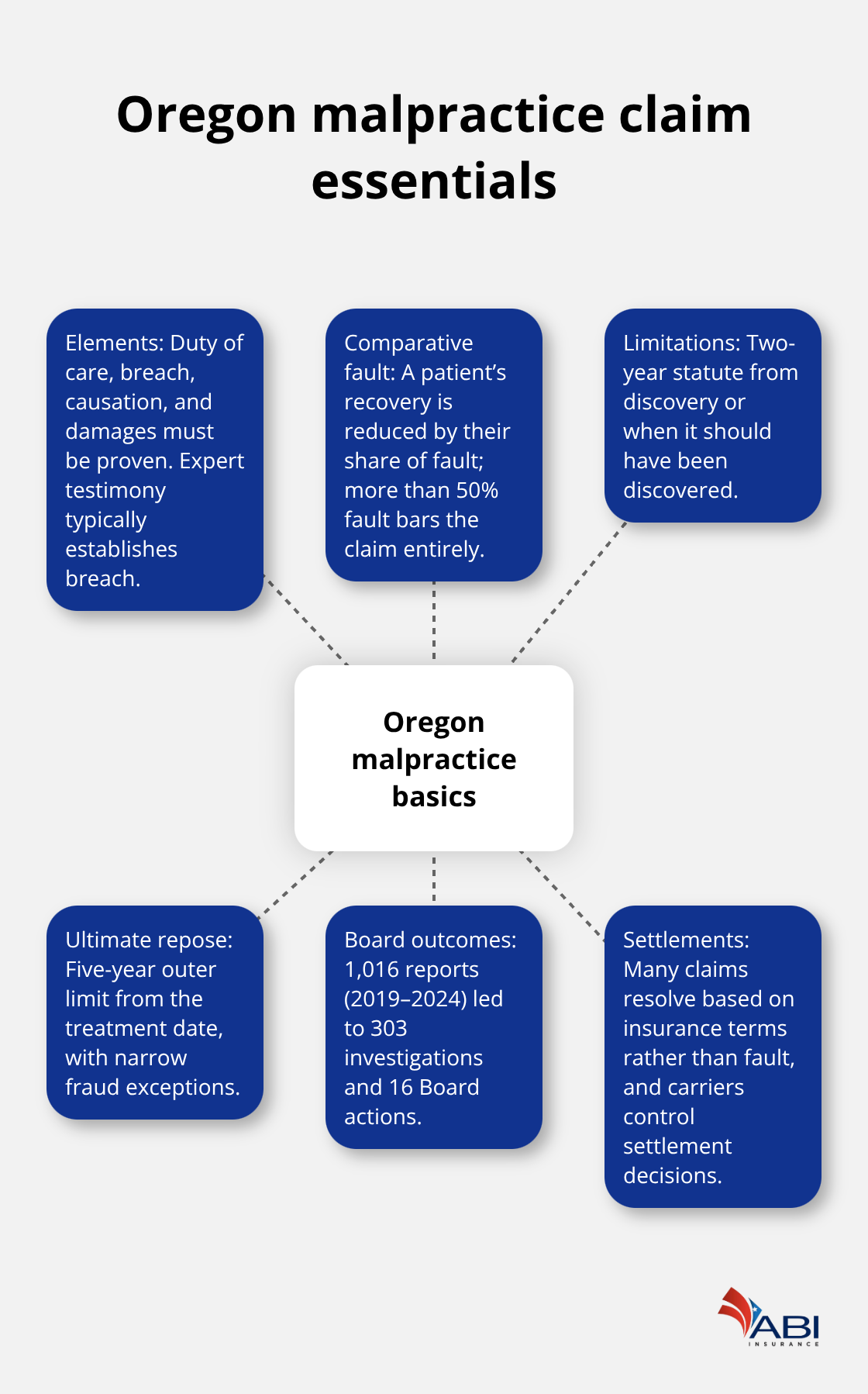
Understanding these legal standards helps you assess your exposure and select appropriate coverage limits before you face a claim.
Oregon-Specific Requirements and Regulations
No Mandatory Insurance, But Facilities Demand Coverage
Oregon does not mandate that physicians carry malpractice insurance. This distinction surprises many doctors — no state law forces you to buy coverage. However, credentialing requirements from hospitals, surgery centers, and health systems effectively make coverage mandatory if you want to practice in most clinical settings. Your employer or facility will demand specific coverage limits as a condition of employment or admitting privileges. Common minimums are $1 million per claim and $3 million aggregate, though some facilities demand $2 million per claim and $5 million aggregate. Before you accept any position, verify the exact coverage requirements in writing. Misunderstanding these requirements can leave you scrambling weeks before your start date or force you to pay substantially higher premiums to meet unexpected minimums.
How the Oregon Medical Board Treats Malpractice Claims
The Oregon Medical Board distinguishes between disciplinary actions and malpractice claims. From 2019 through 2024, the Board received 1,016 malpractice reports, but only 303 triggered investigations and just 16 resulted in actual Board action. This means most malpractice claims settle through insurance without any finding of wrongdoing or violation of the Medical Practice Act. Your insurer may settle a claim to avoid litigation costs even when you believe you delivered appropriate care. Understand this reality when you evaluate policy terms and defense provisions. The settlement decision rests with your carrier, not with you, so clarify your policy’s defense rights and settlement authority before a claim arises.
Tail Coverage: The Hidden Financial Trap
Tail coverage creates the biggest financial trap for Oregon physicians. If you carry a claims-made policy and later switch practices or retire, you must purchase tail coverage to protect against claims filed after you leave. Tail premiums typically cost 40 to 60 percent more than your final annual premium. For a $55,000 annual obstetrics premium, expect a $110,000 tail bill. Many physicians underestimate this cost during career planning. Some employers cover tail expenses when you leave, but others do not. Verify tail payment responsibility before you sign an employment contract. Occurrence policies eliminate tail obligations entirely but cost 40 to 60 percent more upfront, making them more expensive over time unless you plan to practice in a single location for decades.
Shopping Multiple Carriers Saves Significant Money
Shopping across multiple carriers via a broker can save 20 percent or more compared to direct shopping. The Portland metro market has contracted, with top carriers including The Doctors Company, MedPro Group, and CNA, all backed by strong AM Best ratings. A broker accesses quotes from all major Oregon insurers simultaneously, revealing price differences that direct shopping often misses. This approach takes the guesswork out of coverage selection and connects you with carriers that match your specialty and practice structure.

As you prepare to select your coverage, the next section walks you through the specific steps to assess your risk factors and compare policy options that fit your practice.
How to Choose the Right Coverage for Your Practice
Assess Your Clinical Settings and Exposure
Start by listing every clinical setting where you work. Many Oregon physicians practice across multiple locations — a hospital, an urgent care clinic, a surgical center — and each setting carries different liability exposure. Your hospital credentialing requirements may demand $2 million per claim and $5 million aggregate, while your urgent care employer accepts $1 million per claim and $3 million aggregate. You cannot use a single policy to satisfy both unless you purchase the higher limit. This matters because buying excess coverage you do not need inflates your premium unnecessarily, while buying insufficient coverage leaves you personally liable for damages above your policy limits.
Calculate your actual exposure by reviewing each employment contract or facility credentialing requirement in writing before you obtain quotes. Document these requirements alongside your specialty, patient volume, and procedure types. A family medicine physician seeing 20 patients daily faces different risk than an orthopedic surgeon performing complex joint replacements, and your quotes should reflect that specificity.
Understand How Defense Costs Affect Your Coverage
Next, understand how your policy structures defense costs. Some carriers include defense costs within your policy limits, meaning a $100,000 legal defense reduces your available damages coverage to $900,000 on a $1 million policy. Other carriers pay defense costs outside the limits entirely. This distinction dramatically affects your actual protection.
An obstetrics claim can incur $150,000 to $300,000 in legal fees alone before trial, so a policy that erodes your limits through defense spending provides false security. Request sample policies from each carrier and ask explicitly whether defense costs are inside or outside your liability limits. Medical malpractice insurance in Portland protects you against both the defense costs and the final judgment. Your policy structure must account for these realities.
Compare Deductibles and Premium Impact
When you compare deductibles, higher deductibles lower your premium but increase your out-of-pocket exposure if a claim arises. A $5,000 deductible saves roughly 5 to 10 percent annually, but you pay that amount from your own funds before coverage kicks in. Most Oregon physicians choose $2,500 to $5,000 deductibles as a reasonable balance between affordability and manageable risk.
Work with a Broker Who Represents Multiple Carriers
Talk directly with a broker who represents multiple carriers, not a captive agent tied to one insurer. A broker can show you side-by-side comparisons of policy structures, limits, deductibles, and tail obligations across The Doctors Company, MedPro Group, CNA, and other major carriers in the Portland metro market. Shopping across multiple carriers via a broker saves 20 percent or more compared to direct shopping.
The broker also understands facility-specific requirements and can guide you toward carriers that specialize in your specialty and practice structure. This approach removes the pressure of negotiating rates and terms yourself while ensuring you do not overpay for coverage you do not need.
Final Thoughts
Physician professional liability in Oregon demands a concrete plan that starts with your facility’s coverage requirements and extends through tail obligations before they become a financial crisis. Oregon physicians faced 94 malpractice payouts in 2023, averaging $748,909 each, and most claims settle through insurance rather than reflecting actual fault, yet your carrier controls the settlement decision, not you. This reality requires that you select coverage with strong defense provisions and limits matching your actual exposure across all clinical settings.
Your specialty, practice locations, and facility requirements determine the coverage you need (an obstetrics physician cannot use the same policy as a family medicine doctor, and a surgeon working across a hospital and an ambulatory surgery center faces different exposure than someone in a single clinic). Shopping multiple carriers via a broker reveals price differences of 20 percent or more compared to direct shopping and connects you with carriers that understand your specific risk profile. Tail coverage remains the most overlooked financial obligation. If you carry a claims-made policy, expect to pay 40 to 60 percent of your final annual premium as a tail bill when you leave.
Contact ABI Insurance to discuss your physician professional liability Oregon coverage needs and receive personalized quotes that reflect your specialty and practice structure. Our team understands the Portland metro market, the carriers that specialize in physician coverage, and the specific requirements that hospitals and surgery centers impose. Protecting your practice starts with the right conversation today.


 Beaverton Home Insurance Quotes: Finding the Right Policy