At ABI Insurance, we’ve seen homeowners save hundreds of dollars annually by taking advantage of Oregon homeowners insurance discounts they didn’t know existed. This guide walks you through the discounts available to you, the strategies that work, and how insurers calculate your rates.
Oregon Homeowners Insurance Discounts: Ways to Cut Premiums
Bundle Your Home and Auto Policies
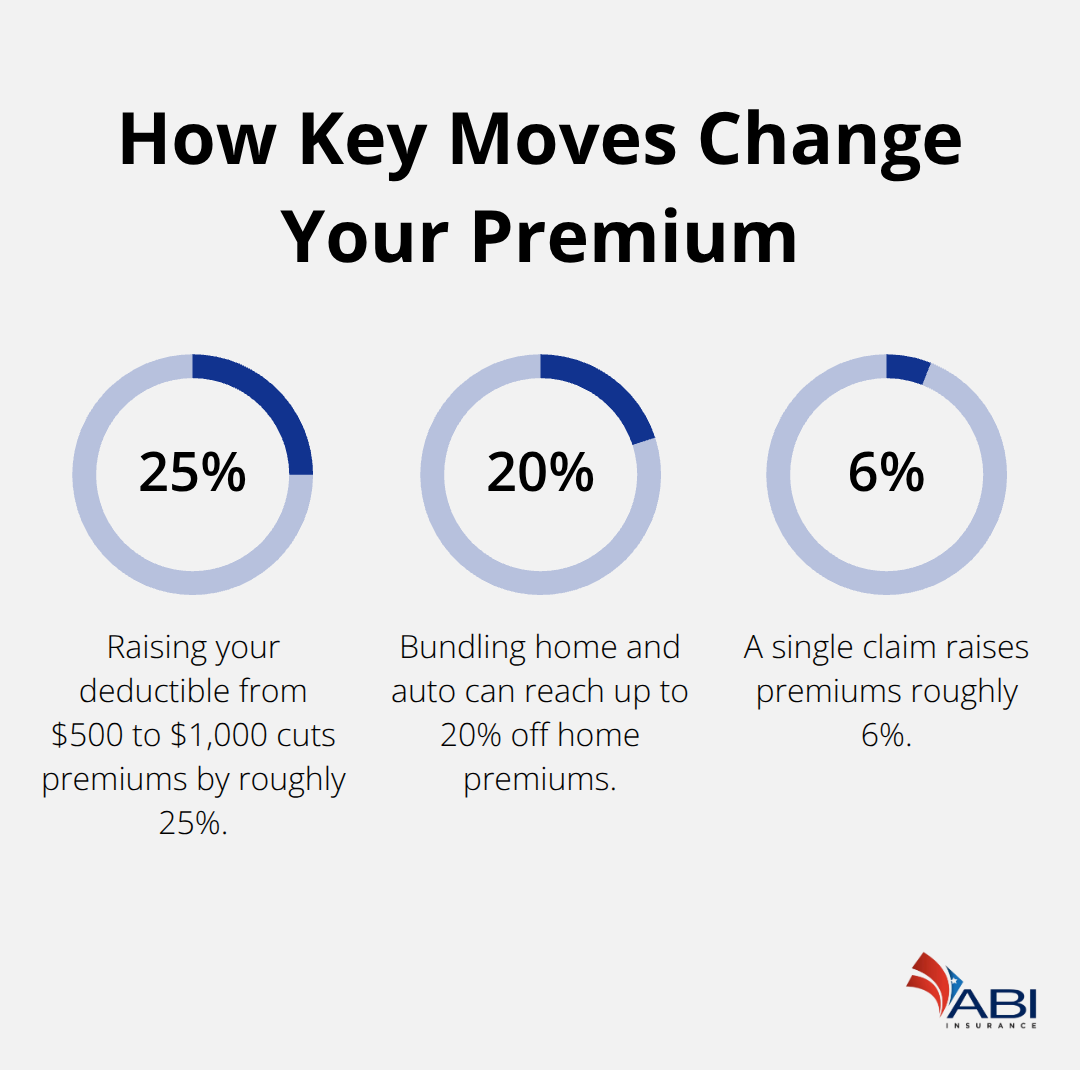
Bundling your home and auto policies stands as the single most effective way to cut your homeowners insurance costs in Oregon. The Hartford reports that bundling saves homeowners an average of $963, with discounts reaching up to 20% off home premiums when combined with auto coverage. This isn’t a minor reduction; it reshapes your annual budget. A homeowner paying $986 annually in Oregon (the state average according to Bankrate) could drop that to around $788 with a bundle discount. Many people assume they already have the best bundle rate, but shopping around can reveal otherwise.
Install Home Safety and Security Features
Home safety improvements deliver measurable premium reductions that compound over time. Installing a burglar alarm or monitored security system typically cuts premiums by around 5%, as well as fire sprinkler systems or monitored fire alarms. In Oregon, where wildfire risk drives underwriting decisions, these investments signal to insurers that you’ve taken risk seriously.
The Oregon Division of Financial Regulation notes that insurers are increasingly writing fewer policies in high-risk areas, so demonstrating defensible space and home-hardening improvements can mean the difference between getting coverage and facing nonrenewal. Document any improvements you make, including fire-resistant roofing, ember-resistant vents, cleared gutters-and share them with your agent during renewal.
Maintain a Claims-Free History
Claims-free history matters significantly for your rates. Staying claim-free for three consecutive years can reduce your deductible through programs like the Disappearing Deductible, which some insurers offer. Even a single claim raises premiums roughly 6% according to Bankrate, so avoiding small claims, when possible, protects your long-term rate. Loyalty to your insurer sometimes pays off through additional discounts for multi-year renewals without losses, though you should still shop every two to three years to confirm you’re not overpaying.
Your discount strategy works best when you combine multiple approaches. The next section reveals how insurers calculate your premium-understanding this process helps you identify which discounts matter most for your specific situation.
How to Cut Your Premium Without Cutting Coverage
Raising your deductible from $500 to $1,000 can cut premiums by roughly 25% according to the Insurance Information Institute. This strategy only works if you can actually cover that higher out-of-pocket cost when a claim happens. Oregon homeowners often overlook this lever because they focus on discounts instead of structural changes to their policy. The math is straightforward: a homeowner paying $986 annually could drop that to around $740 by increasing the deductible alone. However, this only makes sense if you have $1,000 sitting in an emergency fund. If you would struggle to pay that deductible after a loss, stick with the $500 option and find savings elsewhere.
Some insurers also offer a Disappearing Deductible program where your deductible shrinks for each year you go claim-free. This approach rewards you over time without forcing an immediate financial stretch.
Invest in Home Hardening and Defensible Space
Home-hardening improvements matter more in Oregon than most states because wildfire risk directly influences what insurers charge and whether they’ll renew your policy at all. Installing fire-resistant roofing, ember-resistant vents, or clearing 30 feet of defensible space around your home signals risk reduction to underwriters. The Insurance Institute for Business and Home Safety has established standards for these improvements, and the Oregon State Fire Marshal offers certificates when homeowners complete mitigation work that meets those standards.
You should document every improvement with photos and receipts, then share that documentation with your agent. Some insurers require defensible-space assessments before writing policies in high-risk areas, so demonstrating you’ve already done this work strengthens your application and can lower your rate.
Build Your Payment Reliability Record
Credit score impacts insurance premiums in Oregon, though the state restricts how heavily insurers can weight it compared to other states. About 30% of your credit score comes from credit utilization, so paying down balances before renewal helps more than most people realize. Paying your premium in full rather than monthly can unlock additional savings with some insurers.
Setting up autopay and staying current on all payments establishes reliability that insurers notice during underwriting. If your credit has gaps, use tools like Experian Boost to show on-time utility and phone payments to credit bureaus, which can improve your score over time. None of these moves deliver 20% discounts on their own but combined with a bundle discount and a safety feature discount, they compound into meaningful annual savings.
These structural changes to your policy and payment habits work alongside the discounts we covered earlier. The next section explains how insurers calculate your premium. Understanding this process helps you identify which adjustments matter most for your specific situation.
What Actually Determines Your Oregon Homeowners Insurance Rate
Insurance companies don’t pull premium numbers from thin air. Your rate reflects a mathematical model that weighs location risk, property characteristics, and your coverage choices. Understanding how insurers calculate premiums helps you identify which changes lower your costs.
Location Risk Shapes Your Premium Most
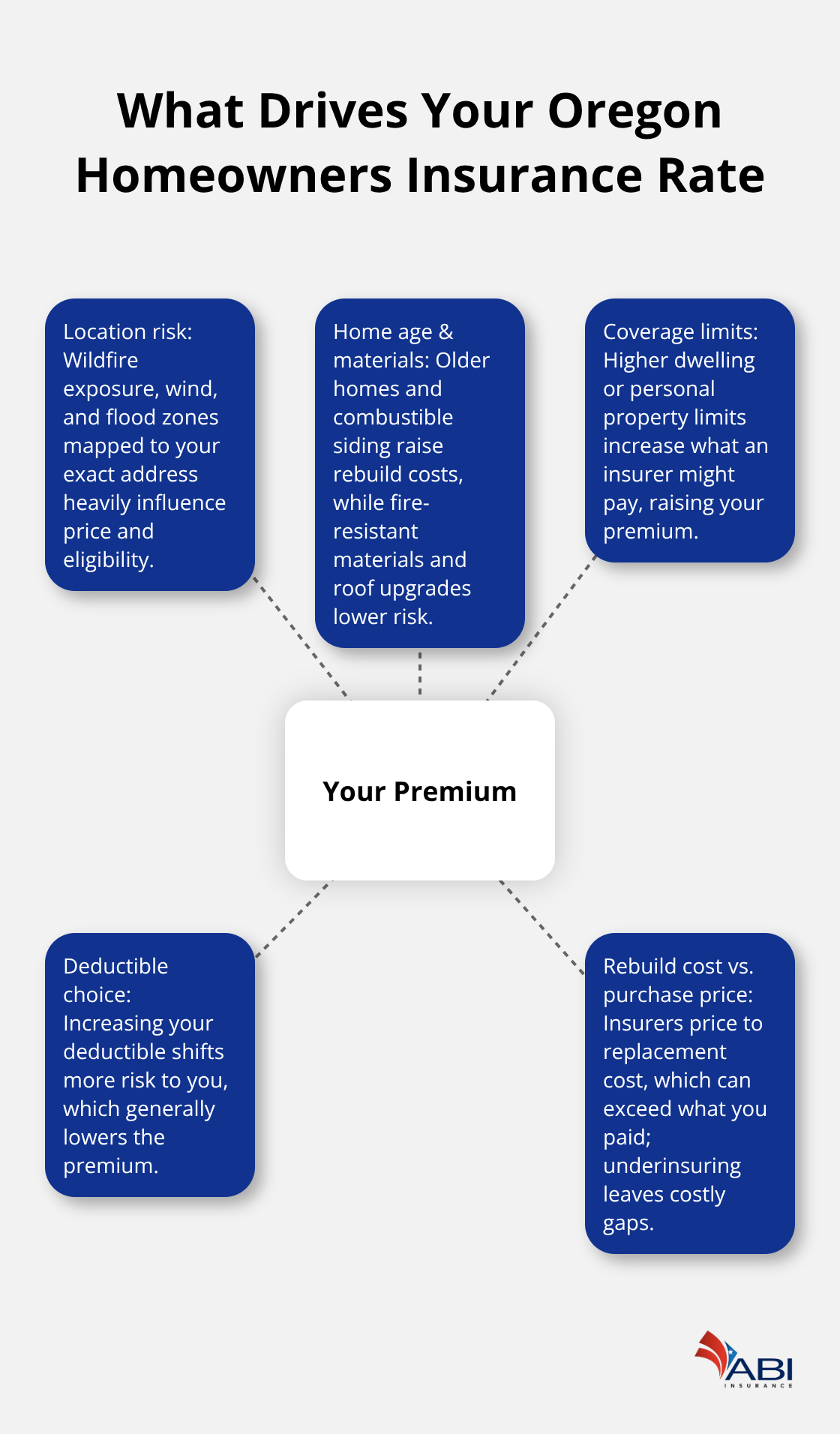
Location drives the biggest premium variation in Oregon. A home in a wildfire-prone area near forested regions pays substantially more than an identical home in a low-risk urban zone. Insurance companies start dropping Oregon homeowners’ policies and raising premiums to limit future losses based on wildfire risk exposure.
Insurers use catastrophe modeling software that maps historical fire patterns, wind exposure, and flood zones specific to your address. A house on the edge of a wildfire zone might see premiums 30% to 50% higher than the same property five miles away in a safer area. This isn’t arbitrary. Oregon wildfire losses since 2020 total nearly $3 billion, which directly shaped how insurers price risk today. Your zip code often determines whether you qualify for coverage at all or face nonrenewal.
Home Age and Construction Materials Affect Rebuilding Costs
Your home’s age and construction materials determine rebuilding costs and fire resistance. A 1970s home with wood siding costs more to insure than a 2015 home with fire-resistant materials because the older property takes longer and costs more to rebuild after a total loss. Insurers also factor in whether your roof is asphalt shingle (cheaper to replace) or metal (more expensive but fire-resistant).
The Oregon Division of Financial Regulation confirms that replacement cost, construction materials, and home age all influence premium calculations. A homeowner with a wood-frame house and old roof might qualify for lower rates simply by upgrading to impact-resistant shingles or metal roofing, which some insurers recognize during underwriting. These improvements signal reduced risk to underwriters.
Coverage Limits and Deductibles Control Your Premium
Coverage limits and deductible choices create the final layer of premium calculation. When you increase dwelling coverage from $300,000 to $400,000, you tell the insurer they’ll pay more in a total loss, so your premium rises proportionally. Your deductible works the opposite way. By raising it from $500 to $1,000 signals you’ll absorb more risk yourself, which lowers what insurers charge.
The Oregon Division of Financial Regulation notes that premiums reflect risk forecasts including coverage limits and deductible choices. What many Oregon homeowners miss is that your rebuilding costs often differs dramatically from your home’s purchase price. A house you bought for $450,000 might cost $600,000 to rebuild due to inflation in labor and materials since 2020. If you base dwelling coverage on purchase price instead of rebuilding costs, you’re underinsured and pay premiums that don’t match your actual replacement need.
Try multiplying your home’s square footage by local per-square-foot building costs, typically $150 to $250 in Oregon depending on construction quality and location. This number should guide your dwelling coverage limit. Insurers also cap valuables like jewelry, watches, and electronics at $1,500 to $2,500 under standard policies, so if you own items worth more, you’ll need to increase those limits separately, which adds small premiums but prevents massive gaps when you file a claim.
Final Thoughts
The path to lower Oregon homeowners insurance costs starts with understanding what moves your premium. Bundling your home and auto policies delivers the biggest immediate savings, typically around $963 annually, while home safety improvements like security systems and fire sprinkler installations compound those savings further. Maintaining a claims-free history protects your rate from creeping upward, and raising your deductible or improving your payment reliability adds additional leverage to your Oregon homeowners insurance discounts strategy.
Start by pulling your current policy and identifying which discounts you already receive. Many Oregon homeowners miss obvious savings simply because they never asked their agent about available programs. Request quotes that include bundling options, and ask specifically about discounts for home safety features, claims-free history, and payment methods.
If you face nonrenewal or premium increases that feel unjustified, request detailed reasons from your insurer. ABI Insurance helps Oregon families and businesses navigate these decisions with personalized guidance based on your specific property and risk profile, so reach out to discuss your options and get a personalized quote today, 503-292-1580.


 Insurance Claims: First Steps for Unit Owners