


Most people think liability protection ends with their homeowners or auto insurance. They’re wrong.
At ABI Insurance, we know that one serious accident can wipe out years of financial progress. An affordable personal umbrella policy fills the gaps your standard policies leave behind, protecting your assets when a lawsuit threatens everything you’ve built.
What a Personal Umbrella Policy Actually Covers
A personal umbrella policy is straightforward: it’s additional liability coverage that kicks in after your auto or homeowners policy limits are exhausted. Think of it as a financial safety net. For example, your standard auto policy might cover $500,000 in liability, but a serious accident could result in a $2 million judgment. With $2 million in umbrella coverage, your umbrella could cover the remaining $1.5 million. The policy protects you, your spouse, relatives living with you, and dependents named on your declarations.
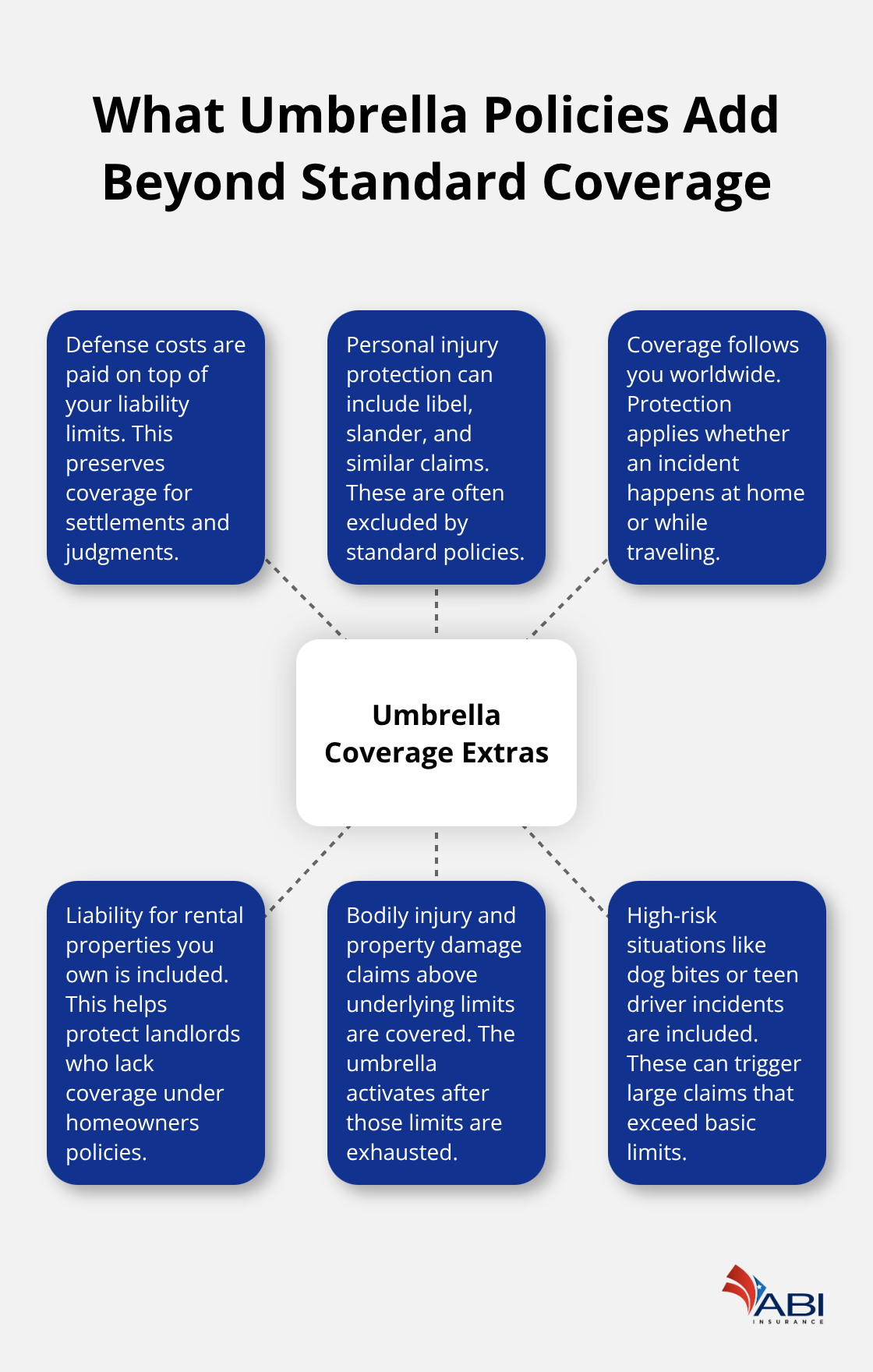
Coverage applies worldwide, so you receive protection whether the incident happens at home or while traveling internationally. One serious accident can exceed standard policy limits quickly, and an affordable umbrella policy prevents financial devastation.
How Much Coverage Actually Costs
Starting at around $300 to $500 annually for $1 million in coverage, umbrella policies offer remarkable value. Each additional $1 million typically costs less than the first, making higher limits surprisingly affordable. A $2 million policy might cost only $600 to $700 per year, roughly $2 per day for substantial extra protection. Most people start with $1 million and increase from there based on their assets and risk exposure. The affordability factor removes the excuse of cost. Bundling umbrella coverage with your auto and homeowners policies from the same insurer often yields additional discounts, further reducing your overall insurance expense.
What Umbrella Covers That Your Other Policies Don’t
Your homeowners and auto policies have narrow liability coverage. An umbrella policy fills those gaps for bodily injury and property damage claims, plus personal injury coverage such as libel or slander. It also covers defense costs and attorney fees on top of your policy limits, not carved out of them. Legal defense in serious cases can cost hundreds of thousands of dollars, which makes this distinction enormously important. Umbrella coverage applies to accidents on your property, dog bites, teen driver incidents, and even online defamation claims. Critically, it covers rental properties you own. Your standard homeowners policy doesn’t extend to liability for rental units, leaving landlords dangerously exposed. An umbrella policy protects against that exposure.
Who Needs Umbrella Protection
You might think umbrella insurance only matters if you’re wealthy. That’s incorrect. Anyone with assets — a home, savings, retirement accounts, or future income — faces exposure to catastrophic liability claims. A lawsuit can attach your wages and bank accounts for years. A judgment can force you to sell property or liquidate investments. Umbrella insurance protects what you’ve built and what you’ll earn tomorrow. Homeowners, renters, landlords, and anyone who hosts others on their property should consider this coverage. The low cost means almost everyone can afford the protection.
Worldwide Protection and Additional Coverage
Umbrella policies extend protection across borders. Whether you travel internationally or own property abroad, your coverage travels with you. This global reach matters because liability doesn’t stop at the U.S. border. The policy also covers scenarios your standard policies exclude entirely. Personal injury coverage includes false arrest, malicious prosecution, wrongful eviction, and wrongful entry, claims that can arise unexpectedly. Defense costs and attorney fees stack on top of your coverage limits, not within them. This means your umbrella pays for legal representation while your policy limit remains available for settlements or judgments.
Determining Your Coverage Amount
Assessing your liability exposure requires an honest inventory of your assets and income potential. Add your home value, vehicles, savings, investments, and retirement accounts (though ERISA-protected 401(k)s typically receive credit or protection). Consider your future earning potential over the next 20 or 30 years. Most people start with $1 million in umbrella coverage, but higher net worth or significant assets warrant $2 million to $5 million. Your insurer can help you evaluate your specific situation and recommend appropriate limits. The next step involves comparing quotes and understanding which policies align with your protection needs.
Why Umbrella Coverage Matters
One lawsuit can cost more than what your homeowners and auto policies combined will pay. We’ve seen clients face $1.5 million judgments when their standard liability coverage maxed out at $500,000. That gap doesn’t disappear. It attaches to your wages, your bank accounts, and potentially forces the sale of assets you’ve spent decades building. Umbrella coverage activates exactly when you need it most, covering the amount between what your underlying policies pay and what a court orders you to pay. A serious car accident, a guest who gets injured on your property, or a dog bite that requires extensive medical treatment can trigger claims that dwarf standard policy limits. The financial exposure is real and immediate, not theoretical.
When Standard Coverage Falls Short
Your homeowners policy typically covers $300,000 in liability. Your auto policy might cover $500,000. Together, that’s $800,000 of protection against an increasingly litigious environment. Medical costs for severe injuries now routinely exceed $1 million. A permanent disability claim can reach $3 million or more when courts factor in lost wages, pain and suffering, and future care costs. Umbrella policies start at $1 million and extend to $5 million in $1 million increments, filling gaps that standard policies leave wide open. The policy also covers defense costs and attorney fees separately from your coverage limit, meaning legal representation doesn’t eat into the money available for settlements. Without umbrella protection, you remain personally liable for everything above your standard policy limits.
How Judgments Attack Your Income
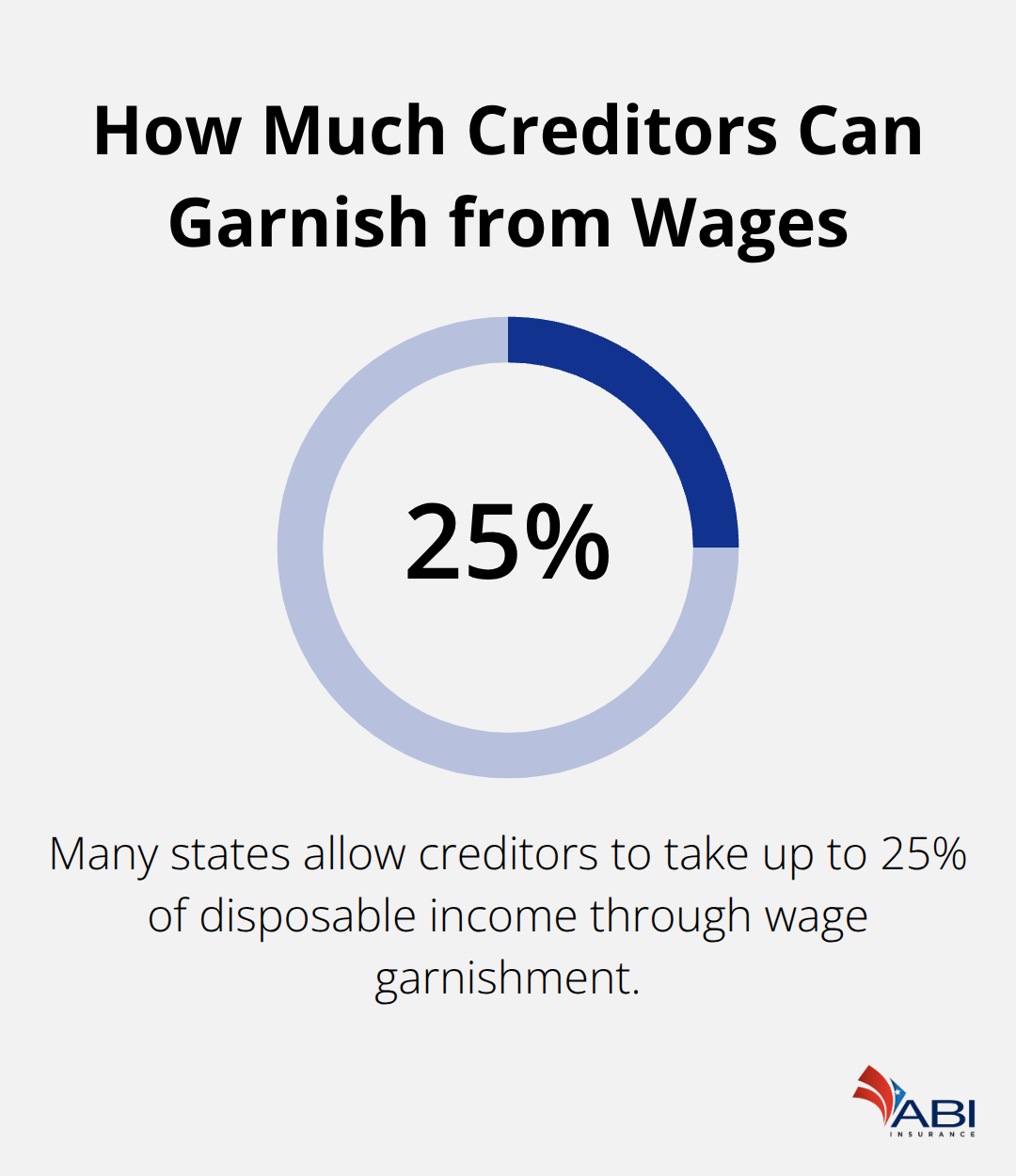
A judgment creditor can pursue your paycheck for years. Wage garnishment laws vary by state, but many allow creditors to take up to 25 percent of disposable income. A $2 million judgment spread across your earnings over 10 years means losing thousands of dollars from your paycheck each month.
Bank accounts could be frozen and emptied through levy proceedings. Investment accounts face the same exposure. Umbrella insurance stops this financial bleeding (and protects your future earnings) by covering liability and preventing judgment from attaching your personal assets in the first place. $300 to $500 annually for $1 million in coverage becomes insignificant compared to protecting decades of earnings and savings from creditor claims.
Why Your Assets Remain Vulnerable
Courts can order the sale of your home to satisfy a judgment. Investment portfolios, vehicles, and other property become fair game for credit collection. State homestead exemptions provide some protection (some states protect up to $1 million in home equity), but most people’s assets exceed these thresholds. Umbrella coverage prevents creditors from reaching your assets in the first place, which proves far more effective than relying on exemptions that vary widely by state and may not cover everything you own. The policy acts as a shield between you and the financial consequences of a major liability claim, protecting what you’ve built and what you’ll earn in the future.
The Real Cost of Remaining Unprotected
Skipping umbrella coverage to save a few hundred dollars annually exposes you to catastrophic financial risk. A single incident can wipe out your savings, force the sale of your home, and attach your wages for years. The math is straightforward: $300 to $500 per year for $1 million in protection costs roughly $2 per day. Most people spend more on coffee. The affordability of umbrella policies removes the primary objection to purchasing coverage. Higher limits ($2 million to $5 million) remain affordable, with each additional $1 million costing less than the first. This pricing structure means you can obtain substantial protection without straining your budget. The question shifts from whether you can afford umbrella coverage to whether you can afford to remain without it.
How to Choose the Right Umbrella Policy for Your Needs
Calculate Your Total Asset Exposure
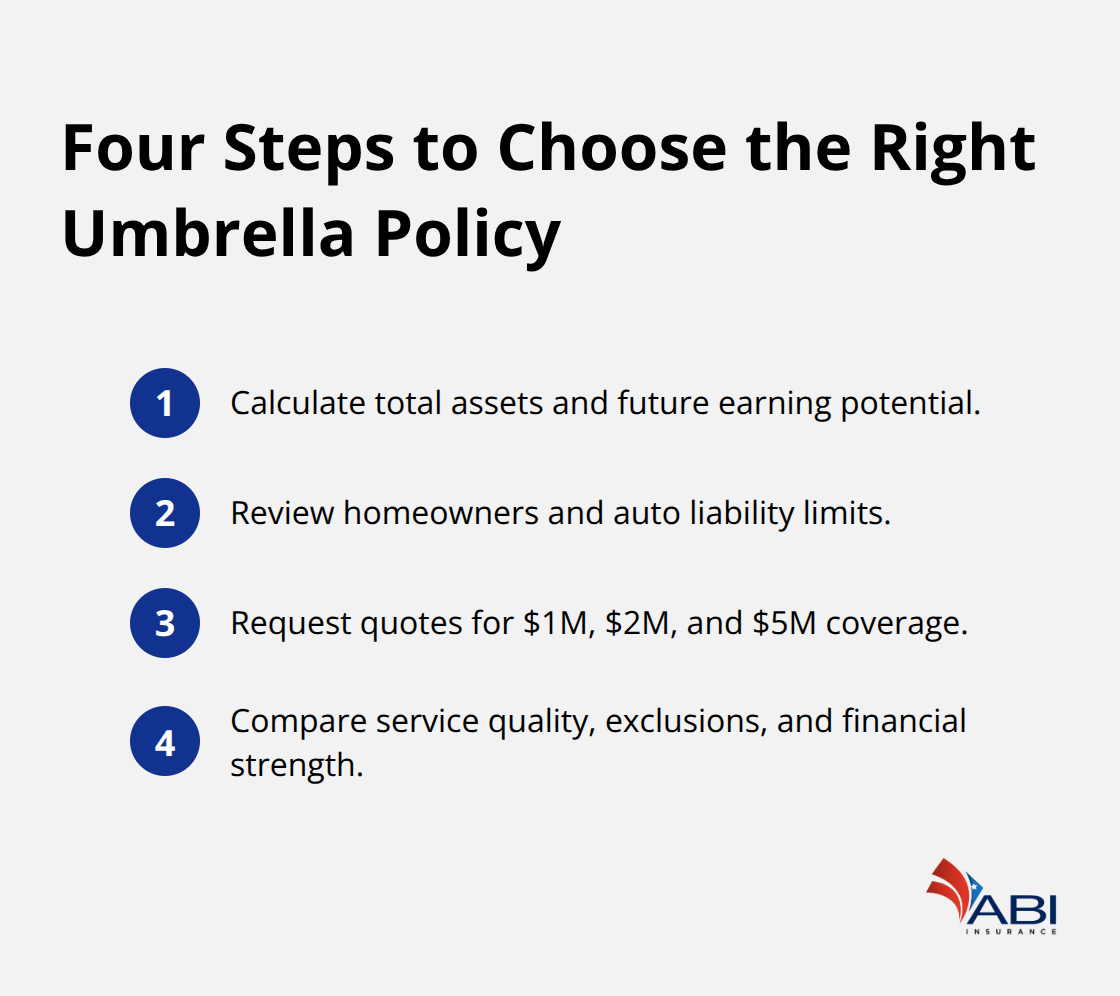
Start with a complete inventory of your assets and income. List your home value, vehicle values, savings accounts, investment portfolios, and retirement accounts. Then calculate your annual income and multiply it by the years until retirement. This represents your future earning potential that creditors can pursue.
ERISA-protected 401(k)s typically receive creditor protection, so exclude those from your calculation. IRAs vary by state law, so check your state’s rules before deciding. Add everything together to find your total exposure if a major liability claim hits.
Most people discover their net worth exceeds $1 million far more than they realized. Carry coverage at least equal to your net worth, preferably more. If you’re worth $1.5 million, consider a $2 million policy. Worth $3 million? Try $2 million to $5 million as the realistic floor for most homeowners, especially those with rental properties or significant assets. The cost difference between $1 million and $5 million coverage runs roughly $200 to $300 annually, trivial compared to the protection gap you’d eliminate.
Review Your Current Policy Limits
Pull your homeowners and auto policy declarations pages right now. Write down your liability limits. Most homeowners policies top out at $300,000 per occurrence. Most auto policies max out at $500,000 per accident. Add those together, and you have your total underlying coverage. Now ask yourself: is that enough if someone suffers permanent disability from an accident on your property?
Medical costs for catastrophic injuries routinely exceed $2 million. Courts award damages for pain and suffering that can double or triple medical costs. Your underlying policies won’t come close. This is where umbrella coverage becomes non-negotiable, not optional. The umbrella activates only after your underlying policies exhaust their limits, so you need those underlying policies in place first. Most insurers require minimum underlying coverage before selling umbrella policies. Typically, $250,000 per person and $500,000 per accident for auto, plus $300,000 per occurrence for homeowners. Check whether your current coverage meets these minimums. If not, increase your underlying limits first. This two-step approach (stronger underlying coverage plus umbrella protection) creates genuine financial security.
Request and Compare Multiple Quotes
Contact ABI Insurance for umbrella quotes. Request quotes for $1 million, $2 million, and $5 million in coverage to compare how costs scale. Pay attention to deductibles (typically $0 to $2,500) and ask whether defense costs and attorney fees stack on top of your coverage limit or come out of it. This distinction matters enormously. A policy that pays defense costs separately from your limit provides far better protection than one that carves legal fees out of your coverage.
Ask about discounts for bundling umbrella with auto and homeowners policies. Bundling typically saves 10 to 25 percent on premiums across all policies. Ask whether the insurer offers the same renewal dates for all your policies. Gaps between renewal dates create coverage gaps. Verify that the insurer is licensed in your state and check their financial ratings through A.M. Best. A company rated A or higher has the financial strength to pay large claims.
Evaluate Service Quality and Policy Details
When comparing quotes, don’t just look at prices. Examine the insurer’s online policy management tools, claims process, and customer service reputation. You want to work with someone responsive when a claim happens. Request sample policy documents and read the exclusions carefully. Business activities, intentional harm, and written contracts are commonly excluded. If you operate a home business or serve on a nonprofit board, ask about supplemental coverage, Errors and Omissions insurance that complements your umbrella policy.
Final Thoughts
An affordable personal umbrella policy protects everything you’ve built for roughly $2 per day. At $300 to $500 annually for $1 million in coverage, umbrella insurance shields your home, savings, investments, and future income from catastrophic liability claims that standard policies won’t cover. One serious accident can trigger a judgment exceeding your standard policy limits by millions of dollars, but umbrella coverage activates exactly when you need it most.
Review your homeowners and auto policy declarations pages and verify your current liability limits right now. Calculate your total assets and future earning potential to determine appropriate umbrella coverage, then request quotes for $1 million, $2 million, and $5 million in coverage. Ask about bundling discounts when you combine umbrella coverage with your existing auto and homeowners policies. This approach typically reduces your overall premium significantly.
We at ABI Insurance help families and businesses across the Portland metro area and Western U.S. protect their assets through comprehensive coverage solutions. Contact us to discuss your specific situation and find the umbrella policy that fits your needs and your budget.


 Commercial Vehicle Insurance Requirements: Stay Compliant and Covered









