


Oregon physicians face real risks in their daily practice. Diagnostic errors, surgical mistakes, and medication mishaps can lead to costly lawsuits that threaten both your career and personal finances.
Doctor medical liability insurance isn’t optional; it is a necessity. We at ABI Insurance understand the specific challenges Oregon doctors encounter, and we’re here to help you find coverage that truly protects your practice.
What Errors Cost Oregon Doctors Most
Diagnostic Failures Drive the Highest Payouts
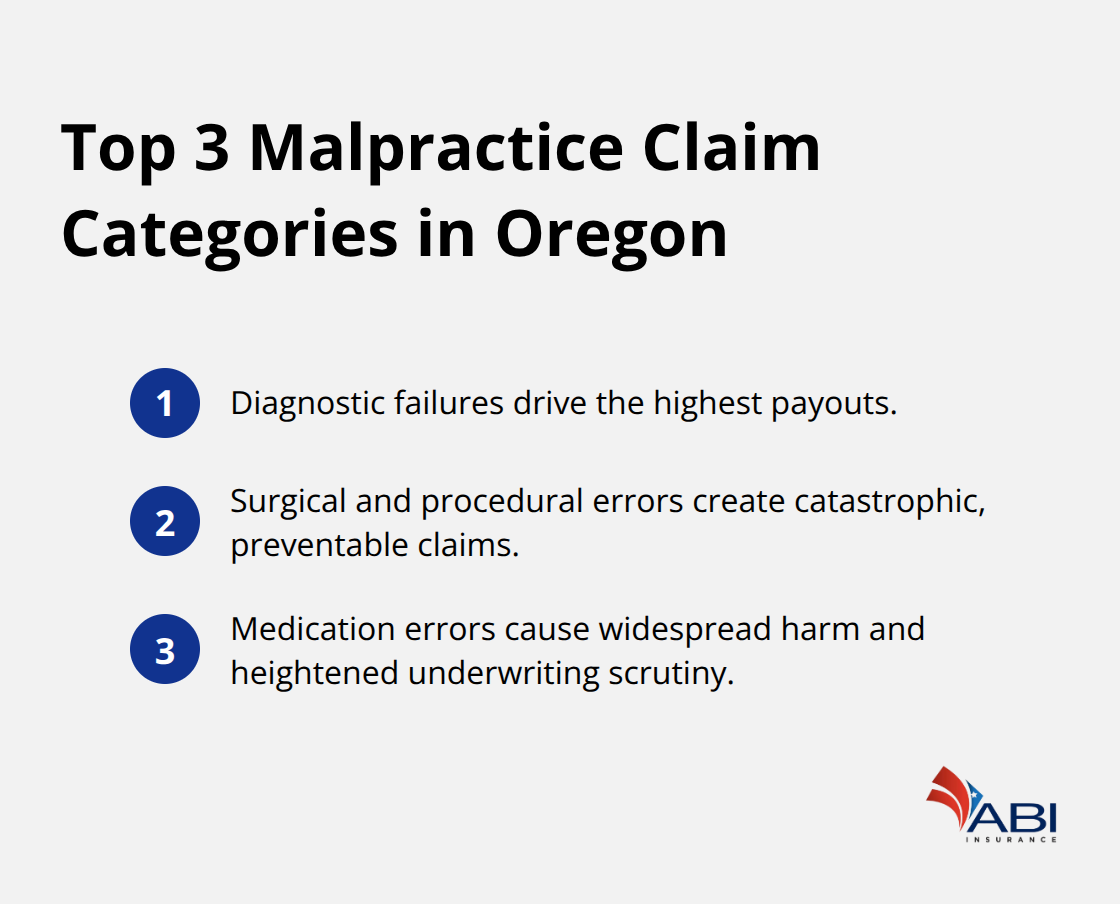
Misdiagnosis and delayed diagnosis remain the leading drivers of malpractice claims against Oregon physicians. According to the National Practitioner Data Bank, Oregon has recorded medical malpractice payouts in recent years, with cases that generate the highest payouts. Typically, these involve diagnostic failures because harm compounds over time — a patient’s condition worsens, treatment is delayed, and the injury becomes more severe. These aren’t edge cases or rare mishaps. They happen in routine clinical settings when a physician orders the wrong test, misinterprets imaging results, or fails to recognize red flags in patient history.
The financial exposure is staggering, but the career damage cuts deeper. A single diagnostic error can trigger peer review scrutiny, credentialing questions, and premium increases that follow you for years.
Surgical Mistakes and Procedural Errors
Surgical mistakes and procedural errors carry similarly high stakes. Wrong-site surgery, retained surgical instruments, and improper technique during procedures generate catastrophic claims because they represent clear deviations from standard of care. These errors are largely preventable through systematic verification protocols and careful team communication, yet they still occur frequently enough to be a primary underwriting concern for insurers.
Medication Errors and Their Ripple Effects
Medication errors, including the wrong drug, incorrect dose, and dangerous interactions, round out the top three claim categories. A pharmacy error or a prescribing mistake can harm multiple patients and expose a practice to mass-tort exposure, which explains why malpractice carriers scrutinize medication management practices closely when evaluating coverage.
How Claims Settle in Oregon
The Oregon Medical Board received 1,016 malpractice reports between 2019 and 2024. It appears most claims settle through insurance rather than disciplinary proceedings. Your insurer’s defense rights and settlement authority matter more than many physicians realize. If your policy gives the insurer unilateral control over settlement decisions, you could face a resolution that damages your professional reputation, even if the insurer minimizes its financial exposure.
Understanding your policy’s defense provisions and negotiating settlement protections upfront is not optional; it is a core component of adequate coverage. The type of policy you select, and the specific terms it contains, will determine how much control you retain when a claim arises.
Coverage Options and Policy Features
Claims-Made Policies: Lower Upfront Costs, Hidden Tail Expenses
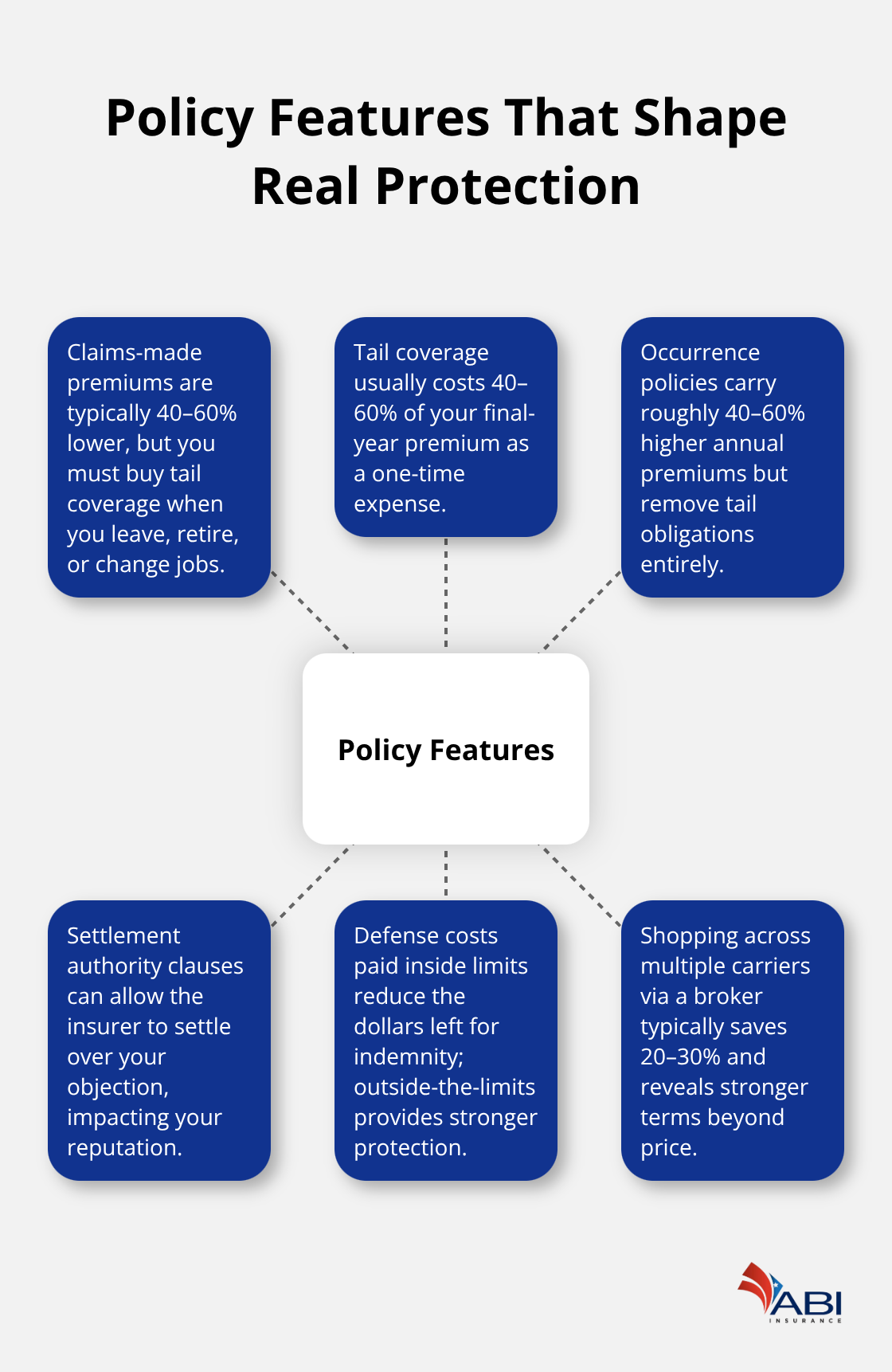
Claims-made policies cost significantly less upfront than occurrence policies, typically 40 to 60% lower in annual premium. The trade-off is substantial: when you leave a practice, retire, or change jobs, you must purchase tail coverage to protect against claims filed after your policy ends. Tail coverage typically costs 40 to 60% of your final-year premium as a one-time expense.
An Oregon family physician paying $7,000 annually on a claims-made policy might face a $14,000 tail bill at retirement. An OB/GYN with major surgery exposure paying $55,000 yearly could owe $110,000 for tail protection. These costs catch many physicians off guard because they focus only on monthly or annual premiums when comparing quotes.
Occurrence Policies: Higher Premiums, Complete Peace of Mind
Occurrence policies eliminate tail obligations since they cover incidents that occur during the policy period regardless of when a claim is filed later. You pay more upfront, roughly 40 to 60% higher annual premiums, but you gain certainty about total lifetime costs. If you plan to practice in one Oregon location for decades, an occurrence policy removes financial uncertainty at career transitions.
If you’re early in your career or you expect to move between practices, a claims-made policy with careful tail planning may serve you better financially. The choice depends on your long-term career trajectory, not just the lowest annual premium.
Defense Rights and Settlement Control Shape Real Protection
Your policy’s defense provisions determine who controls settlement decisions when a claim arises. Many carriers retain unilateral settlement authority, meaning the insurer can settle a case against your objections if settlement costs less than defending the claim. Oregon’s Medical Board data shows most claims settle through insurance rather than Board discipline, so this control matters in practice.
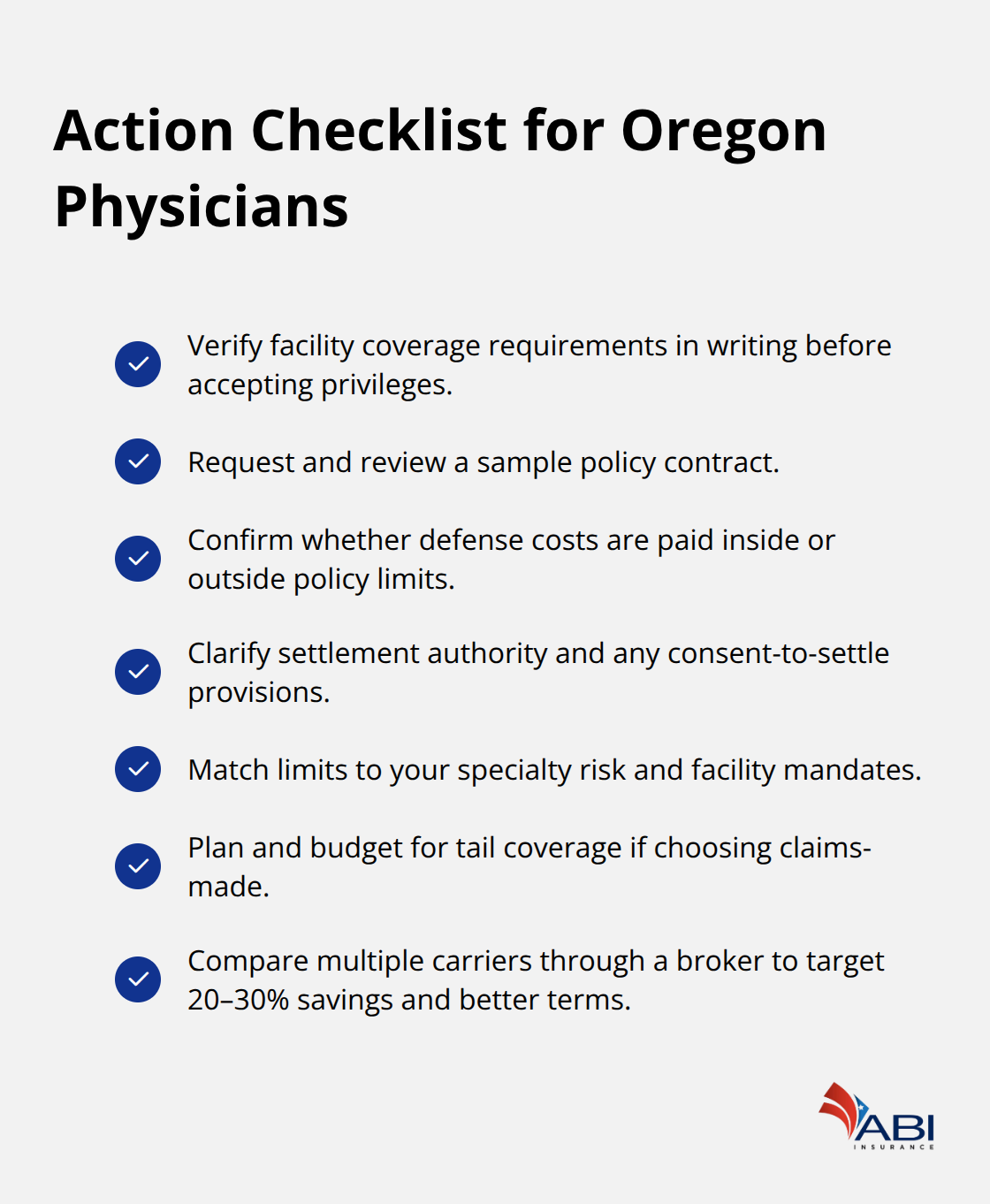
Before signing any policy, request a sample contract and verify whether defense costs paid inside versus outside policy limits affects your coverage. A $1 million policy with defense costs paid inside the limits provides less actual protection than one where defense fees sit outside.
Matching Coverage Limits to Facility Requirements
Standard Oregon credentialing requirements typically demand $1 million per claim and $3 million aggregate coverage, but high-risk facilities may require $2 million per claim and $5 million aggregate. Verify your specific facility’s written requirements before accepting employment, because a mismatch between your coverage and facility mandates can jeopardize your privileges.
Shopping across multiple carriers via a broker yields roughly 20 to 30% savings compared with direct quotes from a single insurer. An experienced broker ensures you compare coverage options and settlement authority rather than focus on premium differences. This comparison process reveals which policies protect your interests when claims arise, not just which ones cost least today.
Why Oregon Physicians Face Unique Liability Pressure
Oregon’s Legal Timeline Creates Extended Risk Exposure
Oregon statutes impose a two-year statute of limitations from discovery of injury, with a five-year ultimate repose from the date of treatment. This window is narrower than in many states. Claims can surface years after an incident occurred, catching physicians unprepared if they lack proper tail coverage or have gaps in their policy history. The National Practitioner Data Bank recorded 94 medical malpractice payouts in Oregon during 2023 totaling $70,397,500, with an average payout of $748,909 per claim. These figures reveal that Oregon physicians face genuine financial exposure, not theoretical risk.
The True Cost of a Single Claim
A single claim can exceed $700,000 in damages, and that payout represents only the settlement or judgment amount. Defense costs your insurer pays to fight the claim can run $100,000 to $300,000 or more, depending on claim complexity and litigation duration.
Without adequate coverage, these costs directly threaten your personal assets, retirement savings, and ability to continue practicing in Oregon.
Unlimited Damages and Asset Vulnerability
Your personal and professional assets sit unprotected if your malpractice insurance limits fall short of actual exposure. Oregon law caps non-economic damages to $500,000 in some personal injury claims, though the Oregon Supreme Court has held that this cap is unconstitutional. Economic damages have no ceiling. A high-profile surgical error or birth injury claim can generate verdicts that dwarf standard $1 million per claim limits, leaving you personally liable for the excess.
Credentialing Requirements Vary by Specialty and Facility
Hospital and clinic credentialing requirements typically mandate $1 million per claim and $3 million aggregate coverage, but that baseline assumes routine internal medicine or family practice risk. High-risk specialties like obstetrics, major surgery, and emergency medicine face credentialing demands of $2 million per claim and $5 million aggregate at many Oregon facilities. If you accept a position without verifying in writing that your coverage matches facility requirements, you risk losing privileges mid-year when credentialing audits reveal gaps.
Claims Settle Through Insurance, Not Board Discipline
The Oregon Medical Board received 1,016 malpractice reports between 2019 and 2024. Some claims resolve through insurance settlements, not disciplinary processes. Your coverage limits and defense rights determine whether you retain professional autonomy when a claim surfaces or whether your insurer’s financial interests override your reputation. Shopping across multiple carriers via a broker typically yields 20 to 30% savings compared with direct quotes. This comparison process exposes which policies protect your settlement rights versus which ones merely appear affordable on the surface.
Final Thoughts
Medical liability insurance forms the foundation of a sustainable practice for Oregon physicians. The data supports this reality: Oregon recorded 94 malpractice payouts in 2023, averaging $748,909 each, and most claims settle through insurance rather than Board discipline. Your coverage limits, defense rights, and policy type determine whether you retain control when a claim surfaces or whether financial pressure forces an unfavorable resolution.
Selecting the right doctor medical liability insurance requires matching your coverage to three concrete factors: your specialty’s actual risk profile, your facility’s written credentialing requirements, and your long-term career plans. An OB/GYN needs different limits than a family physician, and a surgeon moving between hospitals faces different tail obligations than someone who stays in one practice for decades. Shopping across multiple carriers via a broker typically yields 20 to 30% savings. Single-insurer quotes generally expose policies that protect your settlement rights.
ABI Insurance has spent over 40 years helping Oregon medical professionals navigate these decisions with personalized guidance. Our team understands Oregon’s specific legal environment, facility requirements, and specialty-driven risk profiles, and we represent multiple major carriers so we can show you side-by-side comparisons of limits, deductibles, tail obligations, and defense provisions tailored to your practice structure. Contact ABI Insurance today for a comprehensive medical liability insurance consultation that matches your actual exposure and long-term goals.


 Affordable Personal Umbrella Policy: Big Protection, Small Price









