Condo ownership in Portland comes with unique insurance challenges that many owners overlook. Your association’s master policy covers the building structure and common areas, but it leaves significant gaps in your personal protection.
At ABI Insurance, we’ve helped countless Portland condo owners understand exactly what they need to protect their investment. This guide walks you through what your association covers, why individual coverage matters, and how to find the right policy for your situation.
What Your Association’s Master Policy Actually Covers
Your condo association’s master policy forms the foundation of building protection in Portland, but most owners misunderstand what it actually covers. The master policy protects the building’s structural elements and common areas. The roof, exterior walls, lobbies, stairways, elevators, parking areas, and shared mechanical systems like plumbing and HVAC that serve multiple units. According to the Insurance Information Institute, this coverage includes property damage from fire, severe weather, vandalism, and burst pipes affecting shared infrastructure. The policy also provides liability protection if someone is injured in a common area and the association is found responsible.
Three Master Policy Forms Shape Your Coverage
Your association’s bylaws determine whether the master policy is a Bare Walls policy (exterior and common areas only), a Walls-In policy (some interior unit elements like original flooring and cabinets), or an All-In policy (including owner improvements). Request your association’s master policy declaration and summary from the HOA board immediately. This document tells you exactly which form applies and what deductible the association carries. That deductible matters because if a covered loss exceeds the master policy limits or triggers the deductible, the association can assess unit owners for their share of the cost. This is where loss assessment coverage in your individual HO6 policy becomes valuable, protecting you from special assessments that can reach thousands of dollars.
The Deductible Creates Hidden Costs
The master policy deductible typically ranges from $5,000 to $25,000 or more, and this is often the biggest surprise for owners during a claim. If a fire damages the roof and the deductible is $15,000, the association must cover that amount before insurance pays anything. If the association’s reserves are weak, unit owners face a special assessment to cover the gap. Ask your HOA board for the exact deductible amount and request historical records showing whether assessments were triggered in the past five years. This information directly affects how much loss assessment coverage you need in your individual policy.
Critical Coverage Gaps You Must Address
Personal property inside your unit is never covered by the master policy. Your furniture, electronics, clothing, and belongings are entirely your responsibility. The master policy also excludes liability for injuries that occur inside individual units, so if a guest slips in your kitchen, you need your own liability protection. Flood damage is excluded unless the association specifically added a flood endorsement, and standard master policies do not include earthquake coverage.
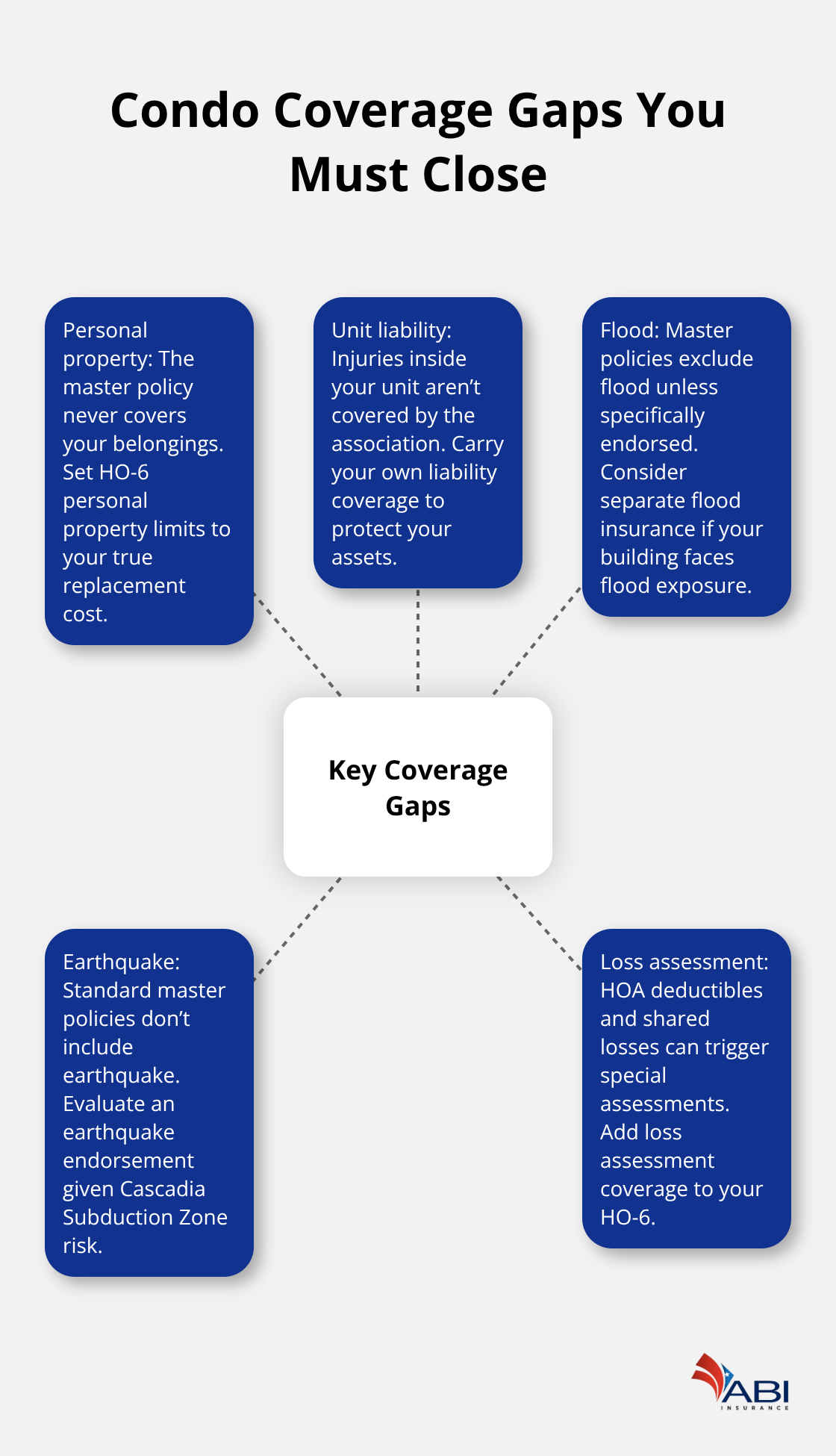
In Portland, where the Willamette River flood risk is real and the Cascadia Subduction Zone poses seismic threats, these gaps create serious exposure that many owners ignore until it’s too late.
These gaps in your association’s master policy are exactly why individual condo coverage matters so much for Portland owners.
Why You Need Your Own Condo Insurance
The master policy gap is real, and it hits Portland condo owners hard when claims happen. Your association’s insurance stops at the building envelope and common areas, leaving your personal world completely unprotected. Interior finishes you’ve upgraded, your furniture, electronics, and clothing inside the unit belong entirely to you under your own policy. The Insurance Information Institute reports that standard master policies do not cover personal property, period. If a pipe bursts in your unit and destroys your sofa and TV, the association’s policy won’t pay a dime. You’ll be out thousands of dollars unless you carry your own HO6 coverage with adequate personal property limits.
Personal Property Coverage Protects What Matters Most
Most Portland condo owners carry around $60,000 in personal property coverage, but if you’ve renovated your interior or own high-value items like jewelry or art, that limit often falls short. A typical laptop costs $1,000 to $2,000, kitchen appliances add another $3,000 to $5,000, and a modest furniture set easily reaches $8,000. Your personal property limit disappears fast. Before you buy a policy, calculate accurate replacement cost estimates for your belongings. This step prevents you from underinsuring and facing out-of-pocket losses when a covered event strikes.
Liability Coverage Fills a Critical Gap
The liability exposure inside your unit is equally serious and often overlooked. If a guest slips on your kitchen floor and breaks their leg, your association’s master policy provides zero liability protection for that incident. You need your own liability coverage, and the standard $300,000 limit that many Portland owners carry may not be enough depending on your assets and risk profile. The Insurance Information Institute suggests starting liability protection at $300,000 to $500,000 and adjusting upward if you own a home, have significant savings, or have higher net worth.
Loss Assessment Coverage Protects Against Special Assessments
Oregon condo insurance includes loss assessment coverage. This coverage protects you from special assessments when the HOA deductible triggers or when shared losses exceed master policy limits. Be sure to check the limit. You may need to increase it. With master policy deductibles ranging from $5,000 to $25,000 or more in Portland buildings, loss assessment coverage typically costs only $50 to $100 per year and has prevented many owners from facing special assessments after major claims.
Water Damage and Sewer Backup Endorsements Matter in Portland
Water damage and sewer backup endorsements are essential in Portland due to heavy rainfall and aging stormwater infrastructure. These endorsements add roughly $75 to $150 annually but protect you from thousands in cleanup costs. Without your own HO6 policy layered on top of the master policy, you’re betting your personal finances on the association’s coverage limits and deductible structure. This bet fails regularly in Portland claims, which is why the next step involves reviewing your association’s specific master policy to identify exactly what gaps exist in your building.
Shopping for the Right Coverage in Portland
Obtain Your Association’s Complete Master Policy
Start with your association’s complete master policy declaration and summary from the HOA board, not a partial version, but the full document with all endorsements and exclusions listed. This step is non-negotiable. Many Portland condo owners skip it and later discover their association carries a $20,000 deductible or lacks flood coverage entirely. Once you have the master policy in hand, you know exactly what the association covers and what deductible triggers special assessments. This foundation prevents costly surprises during claims.
Calculate Your Personal Property and Improvements
Cross-reference the master policy against your unit’s specifics: did you renovate the kitchen or bathroom? Do you own high-value items like jewelry or art? Have you upgraded flooring or installed custom built-ins? These improvements must be covered under your individual HO6 policy, often through an improvements and upgrades endorsement. Calculate your actual replacement cost for personal property by listing major items, including furniture, electronics, appliances, and clothing. Then, total the cost to replace them with new items, not depreciated items. Most Portland condo owners underestimate this figure significantly. If you’ve made interior upgrades and the master policy does not cover improvements and betterments, add those costs separately to avoid underinsurance.
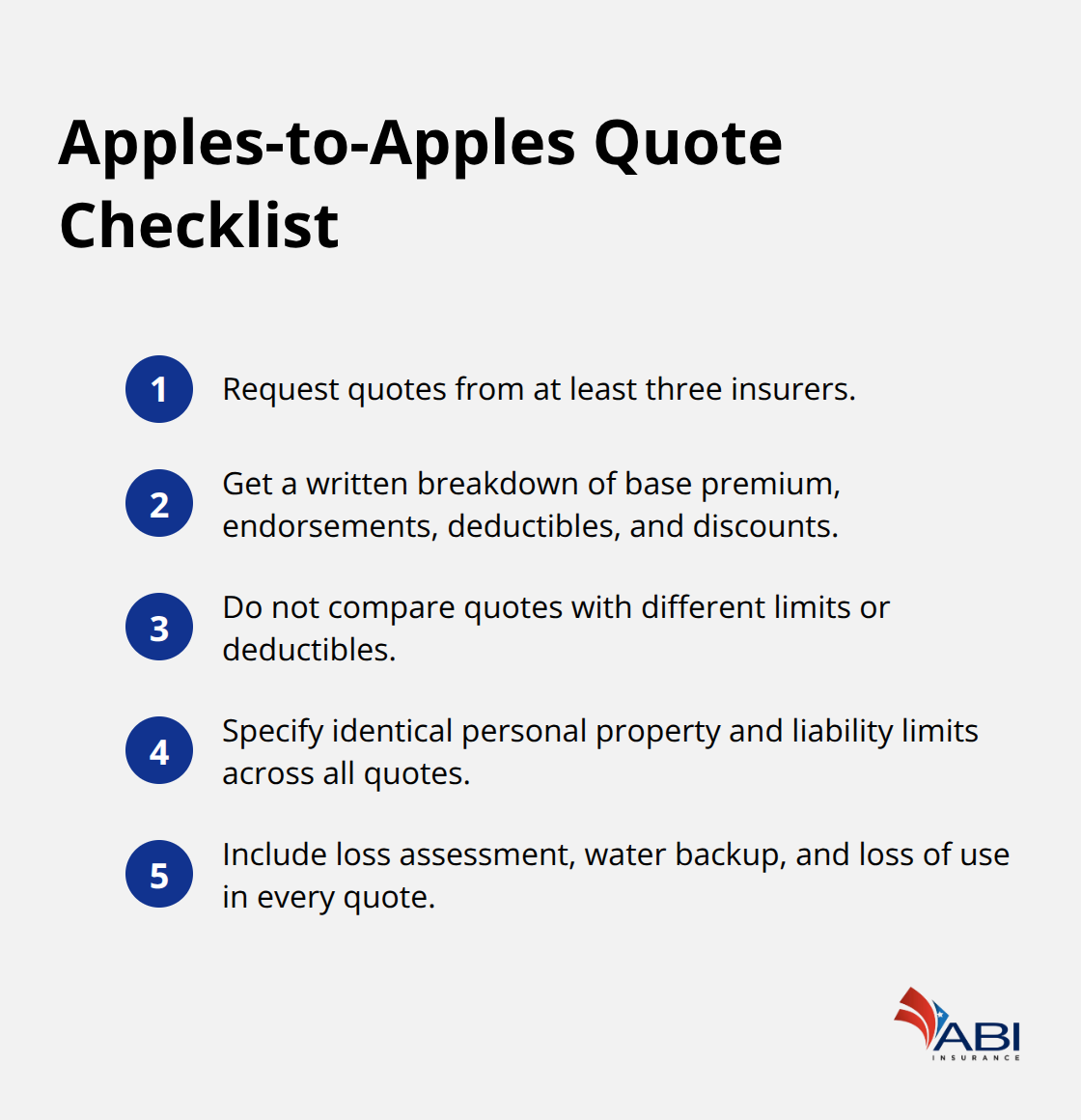
Request Quotes with Identical Coverage Specifications
Request a quote in writing that breaks down the base premium, all endorsements, deductibles, and discounts. Do not compare quotes with different coverage limits or deductibles; you’ll end up comparing apples to oranges. Specify identical coverage across all quotes: personal property limits, liability limits, loss assessment coverage, water backup endorsement, and loss of use coverage. A $200 annual savings might reflect a $100,000 lower liability limit or missing water damage protection, not a genuine savings at all.
Account for Portland’s Location-Specific Risk Factors
Location within Portland drives your costs significantly. Downtown or river-adjacent units face higher flood risk premiums, sometimes $150 to $200 more annually than neighborhoods farther from the Willamette River. Properties in older pre-1970 conversions typically cost 15 to 25 percent more than newer buildings due to construction age and outdated systems. When requesting quotes, provide your building’s year constructed, unit square footage, construction materials (wood-frame versus concrete), number of stories, and the most recent reserve study from your HOA.
Flood risk in Portland is real; if your ground-floor unit sits in a mapped flood zone, separate flood insurance through the National Flood Insurance Program protects you from losses standard policies exclude. Earthquake coverage, while optional, makes sense in Portland given Cascadia Subduction Zone proximity; typical earthquake policies cost $150 to $300 per year.
Work with a Local Portland Insurance Professional
Raising your deductible from $1,000 to $2,500 reduces annual premiums by roughly 10 percent, but only if your emergency savings can absorb a $2,500 out-of-pocket cost. A local Portland insurance professional who understands pre-1970 condo conversions, Willamette River flood patterns, and Cascadia seismic risk will identify discounts for safety devices like sprinkler systems or burglar alarms, claims-history discounts, and non-smoker status that online quote tools often miss. A local agent also coordinates between you and your HOA when claims involve both the master policy and your individual coverage, preventing gaps and disputes that slow reimbursement.
Final Thoughts
Condo association insurance in Portland requires a two-layer approach that most owners misunderstand until a claim forces the issue. Your association’s master policy handles the building structure and common areas, but it leaves your personal property, interior upgrades, and unit-level liability completely unprotected. The gaps are real, and they cost Portland condo owners thousands of dollars every year when fires, water damage, or liability incidents strike.
The path forward is straightforward: obtain your association’s complete master policy declaration from the HOA board, calculate your actual replacement costs for personal property and interior improvements, request quotes using identical coverage specifications, and account for Portland’s specific risk factors including flood exposure near the Willamette River, earthquake risk from the Cascadia Subduction Zone, and the higher premiums that older pre-1970 conversions command. A $2,000 special assessment from an HOA deductible, a $15,000 water damage claim, or a $50,000 liability judgment for a guest injury can devastate your finances if you lack proper coverage. Loss assessment coverage, adequate personal property limits, and sufficient liability protection cost only a few hundred dollars annually but prevent catastrophic out-of-pocket losses.
We at ABI Insurance have guided Portland condo owners through this exact process for years and understand the master policy structures that Portland associations use, the flood and seismic risks that affect your premiums, and the endorsements that actually matter in this market. Contact ABI Insurance for a personalized quote that accounts for your building’s specifics and your personal coverage needs for condo association insurance in Portland.


 Reduce Car Accident Risk with Three Simple Tips