

Startups face a harsh reality: cybercriminals view small businesses as easier targets than large enterprises. Limited budgets, stretched teams, and outdated systems create openings that attackers exploit regularly.
Small business cyber liability isn’t just about data breaches. It’s about the financial devastation that follows — notification costs, legal fees, lost revenue, and regulatory fines that can cripple a young company. We at ABI Insurance have seen firsthand how unprepared startups struggle to recover from these incidents.
The good news is that protection exists. The right coverage and security practices can shield your startup from the worst outcomes.
Why Startups Make Easy Targets
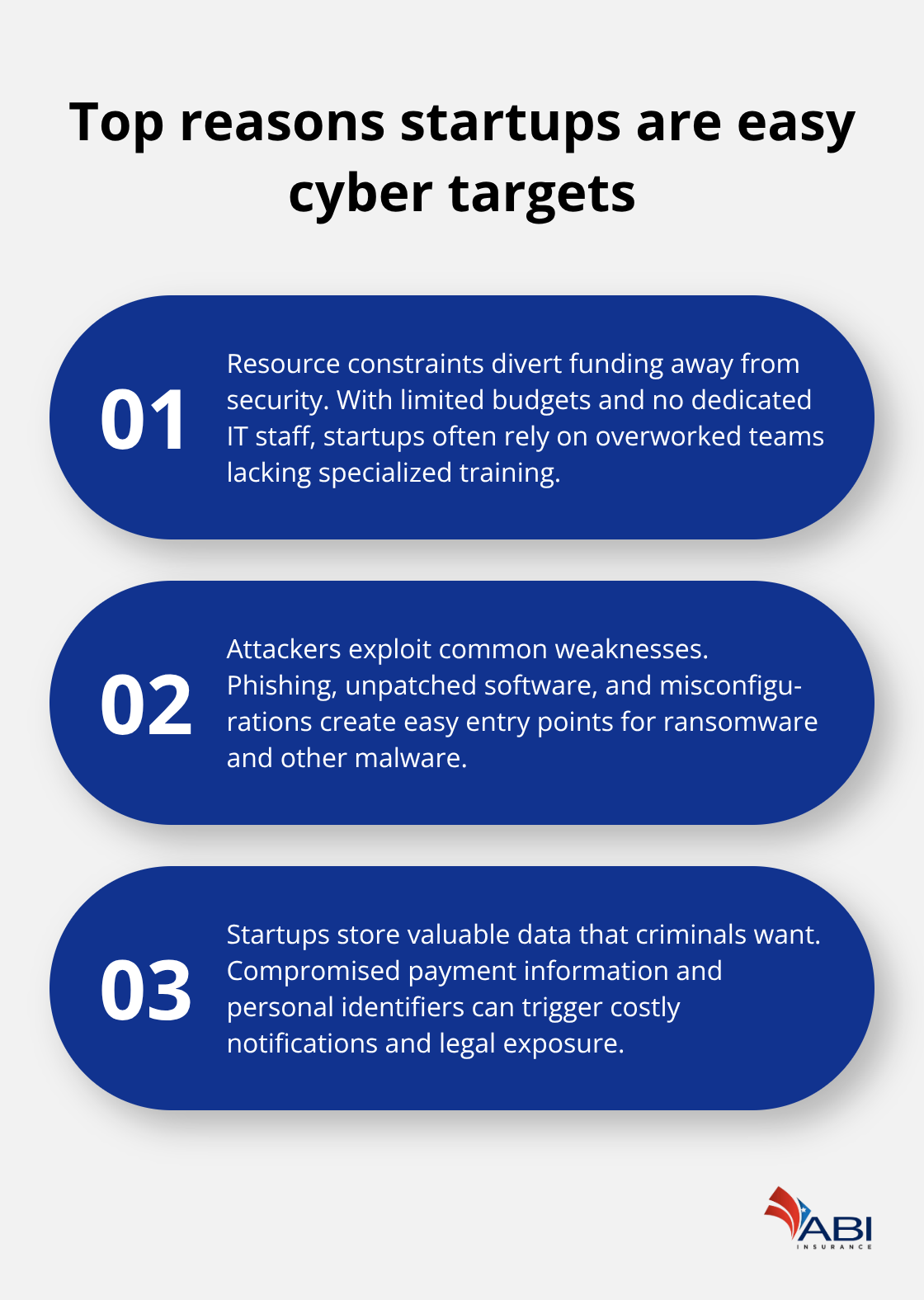
Startups operate in a constant state of resource constraint. Tight budgets force security tools to compete with payroll and product development for funding. Most startups lack dedicated IT staff, leaving cybersecurity responsibilities scattered across already overworked founders or junior employees who lack specialized training. According to the CrowdStrike 2026 Global Threat Report, malware remains the most common cyberattack category, with ransomware encrypting victim data and demanding payment through phishing or unpatched vulnerabilities. Your startup’s systems likely contain exactly what attackers want: customer payment information, personally identifiable information, and business financial records. A single breach can expose hundreds or thousands of customers, triggering notification costs that average $400 or more annually for small-business cyber liability insurance alone. This is before legal fees or regulatory fines are assessed against your account.
.
The Reality of Inadequate Security Infrastructure
Most startups operate with consumer-grade security tools or nothing at all. You might use free email accounts, shared passwords, and cloud storage without encryption. Attackers exploit unpatched software vulnerabilities and platform misconfigurations in products because startups rarely conduct security audits or penetration testing. The CrowdStrike report identifies phishing as a top attack vector, with variants such as spear phishing and business email compromise that target individuals directly. Your team’s lack of formal cybersecurity training means an employee can accidentally grant access to malicious actors through a single compromised email. Startups simply cannot afford the enterprise-level security teams that Fortune 500 companies maintain, which is precisely why cyber liability insurance becomes essential rather than optional.
Why Your Customer Data Attracts Attackers
Startups that handle payment card data, Social Security numbers, or health information present high-value targets. Supply chain attacks (documented extensively in the CrowdStrike 2026 Global Threat Report) show how attackers compromise trusted vendors to access downstream customers. If your startup integrates third-party tools or services, you inherit their security weaknesses. Insider threats also pose significant risk, whether through malicious employees or negligent mistakes like sending sensitive data to the wrong recipients. Identity-based attacks such as credential stuffing and password spraying succeed because startups rarely enforce multi-factor authentication across all accounts. The cost of a breach involving customer data extends beyond notification: regulatory fines under state and federal data protection laws can reach tens of thousands of dollars, plus litigation expenses from affected customers seeking damages.
The Financial Impact of Unprotected Operations
A cyber incident doesn’t stop at breach notification. Your startup faces business interruption when systems go offline, lost revenue while you restore operations, and forensic investigation costs to determine what happened. Ransomware attacks demand immediate payment decisions — pay the criminals or lose access to critical data indefinitely. Regulatory agencies impose fines for failing to protect customer information, and affected customers file lawsuits seeking compensation. These costs accumulate quickly, and most startups lack cash reserves to absorb them. This is where cyber liability insurance steps in. It covers the financial fallout that would otherwise force a young company to shut down.
What Cyber Liability Insurance Actually Covers
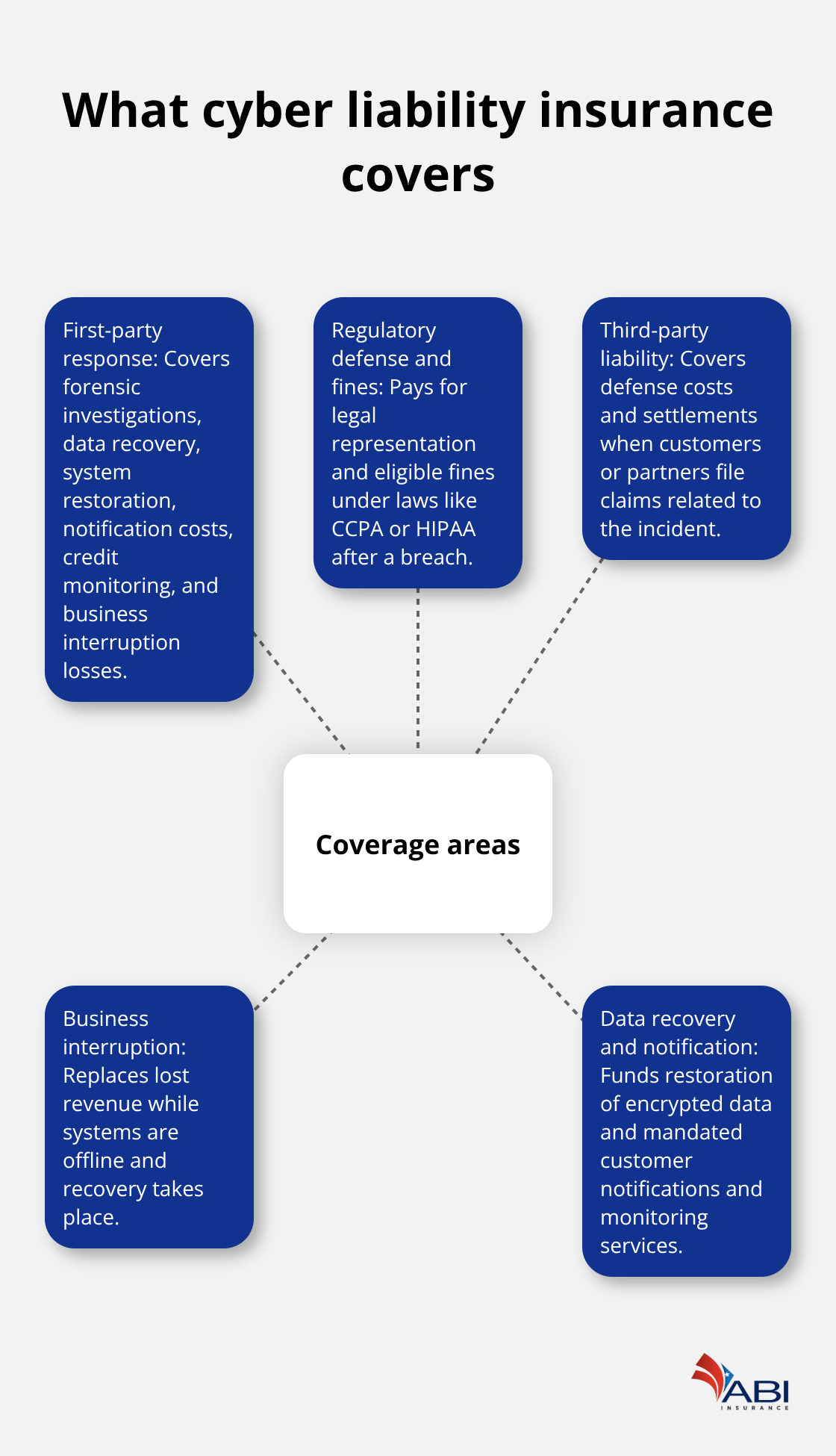
Cyber liability insurance protects startups from the specific financial devastation that follows a breach. This isn’t generic business insurance. It’s engineered to handle the exact costs that sink unprepared companies. First-party coverage pays for your own response and recovery: forensic investigations determine how attackers entered your systems, data recovery and system restoration expenses mount quickly, notification costs inform affected customers, credit monitoring services you must provide to those customers add significant expense, and business interruption losses accumulate while systems remain offline.
These costs add up fast. A typical breach response could run $400 to $8,000 annually just for the insurance component, before you factor in actual forensic fees or credit monitoring services.
How First-Party Coverage Protects Your Operations
First-party coverage addresses the immediate aftermath of a cyber incident. Your startup pays for forensic investigations to understand exactly how attackers compromised your systems. Data recovery specialists restore encrypted files and rebuild corrupted databases. You notify affected customers within legal time limits, a process that requires specialized vendors and legal review. Credit monitoring services protect those customers for months or years following the breach. Business interruption coverage replaces lost revenue while your team works around the clock to restore operations. Without this protection, a single ransomware attack forces your startup to absorb tens of thousands in recovery costs while simultaneously losing customer revenue. First-party coverage transforms a catastrophic financial event into a manageable insurance claim.
Regulatory Defense and Fines Coverage
State attorneys general and federal regulators investigate data handling practices under laws like the CCPA or HIPAA when breaches occur. Your startup needs legal representation to navigate these investigations, and regulatory fines can range from $145 to $2,190,294 per violation depending on severity. Cyber liability policies cover both the legal defense costs and the fines themselves. This protection matters enormously because regulatory agencies don’t care about your startup’s limited resources. They impose penalties based on the number of affected individuals and the sensitivity of compromised data. A healthcare startup handling patient information faces far steeper regulatory exposure than a software company managing basic contact details. This coverage ensures your legal team can mount a proper defense rather than accepting unfavorable settlements due to budget constraints.
Third-Party Claims from Customers and Partners
Third-party coverage handles claims from your customers or partners who suffered losses from the breach. If customers sue your startup for failing to protect their payment card data, this coverage pays legal defense costs and settlements. This matters particularly if you run an agency, SaaS platform, or any business where clients trust you with sensitive information. The CrowdStrike 2026 Global Threat Report documents that identity-based attacks like credential stuffing succeed regularly against unprepared targets, and each compromised account represents potential liability. A single customer lawsuit can cost $50,000 to $200,000 in legal fees alone, regardless of whether you win. Third-party coverage protects your startup’s survival when customers decide to pursue legal action.
Matching Coverage Limits to Your Actual Risk
Most insurers offer policy limits ranging from $1 million to $5 million, with both per-occurrence and aggregate limits. The per-occurrence limit covers a single incident, while the aggregate represents your total annual coverage. This distinction matters enormously. A startup handling 10,000 customer records should carry different limits than one with 100,000 records. Small businesses typically select $1 million per occurrence with $1 million aggregate, which costs far less than higher limits but may prove insufficient if your breach affects thousands of customers. Deductibles typically run around $2,500 for $1 million limits. Higher deductibles reduce your premium but increase out-of-pocket costs after a claim. A startup with minimal cash reserves should weigh this carefully. If a company saves $200 on annual premiums, that means nothing if a $5,000 deductible becomes due during an actual incident.
Your specific data volume and sensitivity should drive coverage decisions. Handling credit card numbers or health information justifies higher limits than managing basic contact information. The cost difference between a $1 million and $2 million policy is modest (often $300 to $500 annually), but the protection difference proves substantial. As your startup scales and collects more customer data, your coverage limits should expand accordingly. This is where the next critical decision emerges: determining which specific policy features and endorsements actually align with your operational reality.
How to Build Real Cyber Security That Startups Can Actually Afford
Insurance protects you after a breach occurs, but the best defense stops attacks before they start. Startups that skip security investments thinking they’re too expensive pay far more in breach response costs. This backwards logic costs businesses their entire future. The reality is that foundational security measures cost almost nothing compared to what you’ll spend on incident response, legal fees, and regulatory fines.
Multi-factor Authentication Stops Most Account Compromises
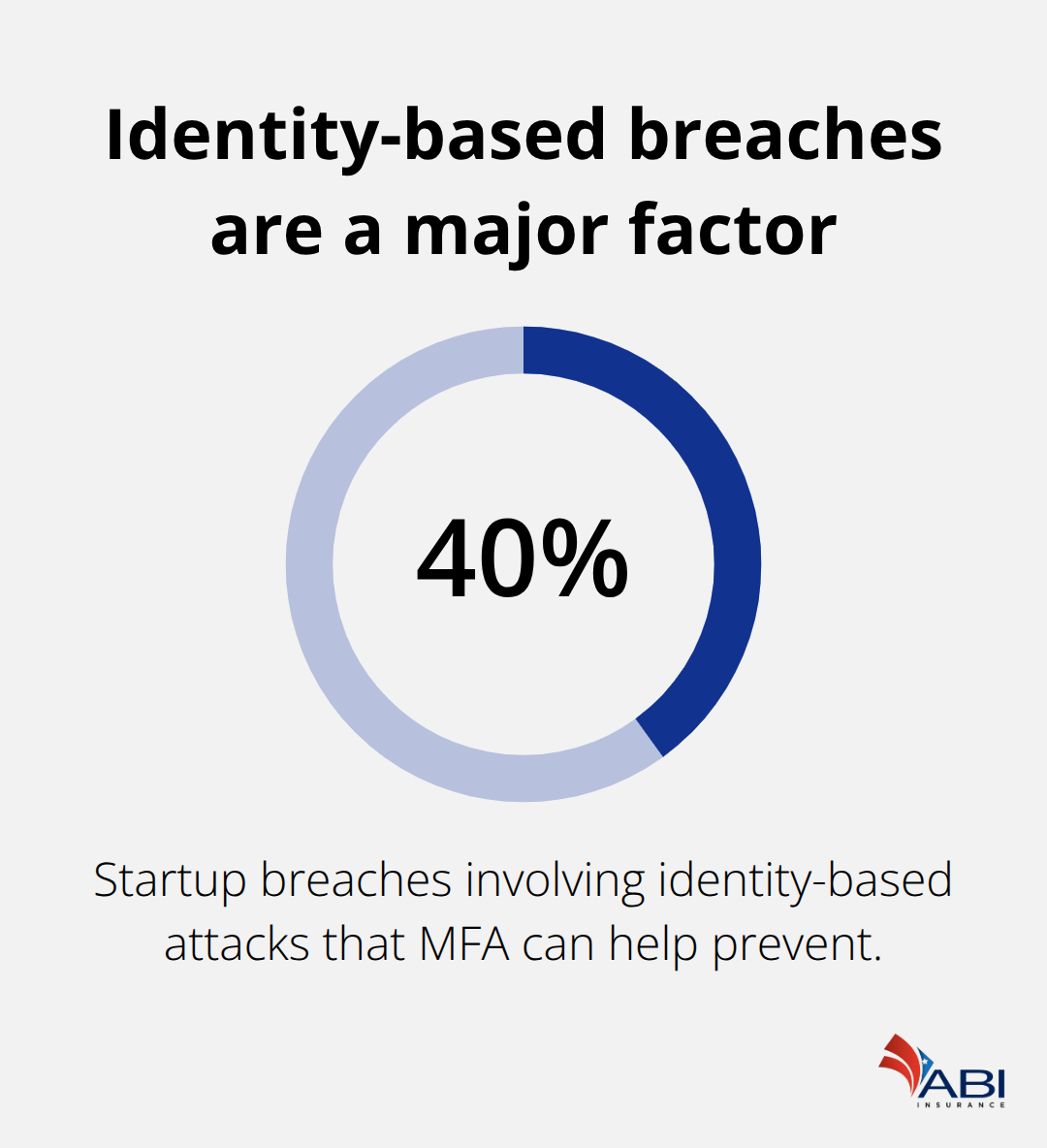
A startup with five employees that implements multi-factor authentication across all accounts spends zero dollars on the MFA itself (most cloud platforms offer it for free) but eliminates the majority of account-compromise attacks documented in the CrowdStrike 2026 Global Threat Report. Credential stuffing and password spraying attacks fail when MFA blocks them, even if an attacker somehow obtains a password. According to a report by Microsoft, implementing MFA can block 99.9% of automated attacks on accounts. Your startup should mandate MFA on every account today — email, cloud storage, financial platforms, et. This takes two hours to implement and prevents the identity-based attacks that compromise 40% of startup breaches.
Patch Management Closes the Door on Ransomware
Unpatched software vulnerabilities represent your second critical weakness. Attackers scan for outdated versions of Windows, WordPress, or third-party plugins because patches exist but companies haven’t applied them. Your startup’s cloud platforms like Microsoft 365 and Google Workspace auto-patch, eliminating this vector entirely. Your internal systems do not. A single outdated server or workstation becomes the entry point for ransomware that encrypts your entire operation. Establish a predictable release schedule for software patches and updates. This takes about four hours monthly and costs nothing. Most ransomware attacks succeed because vulnerabilities patched months or years earlier remain unaddressed on victim systems. Your startup cannot afford to be negligent here.
Employee Training Addresses the Human Element
Employee behavior determines whether your technical security actually works. The CrowdStrike 2026 Global Threat Report identifies phishing and social engineering as top attack vectors precisely because humans remain the weakest link. Your team members receive emails impersonating executives, vendors, or payment processors, asking them to click malicious links or download infected attachments. A single employee falling for one email compromises your entire network. This demands continuous training, not annual compliance theater. Conduct monthly fifteen-minute security awareness sessions covering real threats your industry faces. Show examples of phishing emails your team actually receives. Test employees with simulated phishing campaigns to identify who needs additional coaching. Employees who click malicious links in simulations receive immediate training rather than waiting for annual refresher courses. This approach works because it’s contextual and ongoing rather than forgettable. Your startup should also establish clear consequences for security violations, not punishment, but structured accountability. An employee who disables security software to troubleshoot a problem should face retraining, not termination. The violation matters and should be documented.
Security Audits and Penetration Testing Reveal Hidden Risks
Security audits and penetration testing sound expensive but serve a different purpose than continuous monitoring. An audit identifies what you’ve done right and wrong across your entire operation, typically costing $2,000 to $5,000 for a startup. Penetration testing simulates actual attacks to find vulnerabilities before criminals do, ranging from $3,000 to $10,000 depending on scope. These aren’t annual requirements. Conduct them when you hire your first employee handling customer data, again when you launch new systems or integrations, and every two years thereafter, as your operation grows. The findings from these assessments drive your security spending decisions far more effectively than guessing which tools matter most. A penetration test might reveal that your backup systems lack encryption while your primary systems are well-protected, shifting your priorities immediately. This is how resource-constrained startups spend security dollars effectively: based on actual risk rather than vendor marketing.
Final Thoughts
Cyber threats targeting small businesses have evolved from theoretical risks into operational certainties. Malware, ransomware, phishing, and identity-based attacks documented in the CrowdStrike 2026 Global Threat Report affect startups with the same intensity they target larger enterprises. The difference lies in recovery capacity. A Fortune 500 company absorbs a breach and moves forward, while a startup without proper protection faces closure.
Small business cyber liability insurance addresses the financial devastation that follows a breach. First-party coverage pays for forensic investigations, data recovery, notification costs, and business interruption losses that would otherwise drain your startup’s cash reserves. Third-party coverage protects you from customer lawsuits and regulatory fines that can reach hundreds of thousands of dollars. Together, these protections transform a catastrophic event into a manageable insurance claim rather than an existential threat.
The startups that survive cyber incidents are those that prevent them in the first place. Multi-factor authentication blocks 99.9% of automated attacks at zero cost, monthly patch and software updates close ransomware entry points, and continuous employee training addresses the human vulnerabilities that attackers exploit relentlessly. Security audits reveal hidden risks before criminals find them, and these practices cost almost nothing compared to breach response expenses. We at ABI Insurance have guided Portland-area businesses through this exact process for over 40 years, and our team understands the specific risks startups face and the coverage options that protect your operation.


 Small Business Workers Compensation: What Every Employer Should Know









