

Commercial auto insurance rates vary wildly depending on your business. We at ABI Insurance know that small differences in how you operate — from driver safety records to vehicle maintenance — can swing your premiums hundreds of dollars each year.
This guide walks through what moves your rates up and down, then shows you concrete ways to cut costs without sacrificing coverage.
What Really Drives Your Commercial Auto Insurance Costs
Driving History Sets Your Rate Foundation
Your driving history is the single most predictive factor insurers use to price your policy, and it matters far more than most business owners realize. A clean record with no accidents or violations can positively influence your rates, while a single at-fault accident or moving violation will stay on your record for years and directly inflate your rates.
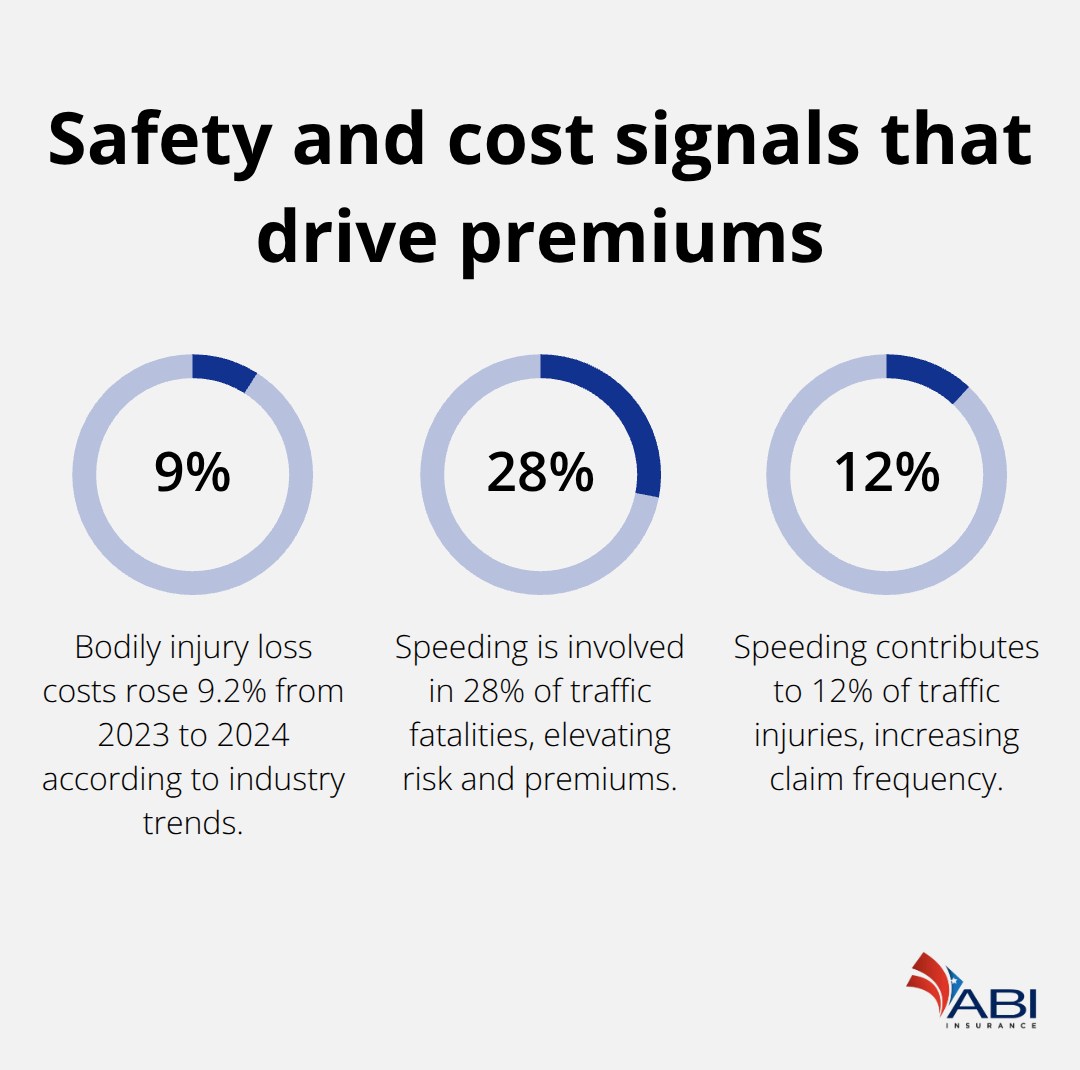
Promoting safe driving habits across your team isn’t just about risk management, it’s about controlling your bottom line. The LexisNexis Auto Insurance Trends Report found that bodily injury loss costs rose 9.2 percent from 2023 to 2024, driven largely by uninsured motorists, medical cost inflation, and speeding-related injuries. Speeding alone accounts for 28 percent of traffic fatalities and 12 percent of injuries, meaning reckless drivers on your payroll don’t just create safety problems; they create insurance rate problems.
Industry Type and Vehicle Selection Matter
If you operate in a high-risk industry like construction or installation contracting, you already pay more than a nonprofit or real estate firm simply because your sector carries inherent operational risk. The type of vehicle matters enormously as well. A food truck operating daily costs significantly more to insure than a company sedan used occasionally for client meetings.
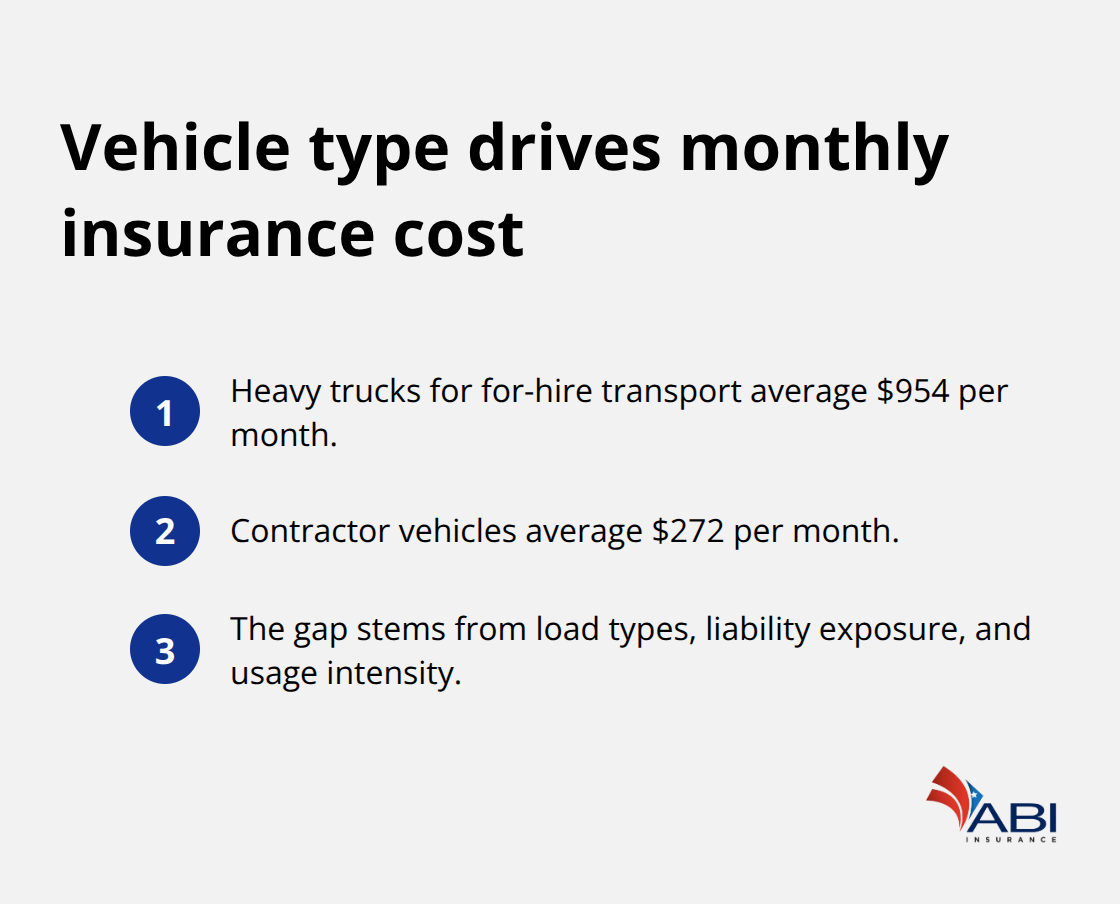
Specialized vehicles like box trucks or dump trucks require additional coverage endorsements that standard passenger cars don’t need. Heavy trucks used for for-hire transport average $954 per month according to Progressive’s 2024 data, while contractor vehicles average $272 monthly. This is a massive difference driven by load types, liability exposure, and usage intensity.
Location and Distance Reshape Your Premium
Where you operate your vehicles shapes your premium more than many business owners expect. Urban areas typically run higher than rural zones due to congestion, theft risk, and accident frequency. Florida and North Carolina show significant premium differences reflecting weather patterns, uninsured driver rates, and local accident costs.
Operating within a 100-mile radius costs less than longer-distance operations because distance directly correlates to accident exposure. High-crime areas and regions prone to weather events like hurricanes or hail naturally push premiums upward. Your annual mileage compounds this effect — the more time your vehicles spend on the road, the more exposure your business has to claims.
How to Cut Your Commercial Auto Insurance Costs
Safety Programs Reduce Claims and Lower Premiums
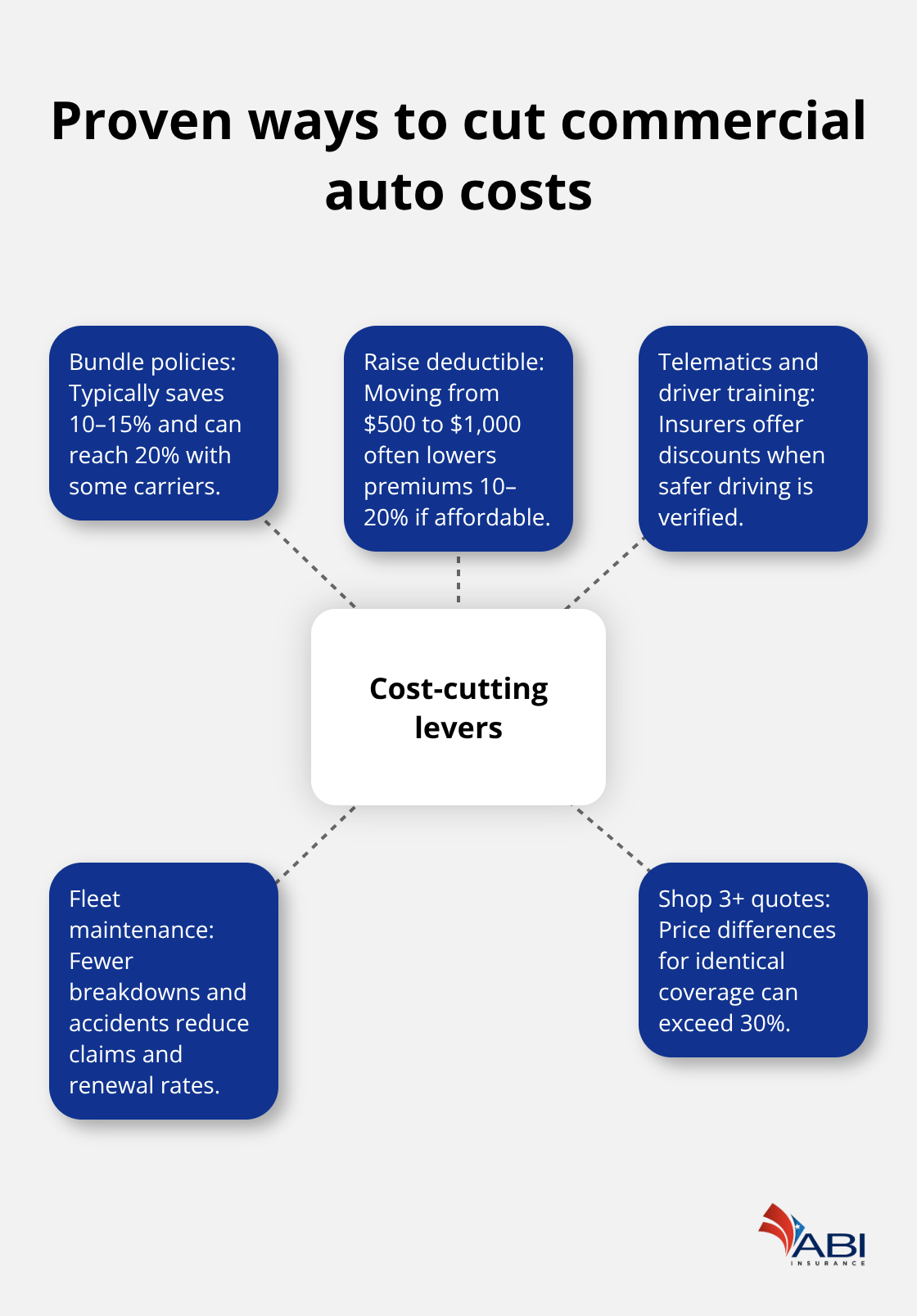
Insurers measure risk through claims data, and companies with structured driver training see measurably lower accident rates. Telematics and driver training programs can reduce premiums, since these tools give insurers concrete proof that your team drives more carefully. Consistency matters. A one-time safety training accomplishes nothing; you need ongoing reinforcement, clear policies against distracted driving, and accountability across all driver levels.
Distracted driving concerns many companies for good reasons. Implement a written policy that applies equally to management and entry-level drivers, then track compliance. When you show an insurer that your fleet has fewer claims because of deliberate safety investments, you move from being a generic rate category to a lower-risk client worth better pricing.
Bundle Coverage to Cut Total Costs Significantly
Bundling your commercial auto with general liability or property coverage typically cuts your total costs by 10 to 15 percent, sometimes reaching 20 percent depending on the carrier. If you pay $245 per month for commercial auto alone, bundling could save you $25 to $50 monthly just on that line. Insurers prefer keeping multiple lines of business with one customer rather than competing for single policies, which is why they reward bundling with real discounts.
Fleet maintenance deserves equal attention because rising vehicle repair costs directly impact your premiums. Regular maintenance reduces breakdowns and accidents, which translates to fewer claims and better rates at renewal. Skipping scheduled service to save money short-term leads to expensive claims and rate increases that dwarf any maintenance savings.
Align Coverage Limits to Your Actual Business Risk
Most business owners either over insure or under-insure because they fail to match their coverage to real operational risk. A common liability limit is $1 million per-occurrence and $2 million aggregate, but if you haul high-value cargo or operate in litigation-heavy states, you might need more. If you operate a single service vehicle in a low-traffic area, you may not need the highest limits.
Raising your deductible from $500 to $1,000 typically lowers premiums by 10 to 20 percent, but only if you can afford that deductible when a claim happens. Schedule an annual policy review to catch coverage gaps created by fleet changes, new routes, or shifts in how you use vehicles. If you added a specialized vehicle or expanded into a different service area, your old coverage may not fit your current risk profile, meaning you’re either overpaying or underprotected.
Costly Oversights That Inflate Your Premium
Misreporting Mileage Destroys Coverage When You Need It Most
Underreporting annual mileage ranks as one of the most frequent mistakes we see. If you operate a service vehicle that logs 50,000 miles yearly but report 30,000 to save on premiums, you’ve created a coverage disaster. When a claim happens, the insurer discovers the discrepancy during investigation and can deny coverage or cancel your policy entirely. The short-term savings evaporate instantly, replaced by uninsured liability exposure that threatens your business.
Mileage directly correlates to accident exposure, so insurers price accordingly. A delivery fleet running 100,000 miles annually faces fundamentally different risks than one running 20,000 miles. Accuracy during the quote phase isn’t about honesty alone; it’s about getting a rate that reflects your operations, not a false discount that collapses when you need coverage most.
Outdated Coverage Leaves You Exposed to New Risks
You add a second vehicle, expand into a new service area, or shift from occasional use to daily commercial operation, but your policy stays frozen in time. Insurers underwrite based on the information you provide at purchase. If your business evolves and your coverage doesn’t, you’re either paying for protection you don’t need or lacking protection you do.
Schedule your policy review whenever your fleet changes, your service territory expands, or your annual mileage shifts significantly. These updates take minutes but prevent expensive gaps in protection that surface only after a claim occurs.
Safety Equipment Upgrades Qualify for Real Discounts
Modern vehicles come equipped with anti-lock brakes, airbags, GPS trackers, and collision avoidance systems that demonstrably reduce accident frequency. When you upgrade your fleet to vehicles with these technologies, inform your insurer immediately. Major carriers offer premium reductions for safety equipment because claims data proves these devices lower loss costs. Ignoring this step means you pay full price for vehicles that cost less to insure.
Final Thoughts
Finding better commercial auto insurance rates comes down to three concrete actions: understanding what drives your specific costs, implementing measurable risk reductions, and comparing quotes across multiple carriers. The factors we’ve covered — driving history, vehicle type, location, and industry risk — aren’t abstract pricing concepts. They’re levers you can pull to lower your premiums without sacrificing the coverage your business needs. A company that invests in driver training, maintains vehicles properly, and bundles policies strategically pays less than one that ignores these details.
An insurance professional matters because they understand how different carriers weigh your risk factors. An agent identifies coverage gaps you’ve missed, spots bundling opportunities that save real money, and explains why one insurer quotes $300 monthly while another quotes $240 for the same protection. They also catch mistakes like underreported mileage or outdated coverage that could destroy your protection when you need it most. The difference between a $200 monthly premium and a $260 premium for identical coverage amounts to $720 annually, money that compounds year after year.
Your next step is straightforward: schedule a policy review with ABI Insurance to assess your current coverage against your actual operations. Work with your ABI Agent to gather quotes from multiple carriers, compare price and coverage details, and specifically ask about discounts for safety equipment, bundling, and driver training programs. If your fleet has changed, your routes have expanded, or your annual mileage has shifted, that review becomes urgent.


 High Net Worth Umbrella Insurance Portland: Luxury Asset Protection









