
Running a small business in Portland means protecting your assets with the right insurance. A Business Owners Policy can cover property damage, liability, and business interruption, but only if you pick the right coverage for your needs.
At ABI Insurance, we help local business owners navigate Portland BOP quotes to find policies that actually fit their operations. This guide walks you through what to compare, how to spot overpriced coverage, and where to find real savings.
What Makes a Business Owners Policy Work for Portland Businesses
A Business Owners Policy combines general liability, commercial property, and business interruption coverage into one streamlined package. The Insurance Information Institute confirms this is the standard structure across the industry. For Portland businesses, this bundling approach typically saves 10 to 15 percent compared to purchasing each coverage line separately. The policy protects your building and contents, covers liability claims from customers or third parties, and replaces lost income if a covered event forces you to close temporarily. Most small business owners cannot absorb the operational gaps that come from piecemeal coverage or protection holes.
Property Coverage Protects What You’ve Built
Property coverage within a BOP guards your building, equipment, inventory, and fixtures against fire, theft, weather damage, and other named perils. The National Association of Insurance Commissioners recommends replacement cost valuation rather than actual cash value. Replacement cost means the insurer pays what it actually costs to rebuild or replace damaged items today, not what they were worth years ago when you purchased them. Actual cash value subtracts depreciation, leaving you significantly underinsured after a loss. For a Portland restaurant with commercial kitchen equipment, refrigeration units, and dining furniture, replacement cost coverage makes the difference between reopening in weeks versus months.
Portland’s wet climate and roughly 150 precipitation days annually increase slip-and-fall and water damage risk, making property coverage especially valuable for retail and hospitality operations. You should verify that your property limits match your actual replacement costs when you request quotes. Underestimating your property value creates a dangerous coverage gap that no other policy component can fill.
Liability Coverage Handles Claims From Others
General liability coverage handles bodily injury and property damage claims when someone gets hurt on your property or your operations damage their belongings. A customer slips on a wet floor, a delivery truck backs into a neighboring storefront, or a product defect injures a user — general liability pays the medical bills, repair costs, and legal fees. Portland’s modified comparative negligence rule (51% fault threshold) shapes how claims settle, but liability exposure remains significant for any business that interacts with the public. You need limits that reflect your actual risk exposure, not the minimum coverage that sounds affordable.
Business Interruption Replaces Lost Income
Business interruption coverage replaces business income lost in a disaster, such as a fire or a natural catastrophe. If a fire closes your Portland office for six weeks, business interruption pays your rent, payroll, and utilities so you survive the gap. Most small business owners underestimate how quickly revenue loss becomes catastrophic. A sole proprietor or small team cannot absorb weeks without income. The PCC Small Business Development Center emphasizes this coverage as essential protection, not an optional add-on.
BOPs typically include business interruption as standard, though you should verify limits match your monthly operating costs when you request quotes. This step separates adequate protection from inadequate coverage that leaves you exposed. Understanding what your policy actually covers and, what it doesn’t, determines whether a BOP truly protects your business or merely creates a false sense of security.
What Changes Your BOP Quote Most
When you request BOP quotes from multiple carriers, the prices will vary significantly. The difference between a $1,200 annual premium and a $2,800 annual premium for similar coverage often comes down to how insurers weigh specific risk factors. Industry classification drives the largest variation in Oregon BOP pricing. Tech and IT businesses run 79% below Oregon’s average, while other industries face significantly higher costs, reflecting the gap between desk-based work and on-site physical labor with higher injury exposure. Your specific industry classification determines your base rate before any other factors apply.
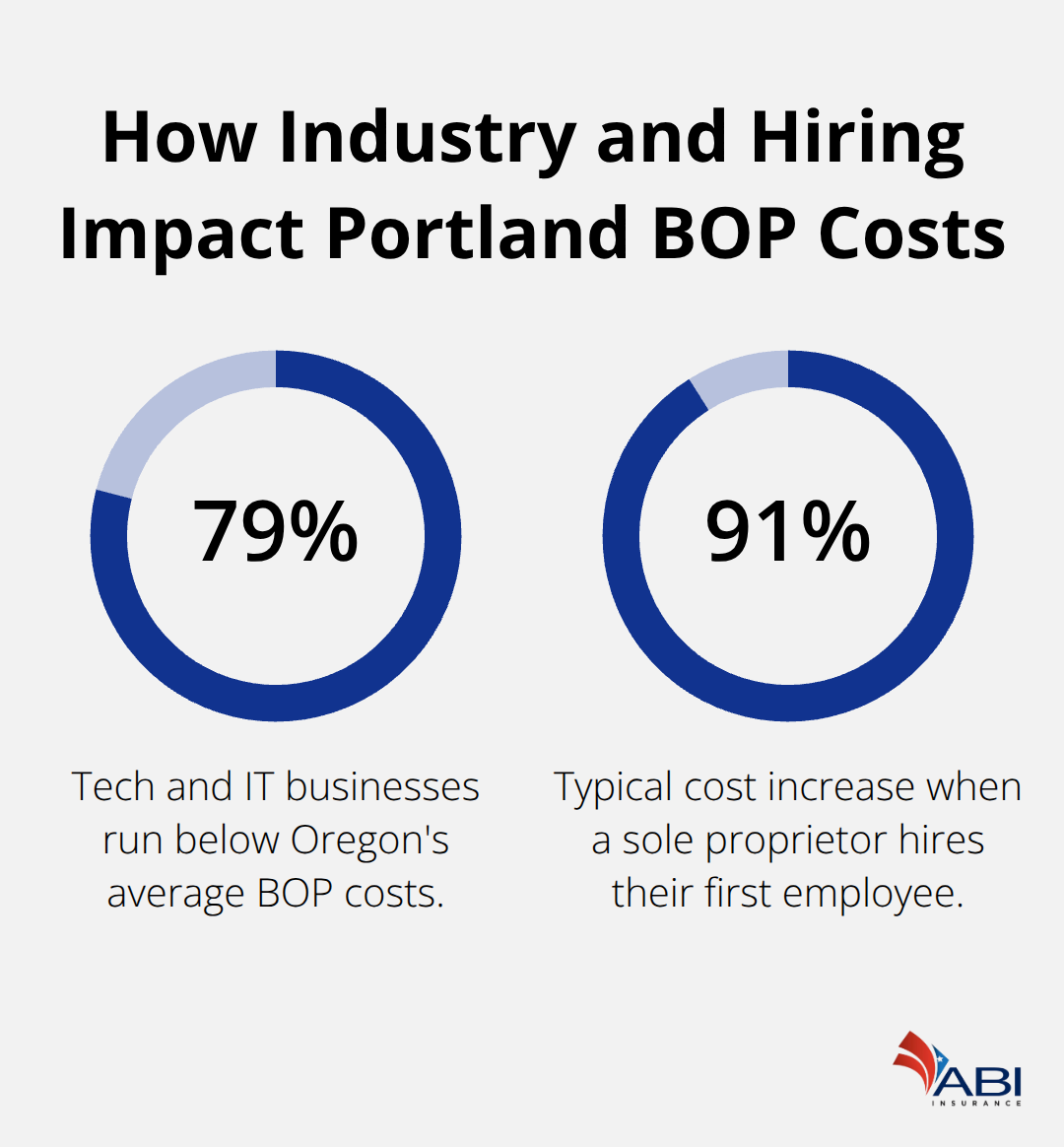
Business size compounds this effect dramatically. A sole proprietor pays roughly $72 monthly for general liability, but adding your first employee typically increases costs by 91 percent. Moving from one to four employees to five to nine employees can push premiums up another 170 percent. Payroll and employee count directly influence underwriting decisions because more people means more exposure to workplace injuries and liability claims.
Your claims history over the past three to five years shapes what you pay more than almost anything else. A clean record with zero claims yields meaningful discounts at renewal, while even one moderate claim elevates your premium significantly. Annual revenue and the type of property you occupy also affect quotes substantially. A restaurant with $500,000 in annual revenue and owned commercial kitchen equipment faces different underwriting than a consulting firm operating from a rented office.
Prepare Consistent Information Across All Quotes
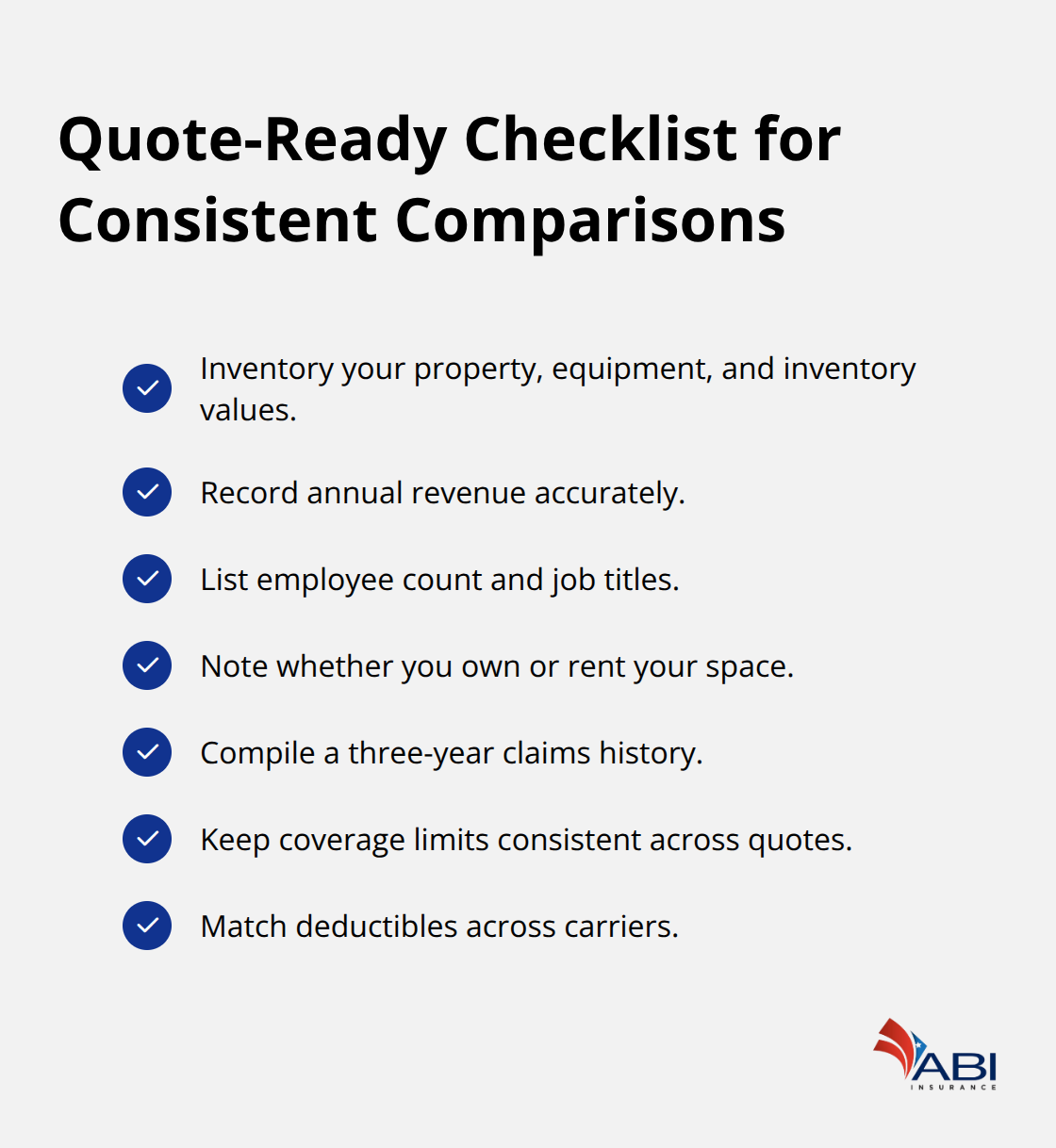
The Small Business Administration recommends preparing a detailed inventory of property, equipment, and inventory value before contacting insurers. Write down your exact annual revenue, number of employees and their job titles, whether you own or rent your space, and a three-year claims history. Specify the same coverage limits and deductibles across all quotes you request. If you ask one carrier for a $1 million per occurrence liability limit and another for $2 million, the quotes tell you nothing meaningful about which company offers better pricing.
Request quotes from at least three carriers using this consistent information. Oregon’s file-and-use rate regulation allows insurers to adjust rates faster than many states, creating pricing variability that makes comparison shopping essential. When quotes arrive, evaluate them on coverage scope and endorsements, not just the bottom-line premium. A $1,500 quote that excludes cyber liability differs fundamentally from a $1,650 quote that includes it.
Verify Coverage Limits Match Your Actual Needs
Check whether business interruption limits align with your actual monthly operating costs. The National Association of Insurance Commissioners emphasizes that adequate limits matter more than minimal price. Bundling your BOP with workers’ compensation, commercial auto, or other policies typically yields 10 to 15 percent savings compared to single-line policies, so ensure all quotes include the same bundled options for fair comparison.
Spot Underpricing and Coverage Gaps
A quote significantly lower than others from reputable carriers warrants scrutiny. Insurers may underprice initially to win your business, then raise rates substantially at renewal once you’re locked in. Compare the financial strength ratings of carriers using A.M. Best ratings before assuming the lowest quote represents the best value. A carrier rated A or higher typically provides more stable pricing and reliable claims handling than lower-rated alternatives.
Watch for quotes that exclude standard BOP components without explanation. Property coverage, liability, and business interruption form the foundation of a BOP. If a quote omits one of these elements or limits it severely, the insurer may be offering a stripped-down Commercial Package Policy rather than a true BOP. Ask directly whether the quote includes replacement cost property valuation or only actual cash value. Replacement cost costs more but leaves you adequately covered after a loss. Actual cash value creates the risk of being significantly underinsured.
Deductibles that seem unusually low should raise questions about what they actually apply to. Some carriers structure deductibles by peril, meaning a $1,000 deductible applies to theft but a different deductible applies to fire or water damage. Verify exactly which perils apply to each deductible level. Vague language about exclusions or endorsements signals a warning. Request a detailed explanation of what the policy does not cover. Equipment breakdown, cyber liability, and crime coverage are common add-ons that should be explicitly included or excluded in writing, not left ambiguous.
Once you’ve narrowed your quotes to carriers with strong financial ratings and transparent coverage details, the next step involves understanding which additional endorsements actually protect your specific business operations.
How to Cut Your Portland BOP Costs Without Sacrificing Protection
Bundling your BOP with other commercial policies delivers the most predictable savings for Portland businesses. When you combine general liability, commercial property, and business interruption into one BOP, then add workers’ compensation, commercial auto, or commercial umbrella coverage through the same insurer, you typically save 10 to 15 percent on total premiums compared to splitting policies across multiple carriers. This savings compounds when you add a third or fourth policy line. The National Association of Insurance Commissioners reports that multi-policy discounts represent one of the most reliable ways to lower your overall insurance spend without reducing coverage. Request quotes that explicitly show the bundled rate versus single-line pricing so you can verify the discount actually appears on your bill. Some insurers bury bundled savings in vague language, so demand a clear breakdown. If an insurer cannot show you the exact dollar savings from bundling, that’s a red flag about their transparency.
What Actually Drives Real Discounts
Your claims history determines whether you qualify for the best available rates far more than shopping around does. A Portland business with zero claims over three years typically pays 20 to 30 percent less than an identical business with one moderate claim in that period. This means your first priority should be implementing genuine loss prevention measures, not negotiating with insurers. Install working alarms, cameras, or fire suppression systems and document their installation in writing. These cost-effective controls often yield premium credits that exceed their installation cost within a single policy year. The Insurance Information Institute confirms that insurers offer measurable credits for verifiable safety improvements. When you request quotes, mention any loss prevention measures you’ve implemented. If an insurer does not acknowledge these controls with a credit, ask why not. Some carriers underwrite more aggressively than others, and this signals which ones take your risk management seriously.
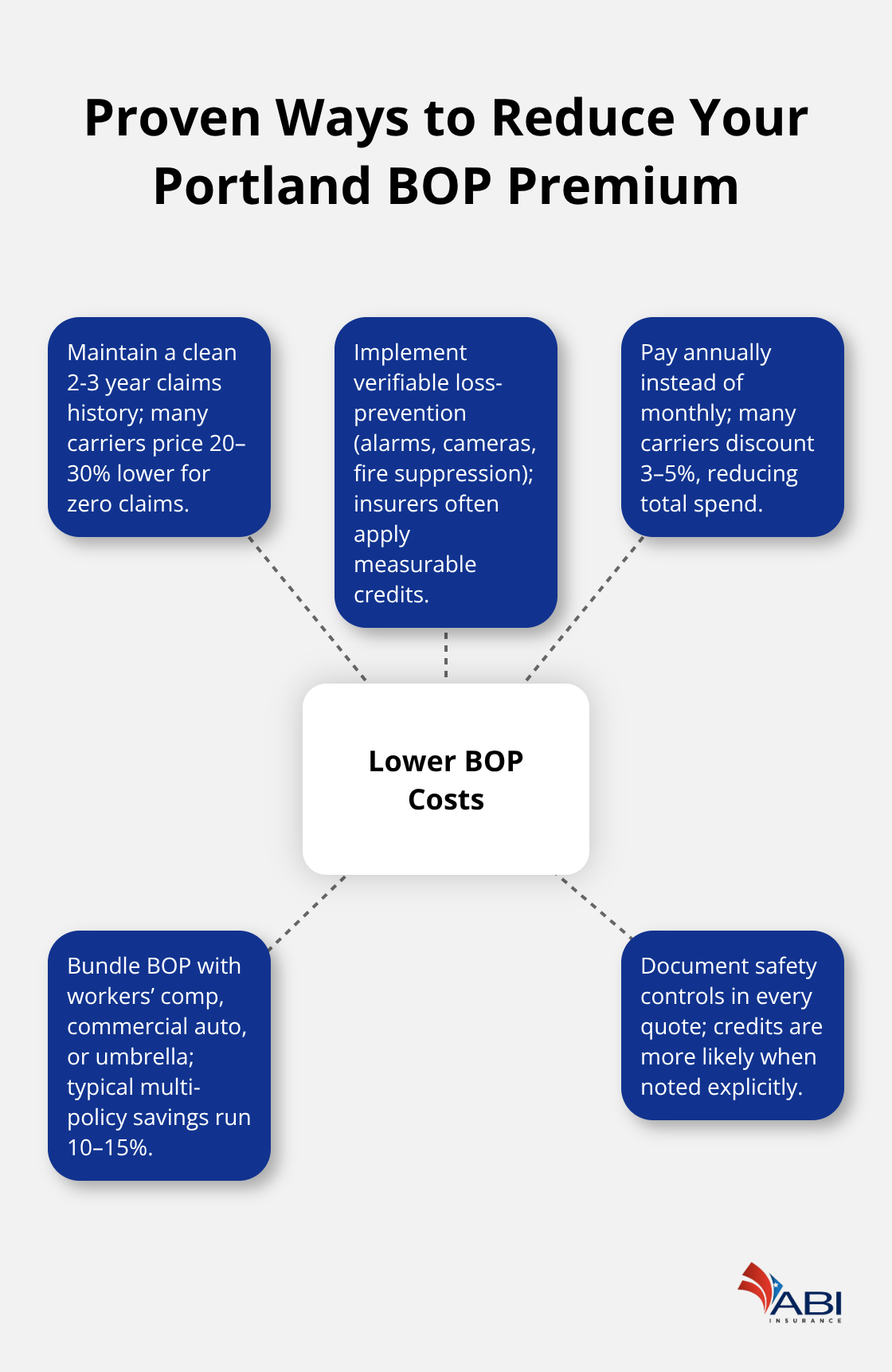
Paying your annual premium upfront rather than monthly also triggers discounts at many carriers, typically 3 to 5 percent. For a Portland business paying $1,800 annually, that’s $54 to $90 in pure savings for changing your payment method. A clean two-to-three-year claims history combined with documented safety controls and annual payment creates the foundation for the lowest possible rates. These factors matter far more than choosing between carriers that offer similar financial stability ratings.
Matching Coverage Limits to Actual Needs Prevents Overpaying
Many Portland business owners either overestimate or underestimate their coverage needs, leading to either inflated premiums or inadequate protection. Business interruption coverage limits should be based on gross earnings, since many expenses continue even when revenue stops. A restaurant with $25,000 in monthly rent, payroll, and utilities needs business interruption coverage of at least $75,000. Requesting quotes with $150,000 in business interruption coverage costs substantially more but provides no practical benefit once you reach operational breakeven. Conversely, requesting only $25,000 leaves you exposed if recovery takes longer than expected. Property coverage limits should reflect actual replacement costs for your building, equipment, and inventory combined, not an arbitrary round number. Request a detailed quote that itemizes property values by category, so you understand exactly what limits you’re purchasing. A Portland tech firm renting office space needs far less property coverage than a manufacturing operation with $500,000 in equipment and materials. The premium difference between appropriate limits and inflated limits often exceeds 20 percent. Getting this right requires honest conversations with your insurer about what you actually own and what would actually cripple your business if lost.
Final Thoughts
Portland businesses operate in a competitive market where the wrong insurance decision costs thousands in either overpaid premiums or inadequate coverage after a loss. A tailored Business Owners Policy protects your property, shields you from liability claims, and replaces income during forced closures. The work you do now to compare Portland BOP quotes accurately determines whether your insurance actually protects your business or merely creates false confidence.
Getting your BOP quote right requires three concrete steps: gather detailed information about your property, equipment, inventory, annual revenue, employee count, and claims history; request quotes from at least three carriers using identical coverage limits and deductibles so you can compare apples to apples; and evaluate each quote on financial strength ratings, coverage scope, and transparency about what is included or excluded. Replacement cost property valuation, adequate business interruption limits, and clear deductible structures matter far more than finding the lowest price. A $200 annual savings on a stripped-down policy evaporates instantly when a covered loss reveals that your coverage was insufficient.
The most effective way to lower your costs involves implementing genuine loss prevention measures, maintaining a clean claims history, and bundling your BOP with other commercial policies. These actions reduce your actual risk profile rather than simply negotiating with insurers. Contact us to discuss your BOP requirements and receive quotes that reflect your actual business profile.







 Unoccupied vs. Vacant Condo Units: Coverage and Loss Prevention