


Most families wait until after a lawsuit or an accident to think about umbrella coverage. That’s a costly mistake.
At ABI Insurance, we see firsthand how the timing of an umbrella policy can make the difference between solid protection and a financial crisis. The right moment to add this coverage isn’t when disaster strikes. It’s when your assets and responsibilities start climbing.
When to Add Umbrella Coverage to Your Protection Plan
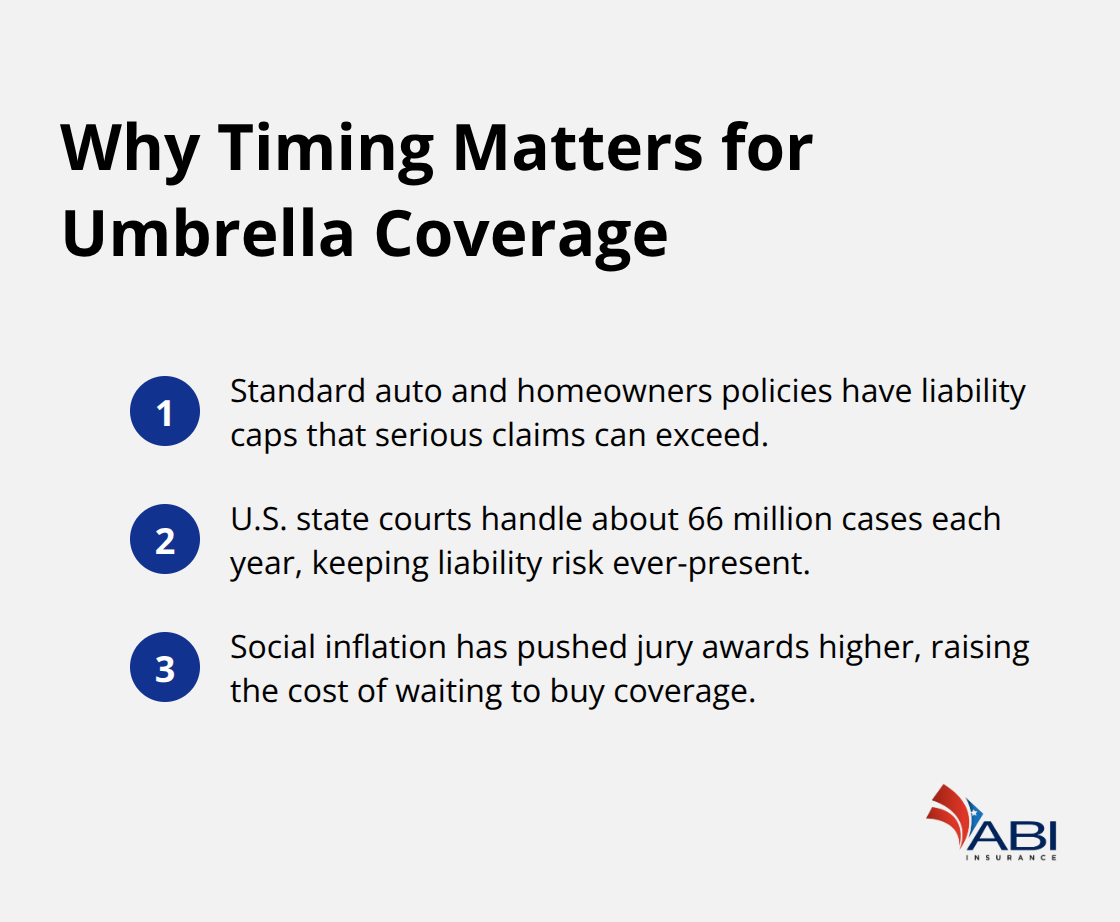
Umbrella insurance isn’t something you buy on a fixed schedule. It’s something you add when specific situations in your life create exposure that your standard auto and homeowners policies can’t handle alone. The Insurance Information Institute reports that state courts handle approximately $66 million cases each year, and social inflation has driven jury awards significantly higher in recent years. That’s the reality behind umbrella timing: waiting costs money you don’t have to spend.
Major Life Events That Signal You Need More Coverage
Marriage and combining households represent one of the clearest triggers. When two people merge their assets, income, and vehicles, their liability exposure jumps immediately. A teenager obtaining their driver’s license marks another hard deadline. Statistically, teen drivers are involved in more accidents. If your child causes a serious crash, the judgment could exceed your auto policy limits by hundreds of thousands of dollars. Purchasing your first home or upgrading to a property with higher value follows the same logic — home equity becomes an asset a lawsuit can target. If you own rental property, that exposure multiplies because you’re liable for injuries that occur on someone else’s property that you control. Starting a small business or becoming self-employed means personal assets are no longer shielded by corporate structure the way a traditional job provides.
Calculating When Your Assets Outpace Your Coverage
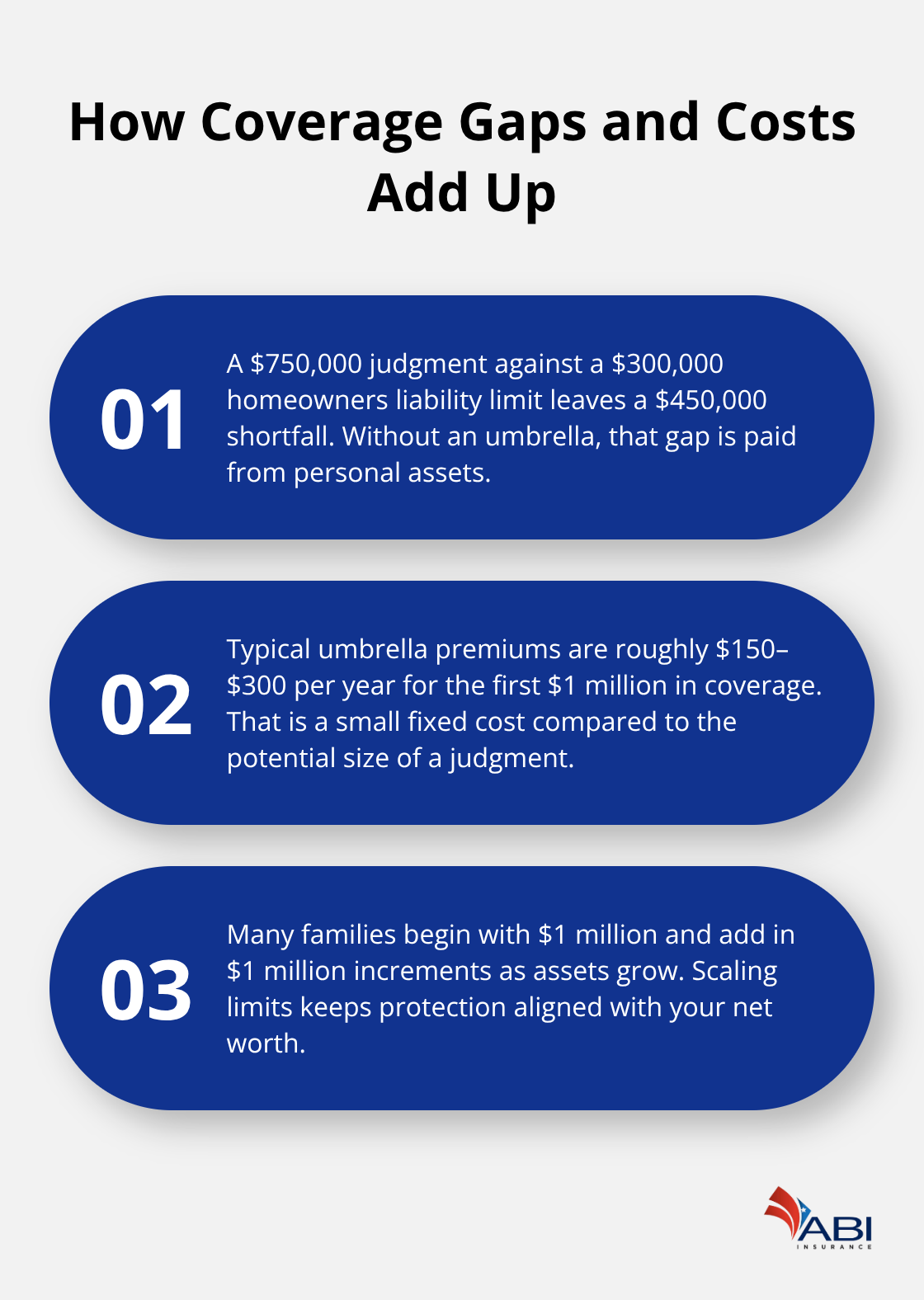
Asset growth happens gradually, but protection gaps grow faster. Most umbrella policies require underlying auto liability limits of at least $300,000 per person and homeowners liability of $300,000. If your net worth, including home equity, vehicles, investments, and retirement accounts, exceeds $500,000, your current coverage likely leaves you exposed. The math is straightforward: if a jury awards $750,000 and your homeowners policy caps at $300,000, that $450,000 gap comes from your assets. Typical umbrella premiums run around $200 to $300 per year for the first $1 million in coverage, making this protection affordable relative to what it guards. Many families start with $1 million in umbrella limits and add another $1 million in increments as assets grow.
A swimming pool, trampoline, or recreational vehicle on your property increases claim frequency and severity, which means your liability exposure rises even if your asset base stays flat.
When to Act Before Problems Multiply
The worst time to discover you need umbrella coverage is during a lawsuit. Proactive families add umbrella coverage when they acquire new assets or take on new activities that increase risk. Hosting frequent gatherings, coaching youth sports, or volunteering on boards create situations where someone on your property or under your supervision could be injured. Ordering packages online and having them delivered to your home, carpooling with other families, or babysitting friends’ children at your house might sound routine. However, each scenario carries liability risk that umbrella policies specifically cover. The timing decision isn’t complicated: add coverage when your assets are worth protecting, your family’s activities multiply potential claims, or your income is substantial enough that wage garnishment from a judgment would hurt.
Identifying Your Personal Risk Threshold
Your specific circumstances determine when umbrella coverage becomes necessary rather than optional. Someone with significant assets faces greater exposure than someone with modest savings. A family with multiple teenage drivers encounters more risk than a household with one adult driver. Your professional role matters too. Self-employed individuals and business owners lack the liability protections that traditional employment structures provide. These conditions rarely announce themselves loudly. They accumulate as life gets busier and more complex, which is precisely why calculating your actual exposure now prevents scrambling later. The next step is to determine exactly how much umbrella coverage your family actually needs.
How Much Umbrella Coverage Your Family Needs
Calculate Your Total Assets at Risk
Start by adding up everything you own. Your home equity, vehicles, investment accounts, retirement savings, and include any other assets a lawsuit could target. If your net worth sits at $500,000 or higher, your existing auto and homeowners policies almost certainly leave you exposed. Some standard homeowners policies cap liability at $300,000, and auto policies can max out between $250,000 and $300,000 per incident. That means a serious accident or injury claim can quickly exhaust your underlying coverage and start eating into your actual assets.
A good rule of thumb is to choose umbrella coverage at least equal to the total value of your property, savings, and investments. This isn’t theoretical math — it’s the difference between protecting your family’s financial future and losing savings you spent decades building. If you own a home worth $400,000 with $200,000 in equity, plus $150,000 in investments and retirement accounts, you sit at roughly $350,000 in unprotected assets. A single liability judgment of $600,000 wipes out everything.
Match Your Coverage to Your Actual Exposure
Typical umbrella premiums run between $200 and $300 per year for the first $1 million in coverage, which means you spend less than $300 annually to guard $350,000 or more in assets. The math heavily favors purchasing coverage now rather than facing a judgment later. Your specific risk profile determines whether $1 million is enough or whether you need more. Families with multiple teenage drivers, rental properties, swimming pools, or trampolines face higher claim frequency and severity.
Someone who hosts frequent gatherings, coaches youth sports, or volunteers on boards creates additional liability exposure beyond normal homeownership. Self-employed individuals and business owners lack the liability protections that traditional employment provides, which means personal assets connect directly to professional risks. Landlords face exposure from tenant injuries, guest accidents on rental property, and liability claims that exceed standard homeowners limits.
Adjust Your Coverage as Your Wealth Grows
Social inflation has driven jury awards significantly higher in recent years, according to the Insurance Research Council, meaning judgments that seemed unlikely five years ago are becoming routine today. If your net worth exceeds $1 million, consider starting with $2 million in umbrella coverage rather than $1 million. As your assets grow through home appreciation, investment gains, or inheritance, revisit your coverage every two to three years and adjust upward accordingly.
The goal isn’t to purchase maximum coverage; it’s to match your protection level to what you actually have worth defending. Once you understand how much coverage you need, next identify which mistakes most families make when they finally do add umbrella protection.
Common Mistakes Families Make With Umbrella Policies
Waiting Until Disaster Strikes to Act
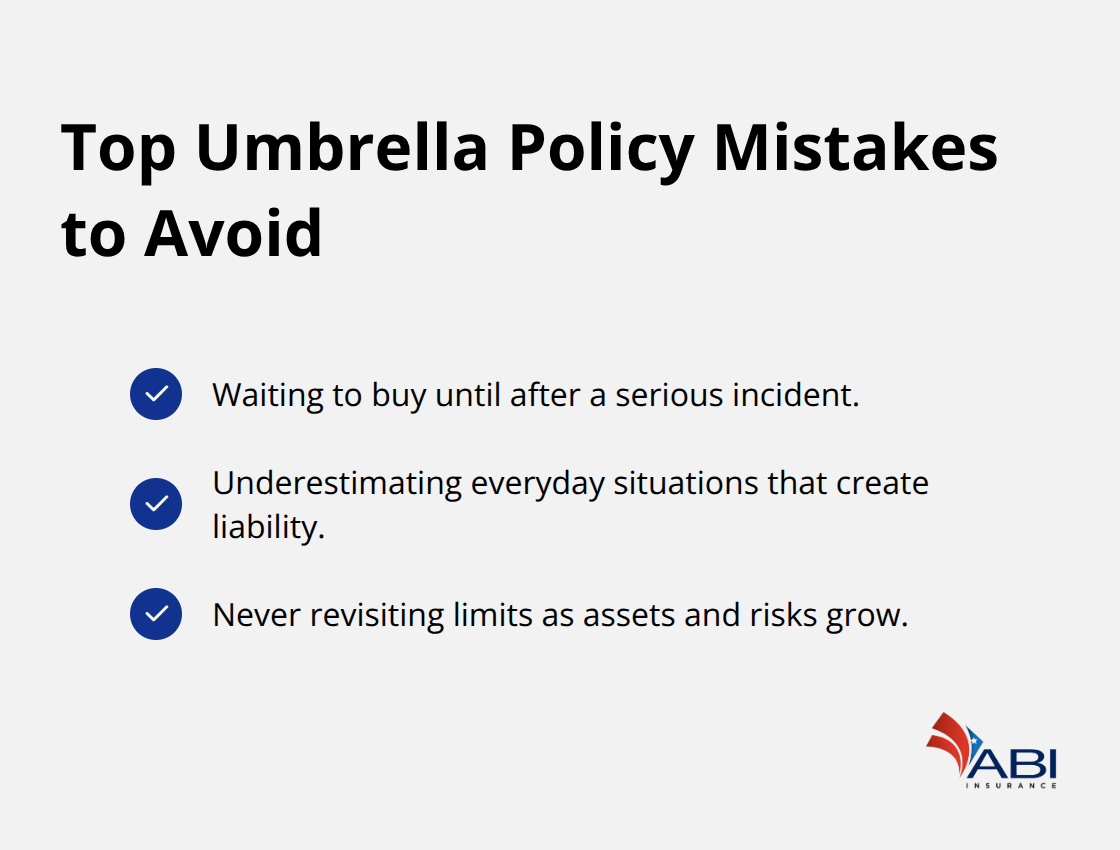
Most families commit the same three errors with umbrella insurance, and each one costs them money they never recover. The first mistake is treating umbrella coverage as something to buy eventually rather than something to add when your situation demands it. Families delay this decision for years, accumulating assets and responsibilities while their underlying policies stay frozen at limits set a decade earlier. Then a single accident happens — a teenager causes a serious multi-car crash, a guest falls at your home during a holiday gathering, or a dog bite occurs in your yard. Suddenly you discover your $300,000 homeowners limit covers only half of the judgment.
The damage is done. You cannot retroactively purchase umbrella coverage for an incident that already occurred. Courts don’t care that you meant to add protection eventually. They care about what you had in place when the accident happened. Waiting until your net worth reaches $750,000 or $1 million to purchase umbrella coverage means you’ve spent years operating without adequate protection during the exact period when you had the most to lose.
Underestimating Which Situations Create Real Liability
The second critical mistake involves fundamentally underestimating which situations create real liability exposure. Families often think umbrella insurance protects them only against major accidents like serious car crashes or pool drownings. That narrow view causes them to skip coverage entirely or purchase limits far too low. A guest trips on a cracked step while leaving your home and breaks their leg. Medical bills and lost wages exceed $200,000. Your homeowners policy covers $300,000 in liability, so you’re fine, right? Except the guest’s lawyer also argues you were negligent in home maintenance. The settlement climbs to $450,000. Your homeowners policy pays $300,000. You personally owe $150,000.
That scenario isn’t hypothetical; it’s routine. Hosting gatherings, allowing your children’s friends to visit regularly, volunteering on nonprofit boards, coaching youth sports, and owning rental properties all generate claims that exceed standard policy limits far more often than most families realize. Each activity multiplies your exposure without most people recognizing the risk.
Neglecting to Review Coverage as Life Changes
The third mistake compounds the first two: families who do purchase umbrella coverage never revisit their limits as their circumstances change. You buy $1 million in coverage at age 35 when your net worth is $400,000. Then at age 50, your home has appreciated $200,000, your retirement accounts have grown to $500,000, and your business generates significant income. Your umbrella limit hasn’t changed in 15 years. That mismatch between assets and coverage leaves you vulnerable to exactly the kind of judgment that destroys wealth.
Review your umbrella needs every two to three years when major life changes occur — your home appreciates, your investments increase, children start to drive, or you purchase rental property. This practice keeps your protection aligned with what you actually own and prevents the gap between your assets and your coverage from widening into a financial liability.
Final Thoughts
The timing of your umbrella policy decision matters far more than most families realize. If you own a home, drive regularly, have teenage drivers in your household, or maintain significant investments, your umbrella policy timing should shift from “someday” to “now.” Americans file approximately 15 million civil lawsuits annually, and social inflation continues to push jury awards higher. This means a single serious accident can generate judgments exceeding $500,000 or more.
Your specific situation determines when umbrella coverage becomes necessary rather than optional. Marriage, purchasing property, starting a business, acquiring rental units, or watching your net worth climb all signal that your existing auto and homeowners limits no longer match your exposure. Add up your home equity, vehicles, investments, and retirement savings. If that total exceeds $500,000, your current coverage leaves you exposed to financial loss that could have been prevented.
The final step involves working with someone who understands your complete financial picture. At ABI Insurance, our team helps families across the Portland metro area and the Western U.S. identify the umbrella protection they need by reviewing your assets, activities, underlying policy limits, and your risk tolerance. Contact ABI Insurance to discuss your umbrella coverage needs and receive a personalized recommendation for your family’s protection.


 Cyber Risk Liability Coverage: Safeguard Your Digital Front Door









