
Cyberattacks cost businesses an average of $4.45 million per incident, according to IBM’s 2024 Data Breach Report. Most companies discover they lack adequate protection only after an attack happens.
At ABI Insurance, we’ve seen firsthand how cyber risk liability coverage fills the gaps that standard policies leave wide open. This guide walks you through what this coverage protects, how to assess your needs, and which policies deliver when you need them most.
What Cyber Threats Actually Cost Your Business
Cyberattacks strike businesses every single day, and the financial damage extends far beyond stolen data. According to IBM’s 2024 Data Breach Report, the average cost of a data breach reached $4.45 million in 2023, and that number continues to climb. Small and medium-sized businesses face the worst odds because attackers know they typically lack dedicated security teams and sophisticated defenses.
Real-World Losses That Hit Hard
A construction firm fell victim to a keylogger attack through phishing and lost $550,000 in unauthorized wire transfers. The bank recovered only $200,000, leaving a $350,000 gap that came straight out of operating capital. Ransomware attacks prove equally devastating. One manufacturing business faced a $750,000 ransom demand with a $500,000 deductible in their insurance policy, leaving them exposed to massive losses on top of recovery costs and downtime. These aren’t hypothetical scenarios. They happen to businesses that thought they were protected.
Why Your Current Policies Leave You Exposed
Your standard business insurance policies were designed decades ago, long before cyber threats became a boardroom priority. General liability policies explicitly exclude cyber incidents. Property and casualty coverage doesn’t touch data recovery, notification costs, or business interruption from a ransomware attack. Even errors and omissions coverage leaves you exposed to third-party claims that stem from a data breach.
When customer data gets compromised, you face liability for notification expenses, forensic investigations, credit monitoring services, and potential regulatory fines. A data breach can trigger notification costs alone that exceed $100,000 for mid-sized organizations. Add legal defense fees, regulatory penalties, and public relations expenses, and you’re looking at costs that standard policies don’t address.
The Coverage Gap That Costs Millions
Businesses can face serious financial trouble when their current coverage falls short of the true cost of a cyber incident. Your existing policies were never built to handle the modern threat landscape. This is where cyber risk liability coverage steps in to fill those dangerous holes and protect what matters most to your operation.
What Your Cyber Coverage Pays For
Immediate Response and Investigation Costs
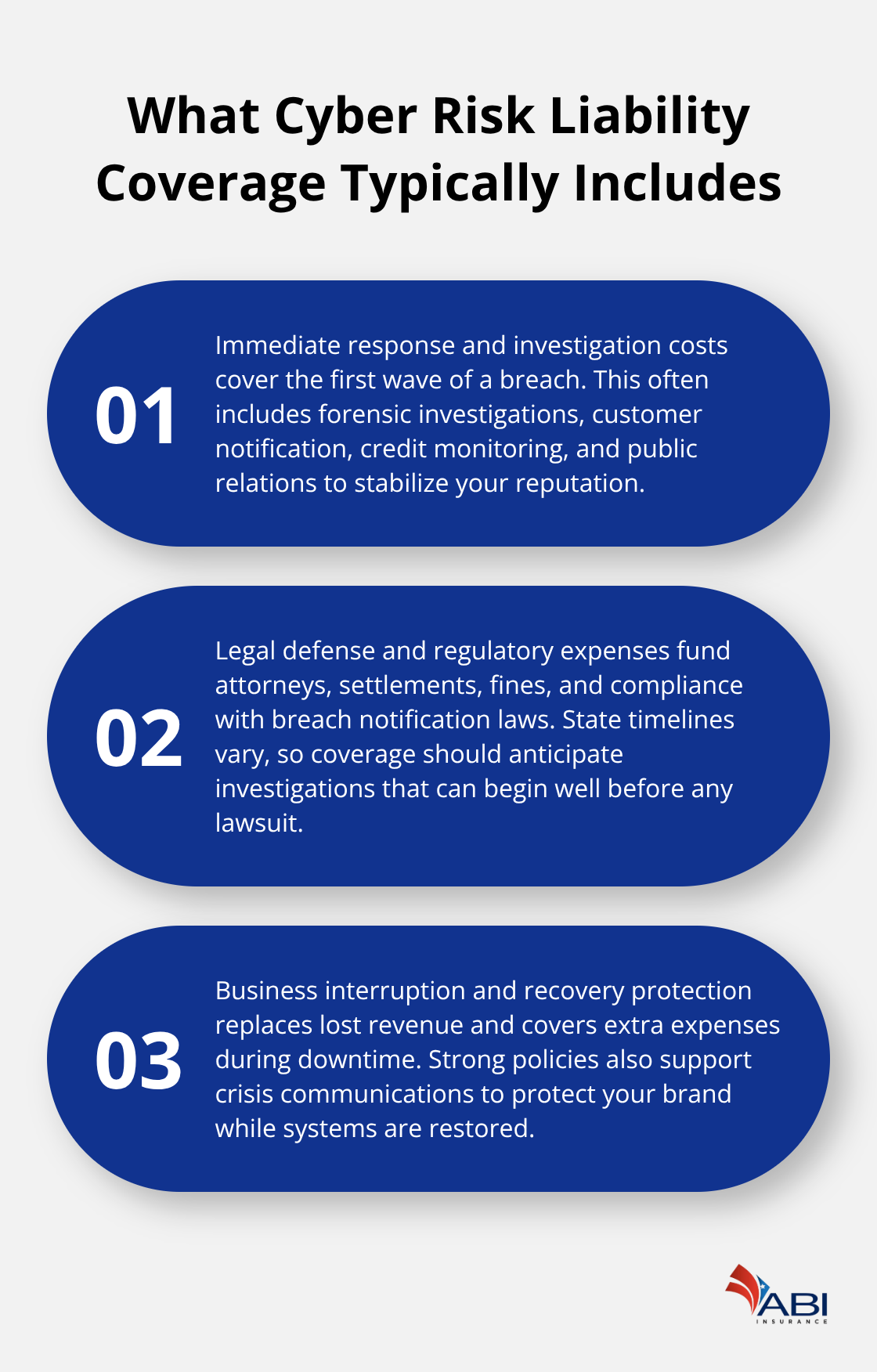
Cyber risk liability coverage addresses three categories of costs that standard policies ignore completely. First, it covers the immediate expense of responding to a breach: forensic investigations to determine what happened, notification costs to inform affected customers, credit monitoring services, and public relations efforts to manage your reputation. When a breach occurs, these response costs alone can range from $100,000 and up depending on the number of affected individuals and the complexity of the investigation.
Legal Defense and Regulatory Expenses
Second, the policy covers legal and regulatory expenses that follow a breach. This includes defense costs if customers or regulators sue your business, settlement payments, fines from state attorneys general or federal agencies, and expenses to comply with breach notification laws. Data breach notification costs vary by state. Some require notification within 30 days, others within 60 days, and each state sets different standards for what constitutes adequate notice. Your policy should specify whether it covers notification expenses for all affected parties or only those required by law.
Legal defense coverage should include representation in regulatory investigations, not just lawsuits. Regulatory investigations often occur before any lawsuit materializes, so ask your insurer whether the policy covers regulatory defense costs separately from litigation costs. Confirm whether the policy includes coverage for cyber extortion demands and the costs associated with negotiating with attackers.
Business Interruption and Recovery Protection
Third, cyber coverage protects against business interruption losses when a cyberattack forces your systems offline. If ransomware encrypts your files or a DDoS attack takes down your website, you lose revenue during downtime and face recovery costs to restore operations. A manufacturing business that suffered a ransomware attack faced a $750,000 ransom demand with downtime costs exceeding the ransom itself. Without cyber liability coverage, that organization absorbed the full financial impact.
Business interruption coverage should account for both lost revenue and the extra costs of operating during recovery, such as overtime for IT staff or temporary equipment rentals. The strongest policies cover crisis management expenses, which include hiring outside communications firms to protect your brand reputation during and after an incident.
Reading Your Policy: What Actually Matters
The specifics matter enormously when you’re evaluating a policy. The difference between covering forensic investigation costs and covering only the notification itself can mean the difference between a manageable loss and a catastrophic one. Review your policy’s definitions carefully because coverage terms vary significantly across insurers. Ask whether the policy includes coverage for cyber extortion demands, regulatory defense costs, and crisis management expenses. These three elements separate adequate protection from comprehensive protection.
When you move forward to selecting a policy, you’ll need to understand not just what each insurer covers, but how their specific terms align with your business’s actual vulnerabilities and financial exposure.
Choosing a Cyber Liability Policy That Fits Your Business
Map Your Data and Critical Systems First
The biggest mistake we see is when business owners select a cyber policy based on price alone, then discover the coverage doesn’t match their actual exposure. Start by mapping what data your business holds, and which systems would cripple operations if compromised. A healthcare practice handles patient records subject to HIPAA regulations, so notification and regulatory defense costs matter more than they would for a retail business. A manufacturing firm depends on continuous production, so business interruption coverage becomes non-negotiable. Spend time identifying which assets are indispensable before you compare a single policy.
Understand Your Deductible Structure
Next, understand your financial capacity to absorb losses. The deductible on a cyber policy functions differently than a standard insurance deductible because cyber incidents often trigger multiple coverage categories simultaneously. A ransomware attack might activate business interruption coverage, forensic investigation coverage, and regulatory defense coverage all at once. If your policy carries a $10,000 deductible per claim but defines each coverage type as a separate claim, you could face $30,000 in out-of-pocket costs before the insurer pays anything. Ask insurers whether they apply a single deductible per incident or separate deductibles per coverage type, because this distinction directly impacts your financial exposure.
Set Coverage Limits Based on Realistic Scenarios
Coverage limits matter equally. The average cost of a data breach reached $4.45 million according to IBM’s 2024 Data Breach Report, but that figure includes massive enterprises. A mid-sized business with 500 employees and customer records might face $500,000 to $1 million in actual losses from a breach. Calculate your realistic worst-case scenario by estimating notification costs at roughly $50 to $200 per affected record, adding forensic investigation costs of $50,000 to $150,000, and factoring in potential regulatory fines based on your industry.
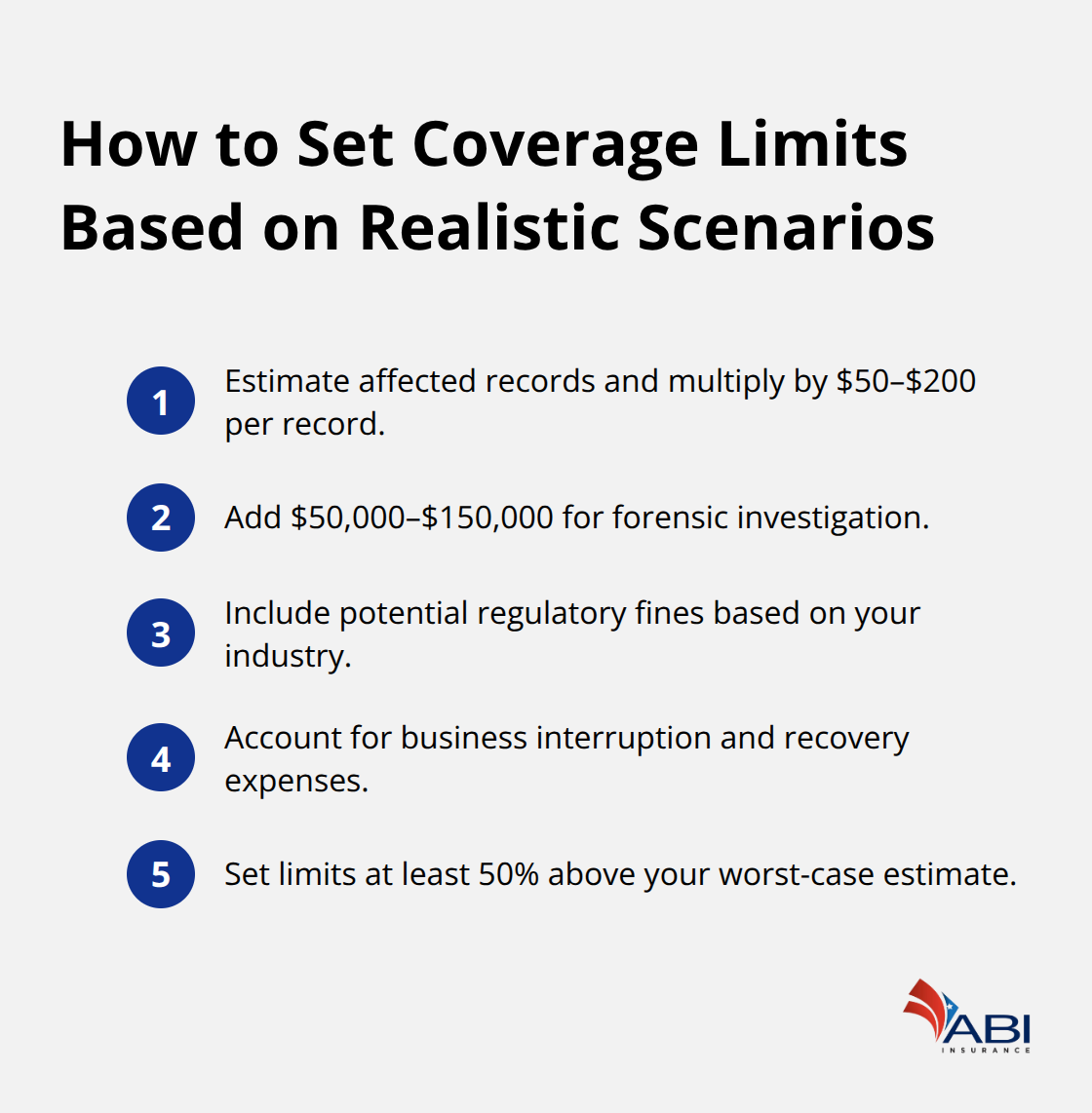
Set your coverage limits at least 50% above your calculated worst-case number because actual incidents frequently exceed initial estimates.
Evaluate Insurer Expertise and Claims Support
When evaluating insurers, prioritize companies with genuine cyber expertise rather than those simply rebranding existing liability coverage as cyber products. Ask whether the insurer has a dedicated cyber claims team available 24/7 and whether they maintain relationships with breach response firms, forensic investigators, and crisis management specialists. Some insurers allow you to choose your own response vendors while others restrict you to their preferred network, so confirm this upfront. Request references from businesses in your industry and ask specific questions about claims experience. Did the insurer respond quickly when the business submitted a claim? Did the insurer dispute coverage or accept claims promptly?
Request a detailed policy comparison document that shows exactly what each insurer covers regarding data breach notification requirements, regulatory investigation defense, cyber extortion expenses, and business interruption. The strongest policies include coverage for the costs of notifying customers regardless of whether notification is legally required, because notification often prevents greater damage to your reputation and customer relationships. Confirm the policy covers regulatory defense costs separately from litigation costs because regulatory investigations frequently occur months before any lawsuit materializes.
Leverage Security Investments for Premium Discounts
Finally, ask each insurer whether your business qualifies for premium discounts based on your security practices. Insurers increasingly reward businesses that implement multi-factor authentication, maintain isolated backups, conduct security awareness training, and deploy endpoint detection and response tools.
Final Thoughts
Cyber risk liability coverage transforms from optional to essential the moment your business handles customer data or depends on digital systems. When a breach strikes, costs accumulate rapidly — forensic investigations, notification expenses, legal defense, regulatory fines, and business interruption losses hit all at once. Standard insurance policies were never built for this modern threat landscape, which is why the gap between your current coverage and your actual needs has become dangerously wide.
The path forward requires matching your coverage to your specific vulnerabilities rather than purchasing a generic policy. Identify which data and systems would cause the most damage if compromised, then set your coverage limits based on realistic worst-case scenarios. Your deductible structure matters enormously because cyber incidents trigger multiple coverage types simultaneously. Confirm whether your policy applies a single deductible per incident or separate deductibles per coverage category, as this distinction directly impacts your out-of-pocket exposure when you need protection most.
Choose an insurer with genuine cyber expertise and 24/7 claims support rather than settling for a company simply rebranding traditional liability coverage. Ask about their relationships with breach response firms and forensic investigators, request references from businesses in your industry, and verify exactly what they cover regarding regulatory defense and cyber extortion expenses. We at ABI Insurance help businesses across the Portland metro area and Western U.S. navigate cyber risk with personalized coverage solutions backed by over 40 years of insurance expertise. Contact us to evaluate your cyber risk liability coverage needs and build protection that matches your business’s exposure.


 Commercial Auto Liability Limits: What Small Fleets Should Know









