


Medical malpractice insurance isn’t one-size-fits-all. Portland doctors face distinct risks based on their specialty, patient population, and practice structure, so choosing the wrong coverage can leave you exposed.
At ABI Insurance, we’ve helped countless Oregon physicians navigate doctor malpractice insurance options tailored to their specific needs. This guide walks you through the coverage types, provider comparisons, and evaluation criteria that matter most for your practice.
What Policy Type Works Best for Your Practice
Claims-Made vs. Occurrence: Understanding the Trade-Off
Claims-made and occurrence policies represent fundamentally different approaches to when coverage applies, and your choice shapes both immediate costs and long-term financial exposure. A claims-made policy covers only incidents where the claim is filed while your policy remains active, which is why premiums run 40 to 60 percent lower than occurrence policies initially. That cost advantage vanishes when you retire or change jobs because you must purchase tail coverage, which covers claims filed after your policy ends for incidents that occurred during your active coverage period. Tail coverage typically costs between 1.5 and 2 times your current annual premium, so a general surgeon paying $30,000 annually faces a $45,000 to $60,000 tail bill at retirement.

Coverage Limits: Meeting Hospital Requirements
Coverage limits merit careful attention because hospital credentialing and facility privilege requirements drive your minimum thresholds. Oregon hospitals typically require $1 million per claim and $3 million aggregate before granting privileges, though some high-risk specialties or larger systems demand $2 million per claim and $5 million aggregate. The National Practitioner Data Bank reported 94 Oregon medical malpractice payouts in 2023 totaling $70.4 million, with an average payout of $748,909. This figure justifies carrying limits at or above facility minimums.
Increasing your limits from $1 million to $2 million per claim typically raises premiums by around 40 percent or more, so many doctors accept the minimum rather than over insuring. This decision depends on your specialty risk and asset protection goals.
Tail Coverage: Timing and Cost Protection
Tail coverage must be purchased by the last day of your active policy to secure favorable rates, and carriers typically offer a 30-day window for standard pricing. Oregon’s statute of limitations allows patients two years from discovery to file a claim and three years for wrongful death cases, which means tail coverage extending two to three years beyond your policy end date provides reasonable protection against delayed discovery claims.
Understanding these policy mechanics positions you to evaluate which providers actually deliver the coverage structure and claims support your practice needs.
Choosing the Right Insurance Provider for Your Specialty
Shopping across multiple carriers yields 30 to 50 percent savings compared to accepting the first quote you receive, making carrier comparison one of the highest-return activities you can undertake. When you request quotes, specify your exact procedures, patient volume, and facility requirements. Vague requests produce vague pricing that won’t reflect your actual risk.

The Doctors Company and MedPro Group all maintain AM Best financial strength ratings of A or higher and actively write physician coverage in Oregon, but premium differences between them for the same specialty can exceed $10,000 annually. A general surgeon might pay $25,000 with one carrier and $35,000 with another for identical $1 million-per-claim coverage, yet many doctors accept the first quote because they assume all policies function the same way. Deductibles also vary substantially. A $2,500 deductible reduces premiums by roughly 10 to 15 percent compared to a zero deductible, but that savings disappears if you face a claim and must pay out-of-pocket before coverage activates. Higher deductibles make sense only if your practice generates sufficient cash flow to absorb that exposure without financial strain.
Financial Strength Determines Claims Payment
An insurer’s financial strength determines whether they can actually pay your claim when severity exceeds reserves. AM Best ratings (A or higher) indicate the carrier can withstand catastrophic losses, which matters because Oregon’s lack of damage caps means individual awards can reach $2 million or more. A carrier offering a $5,000 annual discount but holding a B+ rating creates unacceptable risk, if they face reserve depletion from severe claims across their book, your defense and settlement costs could face delays or inadequate funding. The Doctors Company and MedPro Group have demonstrated consistent claims-handling performance in surgical specialties where claim severity runs highest. When you evaluate a provider, request their average time-to-resolution for claims in your specialty and ask whether they employ local defense counsel in Oregon or rely on outside firms. Carriers maintaining relationships with established Portland-area defense attorneys typically resolve claims faster and more favorably because those attorneys understand local court dynamics and judges.
Local Market Knowledge Shapes Your Options
Oregon’s medical malpractice market contracted over the past five years as several national carriers exited the state, reducing your negotiating leverage if you shop only among remaining competitors. A broker with relationships across all active Oregon insurers can access quotes that individual practices cannot obtain directly, plus negotiate terms like consent-to-settle language that protect your reputation. Consent-to-settle provisions require your approval before settlement, preventing carriers from settling claims against your wishes and preserving your defense record and future insurability. Portland doctors commonly discover that their current carrier’s renewal quote is 20 to 30 percent higher than competing offers for identical coverage, yet they renew anyway because they lack visibility into alternatives. Taking two hours annually to obtain fresh quotes across three carriers typically yields $3,000 to $8,000 in annual savings, a return that justifies the effort.
Specialty Risk Drives Premium Variation
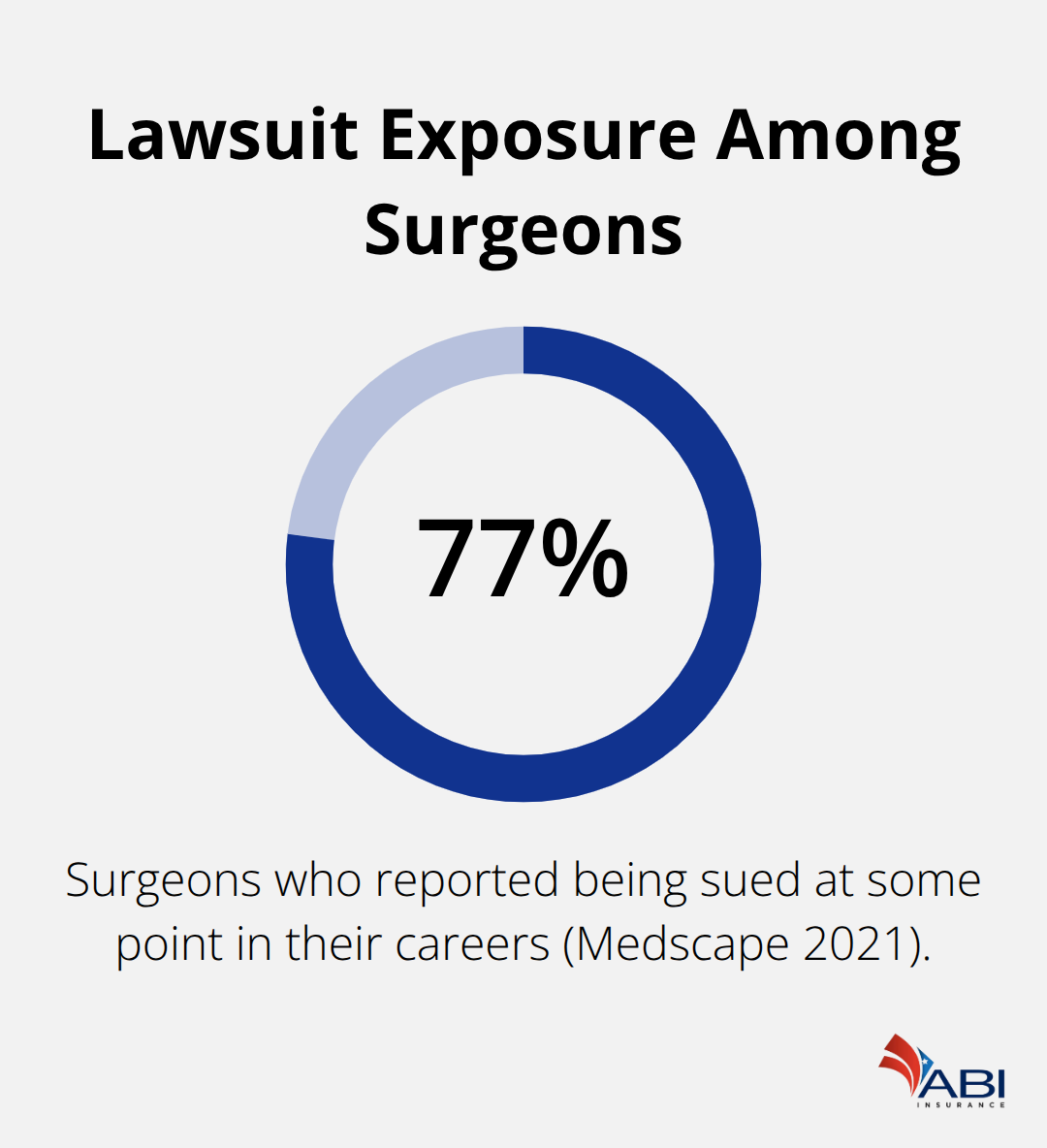
Your specialty determines not just the baseline premium but also which carriers actively compete for your business. Surgical specialties (general surgery, orthopedics, obstetrics) face substantially higher premiums than non-surgical fields because claim severity and frequency run higher in operating rooms. The Medscape 2021 Surgeon Malpractice Report found that 77 percent of surgeons faced lawsuits during their careers, explaining why surgical carriers price risk more aggressively. Emergency medicine and anesthesiology also command elevated premiums due to high-acuity patient populations and time-pressured decision-making. When you request quotes, carriers need to know your exact procedure mix-a general surgeon who performs spine work pays more than one who limits practice to abdominal cases.
Specialty-focused carriers often offer better rates for high-risk fields because they concentrate expertise and claims data in those areas, whereas broad commercial carriers may price surgical work conservatively.
Comparing Quotes Requires Precision
Vague quote requests produce meaningless comparisons because carriers interpret coverage scope differently. Specify your patient volume (annual cases or procedures), the exact procedures you perform, your facility requirements (hospital privileges, ambulatory surgery center, office-based), and whether you supervise residents or mid-level providers. Request quotes showing the same coverage limits ($1 million per claim and $3 million aggregate, or whatever your facility requires), the same deductible, and whether the policy is claims-made or occurrence. Ask each carrier whether their quote includes tail coverage costs or whether tail represents an additional expense at retirement. One carrier’s “competitive” quote might exclude tail entirely, while another includes it — comparing apples to apples requires identical policy structures. Once you receive quotes, verify that each carrier’s AM Best rating meets your threshold (A or higher), confirm their average claims-resolution time in your specialty, and assess whether they maintain local defense counsel relationships in Oregon. This precision transforms quote shopping from a frustrating exercise into a data-driven decision that protects both your finances and your practice reputation.
Matching Coverage to Your Practice Reality
Specialty Determines Your Premium Range
Your specialty, employment structure, and patient volume form the foundation for selecting appropriate coverage, yet most Portland doctors evaluate these factors poorly or not at all. Surgical specialties command dramatically higher premiums than non-surgical fields because operating room incidents generate larger claims. A general surgeon in Portland pays roughly $30,000 annually for $1 million per claim coverage, while a family medicine physician in the same market pays around $7,700 for identical limits, a difference driven entirely by claim frequency and severity data that insurers track meticulously. Orthopedic surgery averages $22,464 annually, obstetrics with major surgery reaches $55,000, and anesthesiology sits around $18,000. These aren’t theoretical numbers; they reflect actual 2025 market rates in Oregon. If you perform spine procedures, your premium climbs above standard general surgery because spine claims run more severe. If you supervise residents or mid-level providers, carriers add exposure premiums because your vicarious liability increases.
Providing Carriers with Precise Information
When you request quotes, carriers need specifics: How many surgical cases monthly? What percentage involve spine work? Do you perform complex reconstructions or straightforward procedures? Vague answers produce useless quotes because carriers cannot price risk what they cannot quantify. Your employment status matters equally. An employed physician at a hospital faces different coverage requirements than a solo practitioner because hospitals impose their own credentialing standards and often require higher limits like $2 million per claim and $5 million aggregate. Some hospital systems demand that physicians carry occurrence policies rather than claims-made, eliminating tail coverage uncertainty entirely. If you transition from employment to solo practice or vice versa, your coverage structure must shift accordingly, and many physicians fail to update their policies when employment changes, leaving themselves exposed to gaps.
Patient Population and Claims History Shape Risk Assessment
Patient population directly influences risk: an internist treating complex chronic disease patients faces different litigation exposure than one managing routine acute care. A practice serving low-income populations experiences different claim patterns than one serving affluent patients. An emergency medicine physician in a high-volume urban trauma center faces substantially higher risk than one in a suburban urgent care setting. When you evaluate coverage, tell carriers your patient demographics, annual volume, and acuity level because these factors shape how aggressively they price your risk. Carriers also weigh your prior claims history heavily; a clean ten-year record can yield 20 to 30 percent premium discounts with major carriers like The Doctors Company or MedPro Group. Conversely, a single prior claim increases your renewal premiums and narrows which carriers will quote you. This reality means that your claims history shapes available options as much as your specialty does.
Comparing Quotes Reveals Substantial Savings
Portland practices often assume all carriers price identically for a given specialty, then accept the first quote without comparison. That assumption costs you thousands annually. Obtaining quotes from three carriers for your exact specialty, patient volume, and procedure mix typically reveals $8,000 to $15,000 annual variation for identical coverage structures. A general surgeon might receive quotes of $26,000, $31,000, and $35,000 from different carriers, a spread that reflects different risk appetite, different underwriting criteria, and different competitiveness in your specific market segment. Taking time to collect precise quotes and compare apples to apples transforms your insurance decision from guesswork into a data-driven strategy. Each carrier interprets your risk profile differently, and those interpretations translate directly into premium differences that accumulate across your career.
Final Thoughts
Medical malpractice insurance protects your career, your assets, and your ability to practice medicine in Portland. Claims-made policies offer lower upfront premiums but require tail coverage planning at retirement or job transitions, while occurrence policies cost more initially but eliminate tail uncertainty entirely. Your hospital or facility will dictate minimum coverage limits, typically $1 million per claim and $3 million aggregate, though high-risk specialties and larger systems often demand higher thresholds.
Carrier selection matters as much as policy type because shopping across multiple providers yields 30 to 50 percent savings compared to accepting a single quote. The Doctors Company and MedPro Group all maintain strong financial ratings and actively compete in Oregon, but their premiums for identical coverage can differ by $10,000 or more annually. Requesting precise quotes that specify your exact procedures, patient volume, and facility requirements transforms quote shopping into actionable data that reveals which carriers actually compete for your business.
Your specialty drives premium variation more than any other factor. A general surgeon pays roughly $30,000 annually while a family medicine physician pays around $7,700 for the same coverage limits. Prior claims history shapes available options; a clean ten-year record yields 20 to 30 percent discounts, while a single prior claim narrows which carriers will quote you. We at ABI Insurance have guided Portland physicians through doctor malpractice insurance options for over 40 years, and contact us for a free consultation and personalized quotes that reflect your specialty, practice structure, and Oregon facility requirements.


 Finding the Right Insurance Broker: A Guide for Community Boards









