


Commercial auto deductibles can be confusing, but they’re one of the most important decisions you’ll make for your business. The deductible you choose directly impacts both your insurance premiums and how much you’ll pay out of pocket when a claim happens.
At ABI Insurance, we help businesses navigate these choices by breaking down the numbers and showing you exactly what different deductibles mean for your bottom line. This guide walks you through calculating costs, building reserves, and selecting the right deductible for your fleet.
What Your Commercial Auto Deductible Costs
Understanding the Basics of a Deductible
A commercial auto deductible applies when a covered vehicle is damaged due to events like collisions, theft, and vandalism. For example, if you have a covered loss and file a $5,000 claim with a $1,000 deductible, your insurer would pay $4,000 and you would pay $1,000 for the deductible. This straightforward concept gets complicated when you consider how it affects cash flow, premiums, and risk exposure across a fleet. The deductible you choose isn’t just a number on a policy; it’s a financial decision that shapes your entire insurance strategy. Most businesses start with common options like $500, $1,000, or $2,000, but the right choice depends on your specific situation, not industry averages.
How Deductibles Impact Your Premiums
Raising the deductible often lowers premium. How much depends on the carrier, fleet, territory, and loss history. Compare both options on your quote rather than using a rule of thumb. The tradeoff is cash at claim time. For example, a business has three covered physical-damage claims in a year.
⦁ $1,000 deductible = $3,000 out of pocket that year.
⦁ $500 deductible = $1,500 out of pocket that year.
The higher deductible only “wins” if premium savings over the year are larger than the extra you pay when claims hit — and if you can write those checks without straining payroll or repairs. Many owners look at premium first. Claim frequency and cash on hand usually decide whether a higher deductible actually costs less.
Fixed vs. Percentage-Based Deductibles
Fixed deductibles – a set dollar amount per claim – are standard for commercial auto and give you predictable costs. Percentage-based deductibles, which calculate based on your vehicle’s value, are rare in commercial auto but appear in some specialty coverages. For commercial fleets, fixed deductibles dominate because they are easier to budget and explain to your accounting team. The key is understanding that your deductible applies per claim, not annually, so a bad month with multiple incidents means you pay multiple deductibles.
Understanding these mechanics sets the foundation for calculating your actual financial exposure. The next section shows you how to project your expected claim costs and build the reserves necessary to handle them without straining your business.
How Much Will Claims Cost Your Business
Calculate Your True Claim Frequency
Knowing your deductible is only half the battle. The real financial challenge is understanding how often claims actually happen and what that means for your cash reserves. Most business owners underestimate claim frequency because they focus on major incidents and ignore smaller damage that accumulates quickly. Start by pulling your claims history from the last three years. Count every claim your fleet filed, regardless of size, and note the deductible you paid each time. If you filed six claims over three years, that equals two claims annually. Multiply two claims by your deductible amount to arrive at your baseline annual deductible exposure.
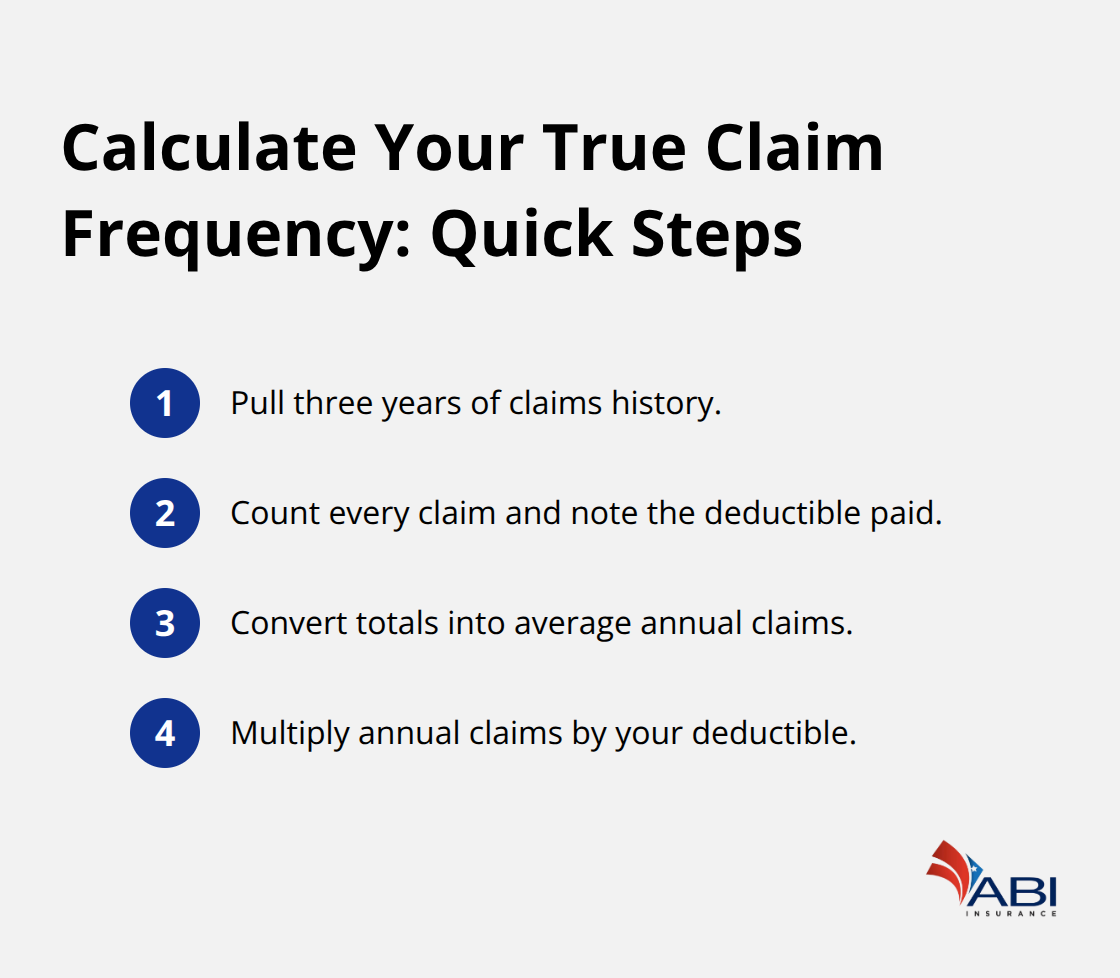
A $1,000 deductible with two annual claims means $2,000 leaves your account every year just for deductibles. Add a bad year with weather events or traffic-heavy seasons, and that number jumps to $3,000 or $4,000. This calculation changes everything because that premium savings from a higher deductible looks less attractive when you write checks for thousands in annual deductibles.
Build a Dedicated Claims Reserve Fund
Once you know your expected costs, build a dedicated claims reserve fund separate from your operating budget. This fund should hold at least 12 months of your average annual deductible costs, plus an additional 30% buffer for claims spikes. If your math shows $2,000 annually, your reserve should be at least $2,600. Keep this money in an accessible account, not invested long-term, because you need it when claims happen.
This matters operationally for a simple reason: when a vehicle gets damaged and you file a claim, the repair shop expects payment quickly. You cannot tell them to wait 30 days for cash flow. Your claims reserve prevents you from dipping into payroll or operational funds when deductibles come due.
Align Deductibles with Your Risk Profile
Factor your deductible costs into your overall risk management strategy by reviewing your choice annually. If your actual claims frequency is lower than expected, moving to a higher deductible at your next renewal might genuinely save money. If claims are higher, a lower deductible despite higher premiums could be the smarter financial move. The key is making this decision with real data, not assumptions.
Your deductible choice should align with your cash position, your actual driving patterns, and your fleet’s claims history, not with what other businesses in your industry typically choose. Understanding your true financial exposure sets the stage for the next critical decision: selecting a deductible amount that actually fits your business.
Selecting a Deductible That Matches Your Business Reality
Cash Reserves Set Your Deductible Ceiling
Your liquid reserves cap how high a deductible you can comfortably carry. If you have limited cash and several units on the road, a high per-claim deductible can wipe an emergency fund if more than one vehicle is hit in a short period. If reserves are stronger and claims are infrequent, a higher deductible may be workable in exchange for lower premium. Do not set the deductible to cash you hope to have next quarter.
Fleet Size and Driving Patterns Shape Claim Frequency
Fleet size and driving patterns determine how often you pay that deductible. A three-vehicle fleet used primarily for local deliveries in moderate traffic faces different claim frequency than a ten-vehicle fleet running long-haul routes through multiple states. Vehicles parked most of the time see theft and weather claims; vehicles on highways see collision claims. Pull your claims data and calculate your annual deductible expense under different scenarios. If your fleet averages one claim every 18 months, a higher deductible might work because you pay it infrequently. If you average three claims yearly, that same higher deductible becomes expensive quickly.
A construction company with five trucks in high-traffic areas might reasonably expect two to three claims annually, making a $500 deductible more sensible than a $1,000 option despite the premium difference. The premium savings from moving to $1,000 disappear when you multiply $1,000 by three claims, totaling $3,000 in annual out-of-pocket costs versus $1,500 at the lower deductible.
Balance Premium Savings Against Out-of-Pocket Reality
The real decision balances your actual claims frequency against your cash reserves and monthly budget capacity. Higher deductibles reduce premiums, but only choose them if your business genuinely goes years between claims or maintains substantial cash reserves. Lower deductibles cost more monthly but provide predictable, manageable out-of-pocket expenses that fit tight cash flow situations. A business with frequent claims and limited reserves should prioritize stability over premium reduction.
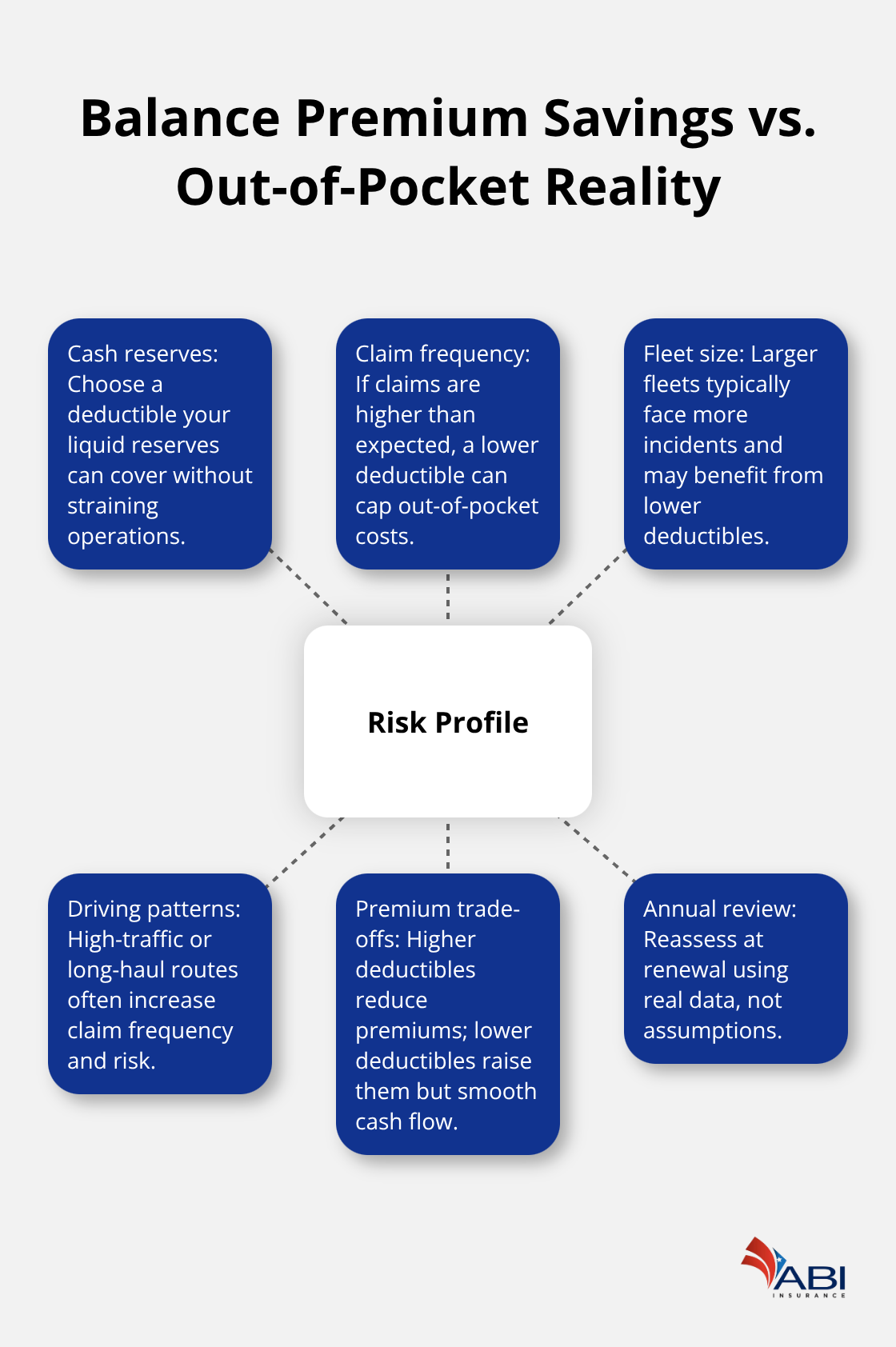
A business with infrequent claims and strong cash reserves can afford to absorb higher deductibles in exchange for lower monthly payments.
Final Thoughts
Selecting the right commercial auto deductible requires honest assessment of your cash position, claim frequency, and financial tolerance for out-of-pocket costs. Successful businesses stop chasing the lowest premium and start calculating their actual annual deductible exposure. If you file multiple claims yearly, a higher deductible that saves $50 monthly becomes expensive when you multiply it by three or four claims.
Your deductible choice shapes your entire risk management approach, so build a claims reserve fund that covers your expected annual deductible costs plus a buffer for bad years. Review this reserve annually and adjust your deductible at renewal if your actual claims history suggests a different approach. Align your deductible with your liquid cash reserves, your fleet size, and your driving patterns rather than industry averages.
At ABI Insurance, we help businesses across the Portland metro area and the Western U.S. navigate commercial auto deductibles, explained through real data and personalized guidance. Visit ABI Insurance to discuss your commercial auto deductible options and explore how we can help you manage risk effectively.


 Medical Malpractice Liability Insurance: What Oregon Medical Professionals Need









