

Portland drivers face unique insurance challenges — rain, congestion, and the region’s high cost of living — all of which push premiums higher than you might expect. At ABI Insurance, we’ve helped Portland residents find auto insurance that fits their situation. This guide walks you through the coverage options that matter most and how to get competitive rates in your area.
Why Portland’s Insurance Costs Might Run Higher Than You Think
Oregon’s average auto insurance premium is $1,997 annually according to recent Experian data, but Portland drivers typically pay more due to the region’s expensive repair shops and medical costs. A single fender-bender repair that costs $800 in rural Oregon can easily run $1,200 in the Portland metro area because labor rates and parts availability drive prices up. Insurance companies factor these regional costs directly into their quotes.
The Pacific Northwest Weather
Rain dominates Portland’s weather calendar with over 150 days of precipitation annually, and this directly impacts your collision risk. Wet roads don’t just cause accidents; they cause specific types of accidents that insurers track carefully. Hydroplaning incidents, reduced visibility collisions, and weather-related single-vehicle accidents happen far more frequently here than in drier climates. Additionally, comprehensive coverage claims can increase during winter months when fallen branches and flooding threaten parked vehicles.
Congestion and Urban Accident Patterns
The Portland metro area experiences consistent traffic congestion, particularly on Interstate 5 and around the I-405 corridor during rush hours. According to traffic data, Portland ranks among the top 30 most congested U.S. metros. More vehicles on the road sometimes means higher collision rates, which insurers measure and price accordingly. Downtown Portland and suburban areas like Beaverton, Lake Oswego, and Tigard all experience their own congestion hotspots where accidents cluster. Insurers adjust premiums based on your specific ZIP code because accident statistics vary dramatically between neighborhoods. A driver in downtown Portland might pay more than someone in outer suburban areas because the data proves accidents happen more often where traffic density is highest.
How Your ZIP Code Determines Your Rate
Your address matters far more than most drivers realize. Insurance companies use accident frequency maps that pinpoint exactly where collisions occur most often (and they update these maps quarterly). A Beaverton address carries different risk factors than a Lake Oswego address, even though both are located in the Portland metro area. Repair costs also vary by location-shops in affluent neighborhoods charge more than those in outer suburbs. This geographic pricing isn’t arbitrary; it reflects actual claims history and local economic conditions that directly impact what insurers pay out.
Understanding these cost drivers helps you approach your next insurance quote with realistic expectations and better negotiating power.
Getting Real Rates in Portland
Finding competitive auto insurance in Portland requires understanding what moves your premium up or down, then using that knowledge to negotiate better quotes. Most drivers waste time comparing policies without knowing which variables matter most for their specific situation.
Many Portland drivers make the mistake of requesting different deductibles from different companies, which makes the quotes impossible to evaluate fairly. When you raise your deductible from $500 to $1,000, your premium typically drops 15% to 25% depending on your age and driving history, but that savings only works if you can afford the higher out-of-pocket cost when an accident happens.
For Portland drivers specifically, try keeping comprehensive and collision deductibles at $500 unless your emergency fund comfortably covers $1,000, because weather-related claims happen frequently enough that the savings don’t justify the financial risk.
Bundling Stacks Savings Quickly
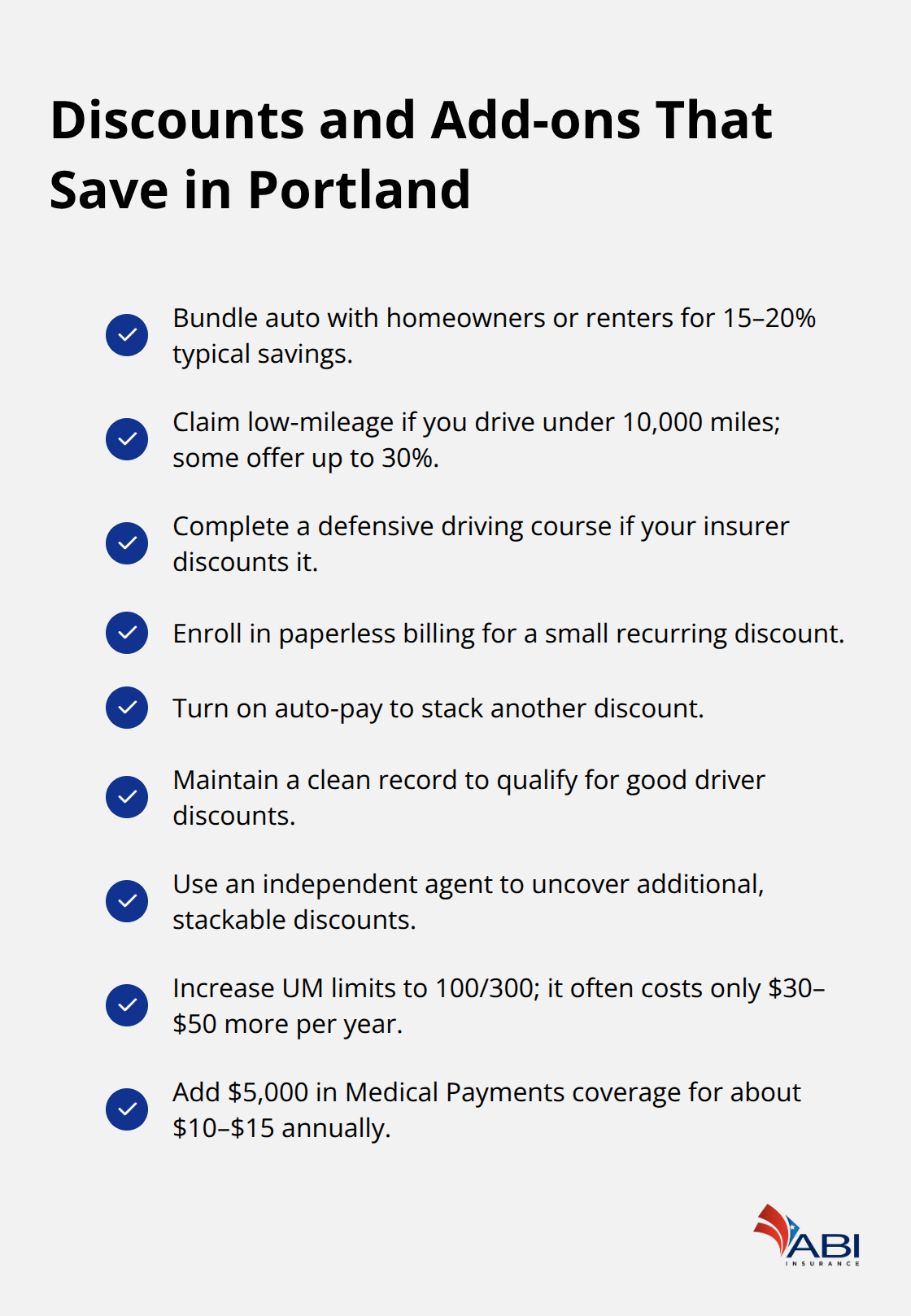
Bundling your auto insurance with homeowners or renters coverage typically saves 15% to 20% on your auto premium, which means the real comparison isn’t between auto policies alone but between bundled packages from different companies. Portland insurers often offer bundling discounts that national competitors don’t emphasize, so explicitly ask about this discount when you call for quotes and request a bundled rate before accepting any offer.
Discounts That Add Up Over Time
Low-mileage discounts matter significantly in Portland, where public transit and biking reduce driving frequency for many residents; if you drive fewer than 8,000 miles annually, some insurers offer discounts up to 30%, though you’ll need to track your mileage or install a monitoring device. Completing a defensive driving course may help you save on auto insurance if your insurer offers a defensive driver discount.
Ask whether your insurer offers paperless billing discounts, auto-pay discounts, or good driver discounts because these stack on top of larger discounts and add up to real money over time. An independent agent who works with multiple insurers can access discounts you won’t find by calling companies directly, and they handle the comparison work while understanding Portland’s specific risk factors that affect your rate.
Coverage Choices That Protect Your Wallet
The quotes you collect will only matter if you select coverage that protects you when accidents happen. Portland’s weather patterns and congestion create specific risks that demand careful coverage decisions.
Coverage That Protects Portland Drivers
Portland’s weather and traffic patterns demand coverage decisions that go beyond what works in other regions. Collision and comprehensive coverage aren’t optional here; they’re financial necessities that protect against the specific risks you’ll face.
Collision and Comprehensive Coverage
Uninsured Motorist Protection in High-Traffic Areas
Uninsured motorist protection addresses a real problem in Portland’s congested metro area where accident rates cluster in high-traffic zones. Oregon requires minimum uninsured motorist coverage, but the state’s minimum of $25,000 per person and $50,000 per accident won’t cover serious injuries in Portland, where medical costs run high.
Increasing your uninsured motorist limits to match your liability coverage — typically $100,000 per person and $300,000 per accident — costs only $30 to $50 more annually. This protection matters when an uninsured driver causes an accident that leaves you injured and unable to recover damages from their policy.
Medical Payments Coverage for Immediate Protection
Medical payments coverage operates differently from uninsured motorist protection. It covers your medical bills regardless of who caused the accident, which matters in Portland, where emergency room visits and follow-up care can be expensive. Adding $5,000 in medical payments coverage typically costs $10 to $15 annually. It covers immediate medical expenses without waiting for liability determination, making it practical protection in a high-congestion area where accidents happen frequently.
Final Thoughts
Auto insurance for Portland works best when you match your coverage to local risks rather than following generic recommendations. Evaluate whether a $1,000 deductible makes financial sense for your emergency fund, and don’t skip uninsured motorist or medical payments coverage given Portland’s accident rates.
An independent agent who understands Portland’s insurance market makes a measurable difference in what you pay and how well your coverage protects you. They know which insurers offer the best rates for drivers in your specific neighborhood, which discounts apply to your situation, and how to structure your coverage for maximum protection without overpaying.
At ABI Insurance, we have spent over 40 years helping Portland families and businesses find coverage that fits their specific needs. Based in Beaverton, we understand the metro area’s unique risks and work with multiple insurers to deliver rates that compete in your neighborhood.


 Physician Malpractice Insurance Oregon: Safeguard Your Practice









