


Oregon physicians face real pressure to get physician professional liability insurance right. The wrong policy leaves you exposed financially, while the right one gives you peace of mind.
At ABI Insurance, we have helped countless clinicians navigate this landscape. This guide walks you through Oregon’s specific requirements, how to assess your coverage needs, and what matters when comparing policies.
What Professional Liability Coverage Protects
Professional liability insurance protects you against claims that your medical judgment or treatment caused patient harm or financial loss. This includes surgical errors, misdiagnosis, delayed diagnosis, medication mistakes, and failure to obtain informed consent. The coverage pays for your legal defense costs, settlements, and judgments up to your policy limits. Without this protection, a single claim could deplete your personal assets, retirement savings, and future earnings. Oregon physicians need to understand that professional liability differs fundamentally from general liability insurance, which covers bodily injury or property damage unrelated to your clinical practice. Your malpractice policy specifically addresses the clinical decisions and treatments you provide to patients.
Claims-Made Versus Occurrence Policies
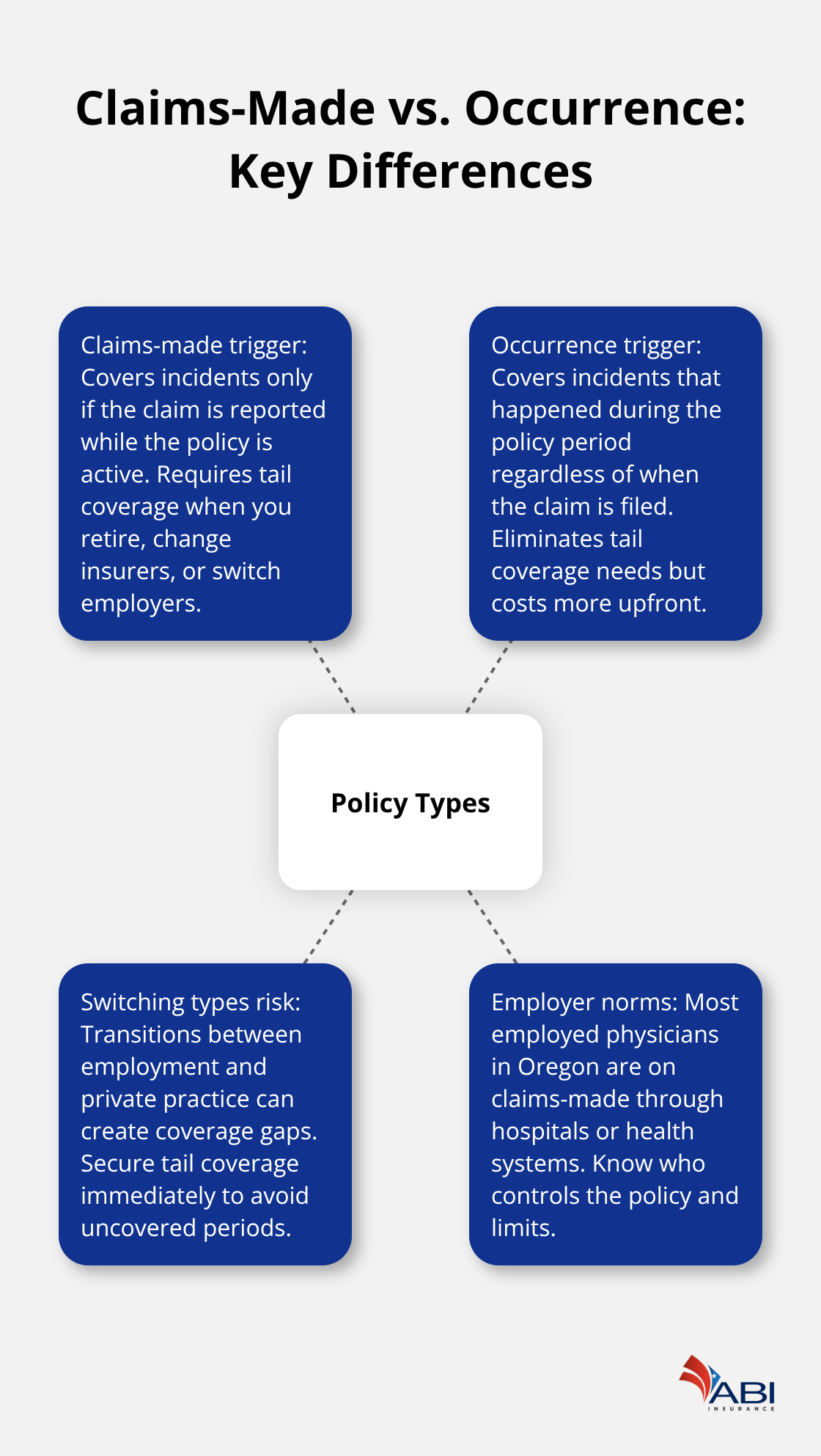
This distinction matters more than most physicians realize. A claims-made policy covers incidents only if the claim reaches your insurance company while the policy remains active. This means you need tail coverage after you retire or change insurers. An occurrence policy covers incidents that happen during the policy period, regardless of when the claim arrives. This eliminates the tail coverage requirement but typically costs 20% to 40% more upfront. Oregon does not mandate one type over the other, but most employed physicians work under claims-made policies through their hospital or health system. If you transition from employment to private practice or vice versa, switching policy types creates coverage gaps unless you purchase tail coverage immediately.
Review your current policy language carefully because many physicians misunderstand when their coverage activates.
Coverage Limits and Tail Protection
Oregon’s medical board does not specify minimum coverage amounts, but hospitals and health systems typically require $1 million per claim and $3 million aggregate. Solo practitioners often carry $1 million per claim and $3 million aggregate, while high-risk specialties like obstetrics and orthopedic surgery may need $2 million per claim and $4 million aggregate. Your coverage limit should reflect your specialty’s claims history, patient population, and personal risk tolerance. Tail coverage protects you after your policy ends by extending your claims-made coverage retroactively to cover incidents that occurred while your old policy remained active. This protection is essential when you retire, change practices, or switch insurers. A physician who worked under claims-made coverage for 20 years without purchasing tail coverage could face uncovered claims for earlier incidents from decades earlier if a patient files suit after retirement.
Why Your Specialty and Practice Setting Matter
Your risk profile determines which coverage limits and policy type make sense for your situation. Surgeons and obstetricians face higher claim frequencies and severity than primary care physicians, which affects both premium costs and recommended limits. Employed physicians typically have less control over their policy selection since hospitals and health systems choose coverage on behalf of their medical staff. Independent practitioners must evaluate their own exposure and select limits that match their patient population and procedure complexity. The transition between employment and private practice represents a critical moment when many physicians make coverage mistakes that leave them exposed.
Understanding these coverage fundamentals positions you to make informed decisions about your specific needs. The next section examines what Oregon’s regulations require and how state law shapes your coverage obligations.
Oregon’s Malpractice Insurance Requirements and What They Mean for You
The Regulatory Landscape in Oregon
The Oregon Medical Board does not mandate minimum coverage amounts, does not require physicians to carry malpractice insurance, and does not specify which policy type you must purchase. This absence of state-level requirements surprises many clinicians who assume Oregon has strict rules. However, this regulatory gap does not mean you have flexibility in your coverage decisions. Your hospital, health system, or medical group almost certainly requires coverage as a condition of employment or admitting privileges. If you practice independently, your malpractice carrier and your own risk assessment become your primary guides.
How Employment Contracts Shape Your Coverage Obligations
Oregon law shapes your coverage obligations through contract requirements rather than licensing board mandates. Your employment agreement or practice bylaws determine your actual coverage needs far more than state regulations do. Hospital systems across Oregon typically require $1 million per claim and $3 million aggregate coverage before they grant admitting privileges. Smaller independent practices and urgent care clinics frequently accept $1 million per claim and $3 million aggregate as minimum standards. Surgical specialties face higher institutional requirements because claims severity trends higher in Oregon’s market.
Understanding Oregon’s Statute of Limitations
Oregon’s statute of limitations for medical malpractice claims runs three years from discovery of injury or one year from when the injury reasonably should have been discovered, with an absolute 10-year cap from the date of the negligent act. This timeline matters directly to your tail coverage decision because claims can surface years after treatment ends. A physician who retires after 25 years of practice without tail coverage remains exposed to claims filed within three years of patient discovery, which could mean coverage gaps for incidents from 22 years earlier. The statute of limitations creates a window of vulnerability that extends well beyond your active practice years.
Verifying Your Institutional Requirements
You should verify your institutional coverage requirements in writing before assuming your employer’s policy meets your personal risk tolerance. Many physicians discover coverage gaps only when they transition between practices or retire. Your employment contract may reference coverage amounts that differ from what your institution maintains. Request written confirmation of your hospital’s or health system’s specific coverage limits and policy type. This documentation protects you if disputes arise about what coverage your employer provided.
Your coverage obligations in Oregon depend far more on your employment contract and institutional requirements than on state law. The next section examines how to assess your individual risk profile and select the right coverage limits for your specialty and practice setting.
Choosing the Right Coverage for Your Oregon Practice
Match Your Coverage Limits to Your Specialty’s Risk Profile
Your specialty and patient population should drive your coverage selection, not what your neighbor paid or what seemed cheapest. Orthopedic surgeons, obstetricians, and neurosurgeons face claim frequencies two to three times higher than family medicine physicians. This means they need higher limits and should scrutinize policy exclusions far more carefully. A primary care physician with a stable patient panel may operate effectively at $1 million per claim and $2 million aggregate, while a surgeon performing complex procedures should consider $2 million per claim and $4 million aggregate minimum. Your specialty and patient population should drive your coverage selection based on actual claims data in your field, making limit selection a financial decision with real consequences.
Your practice setting matters. Employed physicians in hospital systems have institutional risk management support, while solo practitioners absorb 100% of coverage gaps personally. Calculate your actual exposure by reviewing your patient demographics, procedure complexity, and the types of claims your specialty experiences in Oregon’s market.
Evaluate Claims Handling and Local Expertise
When comparing carriers, focus on claims handling speed and local expertise rather than premium price alone. A carrier that settles claims quickly and maintains relationships with Oregon defense attorneys will protect your time and reputation far better than a company that fights every claim to trial. Request specific information about average resolution times, settlement rates, and whether the carrier has established relationships with Oregon medical malpractice defense firms. Ask your state medical society or local hospital credentialing office which carriers handle claims most efficiently in your area.
Calculate Tail Coverage Costs Across Carriers
Compare tail coverage costs across carriers because premiums vary significantly and tail protection becomes non-negotiable when you transition practices or retire. A carrier that charges 250% of annual premium for tail coverage creates a substantial financial burden at career transition, while others charge 150%, saving you tens of thousands of dollars over your career. This difference compounds significantly over your career, so request tail coverage pricing from every carrier you evaluate before making your final decision.
Final Thoughts
Physician professional liability insurance in Oregon requires careful attention to your specific practice circumstances rather than generic solutions. Your coverage limits, policy type, and exclusions should reflect your specialty’s claims history, your patient population, and your institutional requirements. Oregon’s regulatory gap means your employment contract and personal risk assessment drive your actual coverage obligations far more than state law does.
Start by reviewing your current policy language to understand exactly what your coverage includes and excludes. Request written confirmation of your institutional coverage requirements if you’re employed, or calculate your personal exposure if you practice independently. Compare tail coverage costs across multiple carriers because this protection becomes essential when you transition practices or retire, and premium differences can exceed tens of thousands of dollars over your career.
Contact ABI Insurance to discuss your physician professional liability insurance needs with local experts who understand Oregon’s regulatory environment and your specialty’s actual risk profile. Our team has spent more than 40 years helping medical professionals across the Portland metro area secure appropriate protection for their practices. Your coverage decision deserves guidance from professionals who know your market, not generic advice from national carriers unfamiliar with Oregon’s medical landscape.


 Tricked, Not Hacked: Closing Your Association’s Social Engineering Coverage Gaps








