


Your personal assets are at risk every single day. A car accident, a slip on your property, or an injury at your home can lead to lawsuits that exceed what your standard homeowners or auto insurance covers.
An umbrella policy for individuals bridges that gap. At ABI Insurance, we’ve seen how this extra layer of liability protection saves people from devastating financial losses. This guide explains what umbrella coverage is, when you need it, and how to choose the right amount for your situation.
What Umbrella Insurance Covers
An umbrella policy is straightforward: it provides additional liability coverage that activates after your homeowners or auto insurance limits are exhausted. Most standard homeowners policies cap liability at coverage limits chosen by the policyholder, while auto policies typically max out at $250,000 to $500,000. When a lawsuit exceeds these amounts, you pay everything above that threshold out of pocket. Umbrella coverage sits on top of these policies and covers the gap. A $1 million umbrella policy costs between $200 and $300 annually for most individuals, making it one of the cheapest forms of protection available. The coverage applies to bodily injury claims, property damage claims, and certain personal injury situations, for example, defamation or invasion of privacy.
How Standard Policies Leave You Exposed
Your homeowners and auto insurance weren’t designed to protect wealthy individuals or those with significant assets. A serious accident — a guest injured at your home, a dog bite, a car crash where you’re found liable — can generate medical bills, lost wages, and pain-and-suffering awards that far exceed your policy limits. If your homeowners policy maxes at $300,000 and the actual judgment is $750,000, that $450,000 difference comes directly from your bank account, retirement savings, and future earnings. Umbrella insurance closes this exposure without requiring you to increase your underlying policy limits, which would cost far more. The key advantage is that umbrella policies are remarkably affordable because they only pay claims that exceed your base coverage, meaning they rarely pay out, so insurers price them accordingly.
Why Raising Limits Costs More Than Umbrella Coverage
Some people ask whether they should raise their homeowners and auto liability limits instead of buying umbrella coverage. This approach costs significantly more. Increasing your homeowners liability from $300,000 to $1 million might add $400 to $600 to the premium annually, while increasing auto liability similarly costs $200 to $400 more per year. A $1 million umbrella policy covers both exposures for $200 to $300 yearly. Additionally, umbrella policies follow a specific structure: they require you to maintain minimum underlying limits (typically $250,000 for auto and $300,000 for homeowners), then provide coverage above those amounts. This design means the umbrella insurer knows exactly what sits underneath and can price accordingly. The umbrella also covers gaps that your standard policies won’t touch, including legal defense costs that don’t count against your policy limit and certain liability exposures your homeowners or auto policies exclude entirely.
What Happens When You Face a Major Liability Claim
Understanding the mechanics of umbrella coverage matters when you need it. A serious accident triggers a claim against your homeowners or auto policy first. Once that policy limit is exhausted, your umbrella policy activates and covers the remaining liability up to its limit. This layered approach protects your assets without forcing you to carry unnecessarily high limits on your base policies.
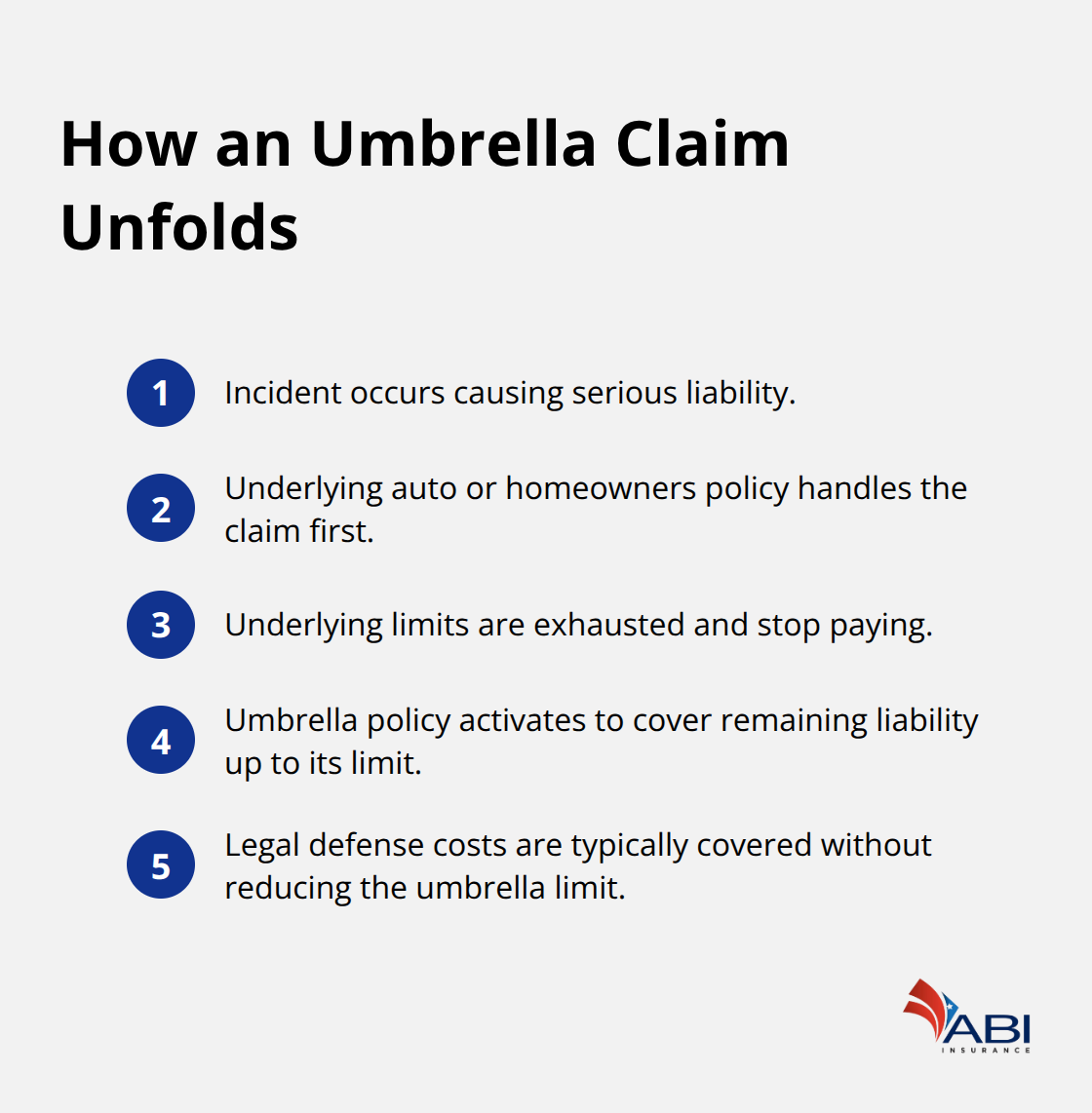
The umbrella insurer coordinates with your underlying carriers to manage the claim, so you’re not juggling multiple companies. Most umbrella policies also cover legal defense costs separately, meaning the insurer pays your attorney fees without reducing your coverage limit. This protection extends to situations your standard policies might exclude, making umbrella coverage far more comprehensive than simply raising your existing limits.
Who Needs Umbrella Insurance
If you own anything worth protecting, umbrella insurance matters. Most individuals across different financial situations wait too long to buy this coverage. The real question isn’t whether you need it, but whether you can afford to go without it. Someone earning $75,000 annually with a paid-off home worth $400,000 faces the same liability risk as a high-income professional. A single accident doesn’t discriminate based on income level. What changes is the financial damage. A homeowner with $300,000 in equity and no umbrella policy loses everything if a serious injury claim exceeds their underlying limits. The same accident for someone with $2 million in assets creates an even larger gap. This is why umbrella coverage isn’t a luxury; it’s a necessity for anyone with accumulated wealth, whether that’s a home, retirement savings, or investment accounts.
When Your Standard Policies Create Real Gaps
Everyday activities create genuine liability exposure that most people underestimate. A backyard gathering, a dog on your property, regular driving, or rental property maintenance all generate scenarios where claims exceed standard coverage. The Insurance Information Institute reports that about one in 1,100 homeowners policies have a liability claim related to the cost of lawsuits for bodily injury or property damage, yet most homeowners policies cap liability at $300,000 or less. Add a serious injury — permanent disability, ongoing medical care, lost wages — and judgments climb to $750,000, $1 million, or higher. A guest injured at your home, a dog bite requiring reconstructive surgery, or liability in a multi-vehicle accident can all trigger these scenarios. Umbrella insurance activates precisely when these situations occur. You don’t need it for minor fender-benders or small property damage claims. You need it when something goes catastrophically wrong, and the medical bills, legal judgments, and liability awards exceed what your homeowners and auto policies will cover.
Why Your Lifestyle and Activities Matter More Than Your Income
High-risk activities make umbrella coverage essential regardless of net worth. Swimming pools, trampolines, and frequent entertaining increase liability exposure. Someone who hosts regular parties, allows neighborhood kids to use their pool, or maintains a rental property faces demonstrably higher claim frequency.
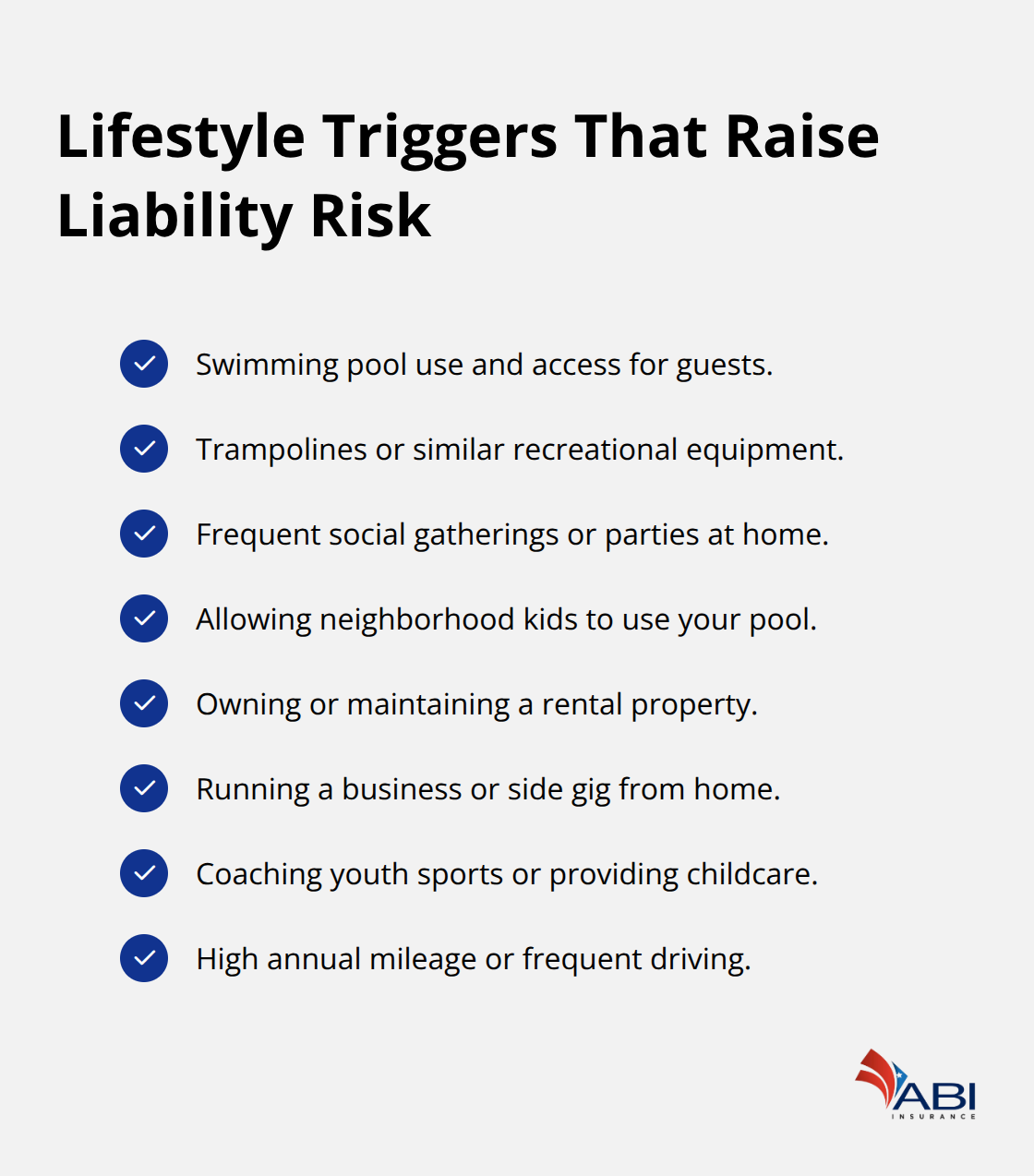
Similarly, commercial activities conducted from a home, coaching youth sports, or providing childcare often exceed standard homeowners coverage. Umbrella policies close these gaps and cover liability exposures that your base policies might exclude entirely. The cost remains remarkably low because insurers price umbrella coverage based on the understanding that serious claims are statistically rare. A $1 million umbrella policy still costs $200 to $300 annually for most individuals. That modest premium protects against the financial catastrophe that could otherwise wipe out decades of savings.
How to Recognize Your Personal Liability Exposure
Your actual risk profile determines whether umbrella coverage becomes urgent. Consider what you own, what activities you pursue, and what could realistically go wrong. A property owner faces higher exposure than a renter. Someone who entertains frequently faces higher exposure than someone who rarely has guests. A person who drives extensively faces higher exposure than someone who works from home. These factors, combined with your total assets, create your liability picture. The timing to purchase umbrella coverage is straightforward: before you need it. Once a serious accident occurs, it’s too late to apply for coverage. The next step involves assessing exactly how much protection your situation requires and understanding what coverage limits make sense for your financial position.
How Much Umbrella Coverage Do You Need
Calculate Your Total Insurable Assets
Start with honest math, not guesswork. Add up your home value, retirement accounts, investment portfolios, vehicles, and any other property that a lawsuit could seize. A homeowner with a $500,000 house, $300,000 in retirement savings, and $100,000 in investments has $900,000 in exposed assets. Someone with $2 million in total assets faces significantly higher exposure and needs proportionally stronger protection.
Most financial advisors recommend umbrella coverage that matches or slightly exceeds your total net worth, though your lifestyle and activities change this calculation. The typical recommendation sits between $1 million and $2 million for most individuals with substantial assets. However, the math changes if you engage in higher-risk activities. Someone who hosts frequent gatherings, operates a home business, maintains rental property, or has a swimming pool needs higher limits than someone with minimal entertaining and low activity exposure.
Understand Your Underlying Policy Requirements
Your umbrella policy requires minimum underlying limits before it activates, typically $250,000 for auto liability and $300,000 for homeowners liability. If your current policies fall below these thresholds, you’ll need to increase them first, which costs money but remains cheaper than raising all your coverage through base policies alone. Once those minimums are met, the real value of umbrella coverage becomes apparent.
A $1 million umbrella costs roughly $200 to $300 annually, while a $2 million umbrella typically runs $300 to $500 or more each year. This pricing makes it economical to carry higher limits than you might otherwise purchase through standard policies. The affordability means you should lean toward higher coverage rather than lower. A $2 million umbrella policy protects against catastrophic outcomes without the premium shock of raising all your underlying limits.
Match Coverage to Your Risk Profile
Beyond $2 million, coverage becomes more specialized and expensive, generally reserved for high-net-worth individuals or those with substantial business interests. Your specific situation, not generic recommendations, should drive your decision. Someone who entertains frequently faces different exposure than someone who rarely has guests. A property owner with a pool faces different exposure than a renter in an apartment.
Try selecting an umbrella limit that aligns with your net worth plus a 20% safety margin. This approach accounts for unexpected liability scenarios without overextending your premium costs. Working with an insurance agent who understands your specific situation (your assets, your activities, your property characteristics) ensures you’re not underinsured or paying for unnecessary coverage.
Final Thoughts
An umbrella policy for individuals stands between your savings and a lawsuit that could eliminate decades of financial progress. The financial protection it provides costs remarkably little compared to the catastrophic losses it prevents. For example, a $1 million umbrella policy runs about $200 to $300 annually, yet it protects against judgments that exceed standard homeowners and auto policy limits by hundreds of thousands of dollars. Standard policies weren’t designed to protect accumulated wealth, and they cap liability at amounts that sound reasonable until a serious accident happens.
Your liability exposure depends on what you own and what could realistically go wrong, not on how much money you earn. A homeowner with a paid-off house faces genuine risk from a guest injury or property damage claim, while someone who entertains frequently or owns a pool faces higher exposure. Calculate your total net worth, add a safety margin, and match that figure to your umbrella coverage limit-most individuals benefit from $1 million to $2 million in protection.
Purchase this protection before you need it, since once an accident occurs, it’s too late to apply. ABI Insurance can assess your specific situation, determine appropriate umbrella limits, and verify that your underlying policies meet your umbrella policy needs.


 Is Your Condominium Association Ready for the Next Big Earthquake?









