


Condo owners face a financial blind spot that most don’t realize until it’s too late. Your standard homeowners policy leaves earthquake damage completely uncovered, which means a single seismic event could wipe out your investment.
At ABI Insurance, we’ve seen firsthand how devastating this gap can be. This guide walks you through condo owner earthquake coverage and how to protect what you’ve built.
Why Earthquake Coverage Matters for Condo Owners
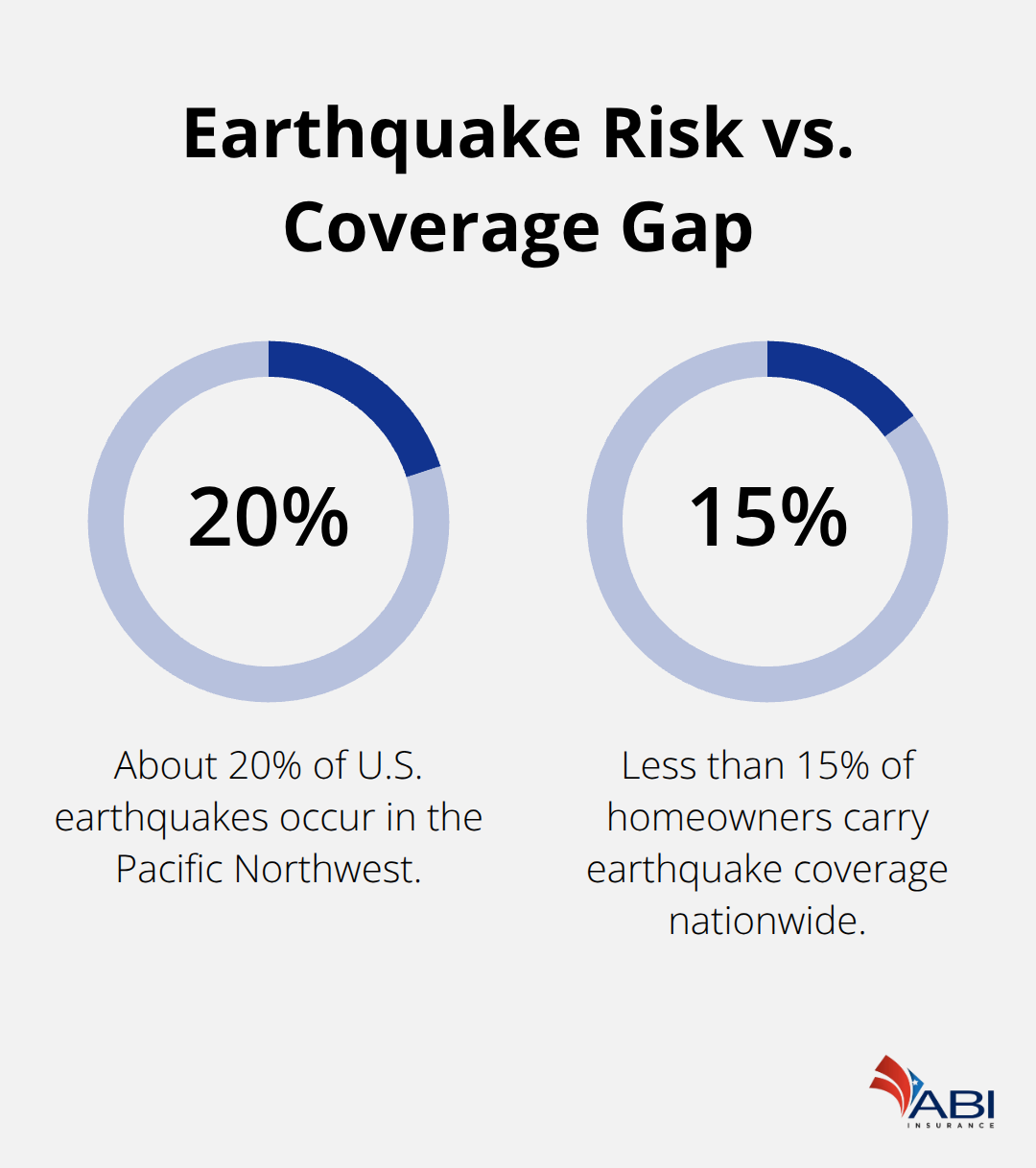
Condo owners sit in a precarious position when it comes to earthquake risk. The U.S. Geological Survey reports that about 20% of the nation’s earthquakes occur in the Pacific Northwest, making high-rise condos in this region particularly vulnerable. A single moderate earthquake can cause structural damage exceeding $100,000 to individual units, yet most condo owners discover too late that their standard homeowners policy provides zero protection. Insurance Information Institute data shows that less than 15% of homeowners nationwide purchase earthquake coverage, leaving many homeowners exposed to catastrophic financial loss.
Your Homeowners Policy Has a Massive Gap
Your homeowners insurance covers fire, theft, and weather-related damage, but earthquake damage sits entirely outside that protection. When the 2011 earthquake in Virginia caused an estimated $300 million in damage across the eastern United States, thousands of homeowners faced this harsh reality. High-rise condos face amplified risk because seismic waves travel upward through building structures, and upper-floor units experience stronger shaking than ground-level properties. Many condo owners assume their coverage is complete, only to face six-figure repair bills after seismic events.
High-Rises Face Disproportionate Costs
Earthquake damage in high-rise condos involves far more than cracked drywall. Structural engineers report that damage to shared building systems — elevator shafts, water lines, electrical conduits, and foundation connections — can total millions of dollars. When these shared systems fail, individual unit owners often bear significant repair costs through special assessments, regardless of their own unit’s direct damage. Without earthquake coverage, you’re betting your entire investment on the odds that your building won’t experience a significant seismic event.
Understanding Your Actual Exposure
The financial stakes extend beyond your unit’s walls. Condo associations typically carry master policies that cover common areas, and these policies rarely compensate individual owners for their personal losses (structural damage to your unit, personal property, or temporary housing). This gap means you absorb the cost yourself unless you hold separate earthquake coverage. The combination of individual vulnerability and shared building complexity makes earthquake protection a financial necessity, not an optional add-on.
What Earthquake Coverage Actually Covers
Structural Damage to Your Unit
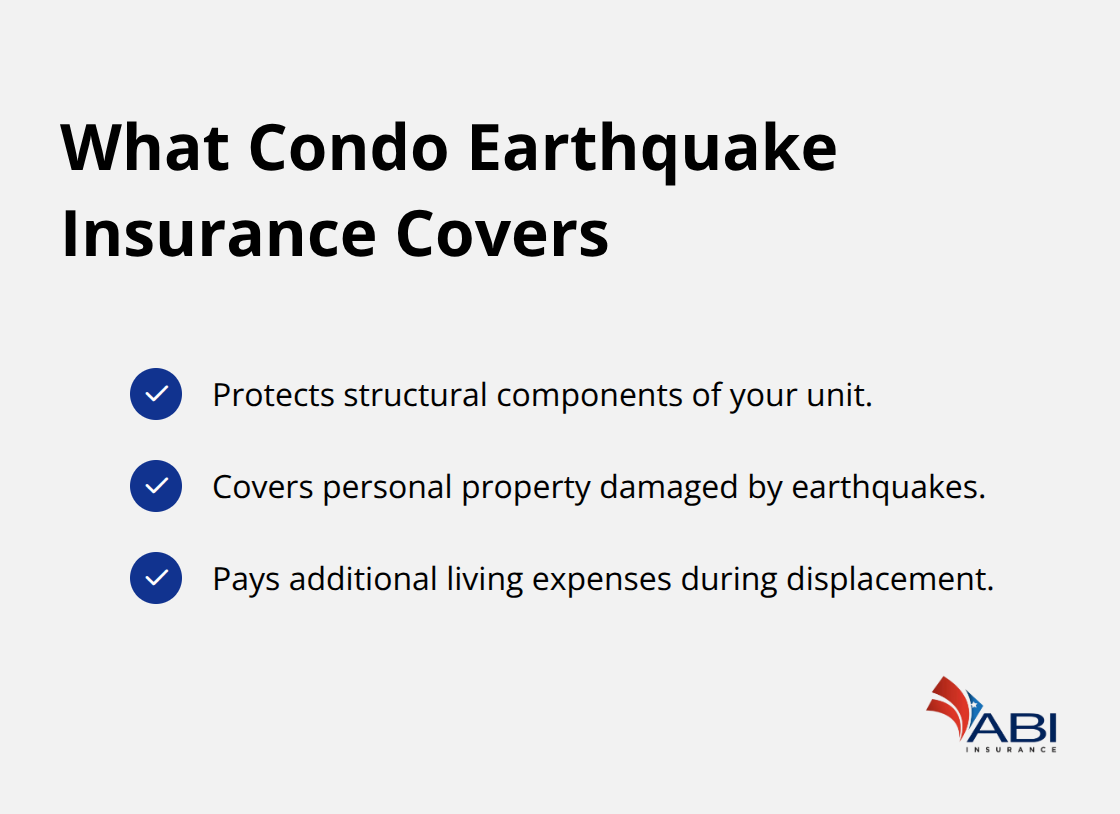
Earthquake coverage protects the structural components of your individual unit-walls, floors, ceilings, built-in cabinetry, and permanently attached fixtures. When a moderate earthquake strikes, structural repairs in high-rises can be substantial, and without specific earthquake coverage, you pay this entirely out of pocket. Coverage limits typically range from $50,000 to $500,000 depending on your unit’s value and your chosen deductible. Your condo’s master policy covers common areas only, leaving your personal unit’s structural integrity your sole responsibility.
Personal Property and Living Expenses
Earthquake coverage also protects your personal property — furniture, electronics, clothing, and other belongings inside your unit that sustain earthquake damage. A single seismic event can destroy thousands of dollars in household goods. Your condo’s master policy won’t compensate you for these losses. The third component covers additional living expenses, also known as loss of use, if the earthquake makes your unit uninhabitable. If structural damage forces you to relocate temporarily, this coverage pays for hotel stays, restaurant meals, and other necessary expenses while repairs proceed, typically offering $10,000 to $50,000 in protection depending on your policy.
Understanding Deductible Structure
The deductible structure differs significantly compared to standard homeowners insurance. Earthquake deductibles are percentage-based rather than fixed amounts, typically ranging from 2.5% to 25% of your coverage limit. This means if you carry $200,000 in structural coverage with a 15% deductible, you absorb the first $30,000 in losses before insurance begins paying. Most condo owners underestimate their actual earthquake exposure and select deductibles that are too high for their financial situation.
Selecting the Right Deductible and Limits
Lower deductibles (2.5% to 10%) cost more in premiums but activate coverage faster when damage occurs. Evaluate your emergency savings and repair capacity before selecting a deductible — a high deductible saves premium dollars but creates genuine financial hardship if an earthquake strikes. Coverage limits deserve equal attention because they must reflect both your unit’s replacement cost and the typical damage patterns in high-rise structures. Local seismic risk and your specific building’s vulnerability determine whether your current selections leave you adequately protected or dangerously exposed.
Selecting the Right Coverage for Your Condo’s Earthquake Risk
Choosing earthquake coverage requires moving past premium price and calculating what your unit would cost to rebuild. Most condo owners start with the wrong question — they ask what coverage costs instead of what they’d lose without it. Start with your unit’s replacement cost, which your condo association’s master policy documents should specify, or your real estate agent can estimate from comparable sales in your building. High-rise structural repairs cost substantially more than single-family homes because contractors must coordinate with building management, navigate shared systems, and often work within occupied buildings. If your unit would cost $400,000 to rebuild, selecting $150,000 in coverage leaves you exposed to a $250,000 gap that insurance won’t fill.
Calculate Your Deductible Against Emergency Reserves
Your deductible choice directly impacts your financial exposure during recovery. A 20% deductible on $300,000 coverage means you pay $60,000 before your policy activates; a sum most households cannot cover immediately. At ABI Insurance, we recommend condo owners calculate their genuine emergency reserves before locking in a deductible. If you have $30,000 saved, a 10% deductible makes sense. If you have $75,000 available, you can comfortably handle 15% to 20% and save substantially on premiums. The trade-off isn’t theoretical — it’s the difference between recovering quickly after an earthquake or facing years of financial strain.
Assess Your Building’s Actual Seismic Vulnerability
Your specific building’s age, construction method, and location matter far more than general regional risk statistics. Condos built before 1980 in seismically active areas face substantially higher damage risk because older construction standards didn’t account for modern seismic engineering principles. The U.S. Geological Survey’s earthquake hazard maps show detailed risk by zip code. Review the specific map for your building’s location rather than relying on broad regional assumptions.
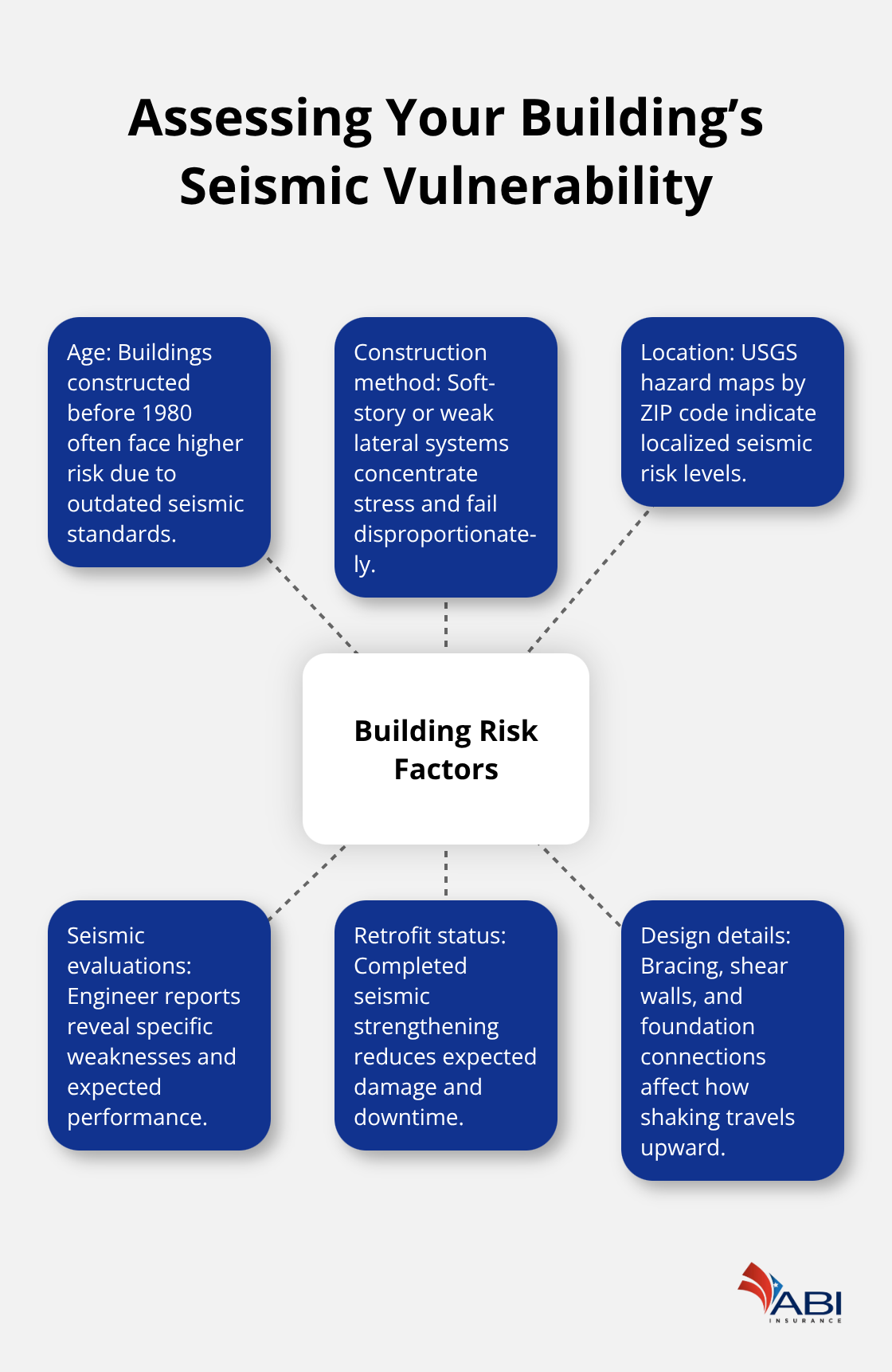
Soft-story construction — common in older Portland-area condos where ground floors contain large windows or open parking areas — experiences disproportionate damage during earthquakes because the building structure concentrates stress on fewer support points.
Ask your condo association directly whether engineers have completed seismic evaluations of your building. Many associations commissioned these studies after significant seismic events. If your building has been evaluated, request the findings because they reveal actual vulnerability rather than general risk categories. Buildings with known structural weaknesses warrant higher coverage limits and lower deductibles because potential damage increases significantly. Conversely, newer construction with modern seismic bracing might justify higher deductibles since damage likelihood decreases. Your building’s retrofit status matters too many older condos have undergone seismic strengthening that reduces vulnerability and should factor into your coverage decisions.
Match Coverage to Your Financial Capacity and Timeline
The insurance industry standard of selecting coverage limits based solely on replacement cost misses a critical reality for condo owners — you need coverage that aligns with your actual ability to manage financial disruption. A condo owner with $800,000 in liquid assets can comfortably carry a 20% deductible and aggressive coverage limits because they can absorb the deductible while waiting for insurance reimbursement. A condo owner with $50,000 in emergency savings needs much lower deductibles because they lack the cash reserves to pay substantial out-of-pocket amounts.
Your coverage decision should also account for your building’s special assessment history. If your condo association has levied special assessments multiple times in recent years, earthquake damage would likely trigger another assessment on top of your individual repair costs. This reality argues for higher personal coverage limits to avoid compounding financial stress. Additionally, consider whether you plan to remain in your unit long-term or sell within five years. Long-term owners should prioritize comprehensive coverage that protects their entire investment. Short-term owners might accept higher deductibles and lower limits since they’re transferring the property’s long-term risk to future buyers. Your coverage should reflect your actual financial situation and timeline.
Final Thoughts
Earthquake damage to your condo isn’t a remote possibility; it’s a financial reality that can strike property owners every year. The gap between what your standard homeowners policy covers and what an actual earthquake costs makes condo owner earthquake coverage a straightforward financial decision, not an optional luxury. Without specific earthquake protection, you absorb every penny of structural repairs, personal property losses, and displacement costs yourself.
Insurance companies base earthquake premiums on your building’s age, location, and construction type-factors that don’t improve with time. Older condos face higher premiums as buildings age, and seismic risk doesn’t decrease. Waiting another year or two before purchasing coverage means paying more for the same protection, and you live with unprotected financial exposure during that entire period.
Your next step is straightforward: calculate your unit’s replacement cost, determine what deductible your emergency savings can actually support, and get a specific quote for your unit. ABI Insurance has spent more than 40 years helping Portland-area condo owners navigate this decision, and their team understands high-rise vulnerability and what different deductible levels mean for your specific financial situation.


 Don’t Go Out on a Limb









