
Running a commercial vehicle comes with legal obligations that vary significantly by state. At ABI Insurance, we know that understanding your commercial vehicle insurance requirements isn’t about staying compliant. It is also about protecting your business from financial disaster.
This guide walks you through the specific coverage limits your state demands, the optional protections that make sense for your operation, and how to identify gaps in your current policy.
What Your State Requires for Commercial Vehicles
Minimum liability limits vary significantly by state
Every state sets different minimum liability requirements, and failing to meet them costs far more than the premium difference. Oregon requires 25/50/20 split limits — $25,000 per person and $50,000 per accident for bodily injury, plus $20,000 for property damage. That is the floor, not the ceiling. Other states impose their own thresholds, so you must verify your location before operating.
Getting the liability limits wrong exposes your business to fines, license suspension, and personal liability that no business owner can afford.
Additional coverages states mandate
Many states require protections beyond basic liability. Uninsured and underinsured motorist coverage protects your drivers when the other party lacks sufficient insurance and most states mandate this. Personal Injury Protection covers medical bills and lost wages regardless of fault in no-fault states. These aren’t optional add-ons in those jurisdictions; they’re legal requirements. A state-specific commercial quote shows you exactly what your location demands and what optional protections make sense for your operation.
Personal auto policies won’t cover your business
Business owners frequently confuse personal auto policies with what commercial operations need. Personal policies typically exclude or limit business use. If you transport products, clients, or equipment for work, a personal policy won’t cover you. Claims get denied. You face personal liability. Your business remains unprotected. Commercial auto coverage is the only way to stay compliant and protected.
Coverage needs shift by industry and vehicle type
A contractor needs different protection than a delivery service. If you carry tools or equipment, inland marine coverage protects loose items in the vehicle, while permanently installed equipment typically falls under standard policies. Contractors should verify state requirements and consider higher liability limits since job site accidents involving your vehicle create significant exposure.
Delivery services face different risks. You transport goods or people regularly, which increases accident exposures. Many delivery operations need hired and non-owned auto coverage to protect when drivers use personal vehicles for business purposes. For-hire transport trucks operating across state lines fall under FMCSA regulations and must maintain proof of insurance on file. For-hire property carriers with vehicles under 10,001 pounds need minimum $300,000 bodily injury and property damage coverage; those over 10,001 pounds need $750,000. Heavy haul or hazmat operations require $1,000,000 to $5,000,000 depending on what you transport. Operating without proper FMCSA compliance results in authority revocation and significant fines.
Getting your exact obligations straight
The quickest way to determine your exact obligations is obtaining a state-specific quote that accounts for your vehicle type, business operation, and any interstate activity. This quote reveals what your state mandates and what gaps exist in your current protection-information you’ll need before you move forward with coverage decisions.
Beyond the Minimum: What Protects Your Business
State minimums leave your business exposed
State minimums exist to meet legal thresholds, not to protect your business from reality. A single accident involving a commercial vehicle generates medical bills, lost wages, property damage, and legal fees that dwarf the baseline coverage your state requires. We see businesses underestimate their exposure constantly, then face catastrophic out-of-pocket costs after a claim.
Uninsured and underinsured motorist coverage fills a critical gap
Uninsured and underinsured motorist coverage helps protect you from at-fault drivers who cause a car accident and don’t have enough insurance to pay for your injuries or damages. UM/UIM protection covers your vehicle, your drivers, and your passengers. Many businesses operate in areas where uninsured drivers represent a genuine risk. Some business owners skip this coverage to save a few dollars monthly. That calculation fails the moment a serious accident occurs.
Collision and comprehensive coverage protect your assets
Collision covers crash damage; comprehensive coverage handles theft, vandalism, fire, hail, and weather events. If you finance or lease your vehicles, your lender requires these coverages regardless of state law. But even if you own your vehicles outright, skipping these protections exposes equipment worth thousands to uninsured loss. A contractor with a $40,000 truck and no collision coverage faces financial loss if an uninsured driver hits that vehicle.
Hired and non-owned auto coverage addresses borrowed vehicle exposure
Hired and non-owned auto coverage protects your business when it uses vehicles it doesn’t own. A delivery service that occasionally uses employee personal vehicles, a contractor who borrows a colleague’s truck, or a sales team using rental cars for client meetings all face liability if an accident occurs in that borrowed or rented vehicle. Your standard commercial policy may not cover these situations. Hired and non-owned coverage extends protection to vehicles your business uses temporarily but doesn’t own or lease.
This matters because employee personal auto policies explicitly exclude business use, leaving your company liable if a claim arises. When you obtain a commercial auto quote, ask specifically whether your coverage includes hired and non-owned vehicles, or whether you need an endorsement. Most businesses discover gaps in this area only after an accident occurs.
Identifying coverage gaps before they cost you
Your current policy may contain exclusions or limitations you haven’t identified. Personal belongings theft, illegal activities, intentional damage, or items not installed in the vehicle often fall outside standard coverage. Verify what your policy covers by reviewing the declarations page and exclusions section. A state-specific commercial quote reveals what gaps exist in your current protection and what endorsements address your specific operation. The businesses that avoid costly surprises after accidents take time to understand their coverage before they need it.
Industry-Specific Commercial Vehicle Insurance Needs
Trucking operations demand FMCSA compliance
Trucking operations face entirely different insurance demands than delivery services, and both differ drastically from specialty vehicle operators. The FMCSA sets hard requirements based on what you transport and how much your vehicle weighs, and these regulations don’t care about your budget or preferences. For-hire property carriers with vehicles under 10,001 pounds need $300,000 minimum bodily injury and property damage coverage according to 49 CFR Part 387. Cross that 10,001-pound threshold and the requirement jumps to $750,000. Hazmat carriers operate under even stricter rules. Carriers of certain hazardous materials require $1,000,000 BIPD, while those hauling explosives, poison gas, or radioactive materials face $5,000,000 minimums. These aren’t suggestions. Operating without proper FMCSA compliance results in operating authority revocation, which means you stop generating revenue immediately.
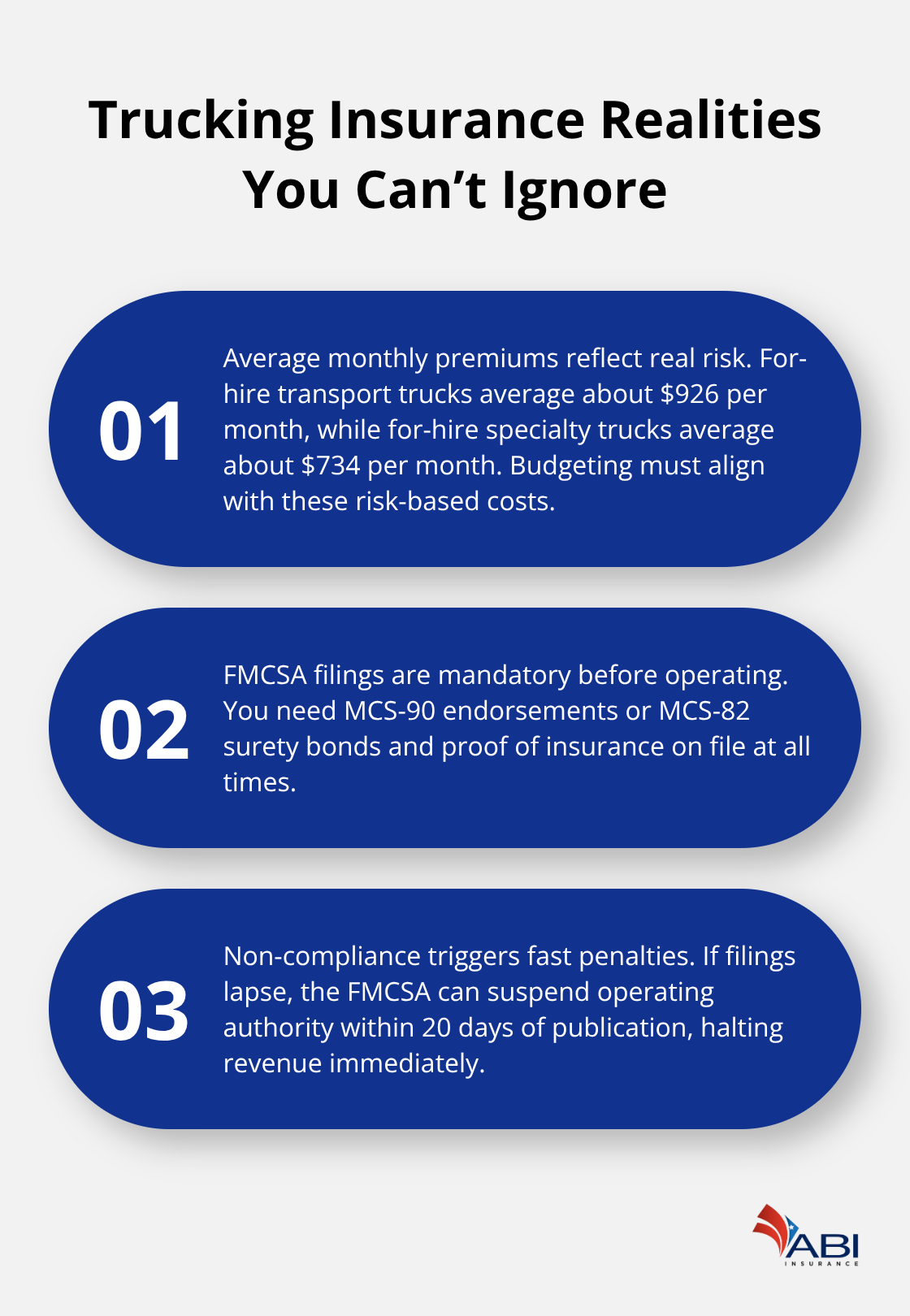
Heavy haul and multi-vehicle operations consistently see higher premiums because the exposure scales with cargo value and accident severity. Progressive commercial data from 2025 shows for-hire transport trucks average $926 monthly, while for-hire specialty trucks average $734 monthly — meaningful differences that reflect the actual risk these operations carry. You must file MCS-90 endorsements or MCS-82 surety bonds with the FMCSA before you legally operate. Always keep current proof of insurance on file. Failing to maintain current filings triggers authority suspension within 20 days of non-compliance publication in the FMCSA Register.
Delivery and last-mile operations need hired and non-owned coverage
Delivery and last-mile operations present different exposure. You transport goods or people regularly, which increases accident frequency and severity compared to standard commercial use. Many delivery operations need hired and non-owned auto coverage because drivers use personal vehicles for business purposes; employee personal policies explicitly exclude business use, leaving your company liable if an accident occurs. The cost of adding hired and non-owned coverage runs from $30 to $100 monthly, but operating without it on borrowed or rented vehicles exposes your business to catastrophic liability.
When you obtain a commercial auto quote, verify whether your coverage explicitly includes hired and non-owned vehicles or whether you need an endorsement. Most businesses discover these gaps only after an accident creates a claim denial, which is far too late to address the problem.
Specialty vehicles require tailored coverage solutions
Specialty vehicle operators face coverage gaps that standard policies don’t address. A food truck carries inventory, equipment, and customer liability exposure that a standard commercial auto policy may not fully cover. Mobile service vehicles with permanently installed tools need verification that equipment coverage applies. Contractors carrying expensive equipment in vehicles need inland marine coverage for loose tools and portable equipment, since standard policies typically cover only permanently installed items. These specialized needs (food service, mobile repair, equipment transport) demand attention during the quote process to prevent costly coverage gaps after an accident occurs.
Final Thoughts
Commercial vehicle insurance requirements exist to protect your business, your drivers, and the public. Meeting state minimums keeps you legal, but full coverage protects your actual financial exposure. The gap between what your state requires and what your business truly needs often determines whether an accident becomes a manageable claim or a catastrophic loss.
Start with a state-specific commercial auto quote that accounts for your vehicle type, business operation, and any interstate activity. This quote reveals your exact legal obligations and identifies coverage gaps in your current protection. Review your existing policy declarations page and exclusions section to understand your coverage and pay particular attention to hired and non-owned auto coverage if your operation uses borrowed or rented vehicles.
An insurance professional who understands your specific industry eliminates guesswork and identifies coverage gaps you might miss. Contact ABI Insurance to review your current coverage and ensure your business has the protection it needs.


 Affordable Cyber Liability Insurance: Protect Your Digital World on a Budget









