


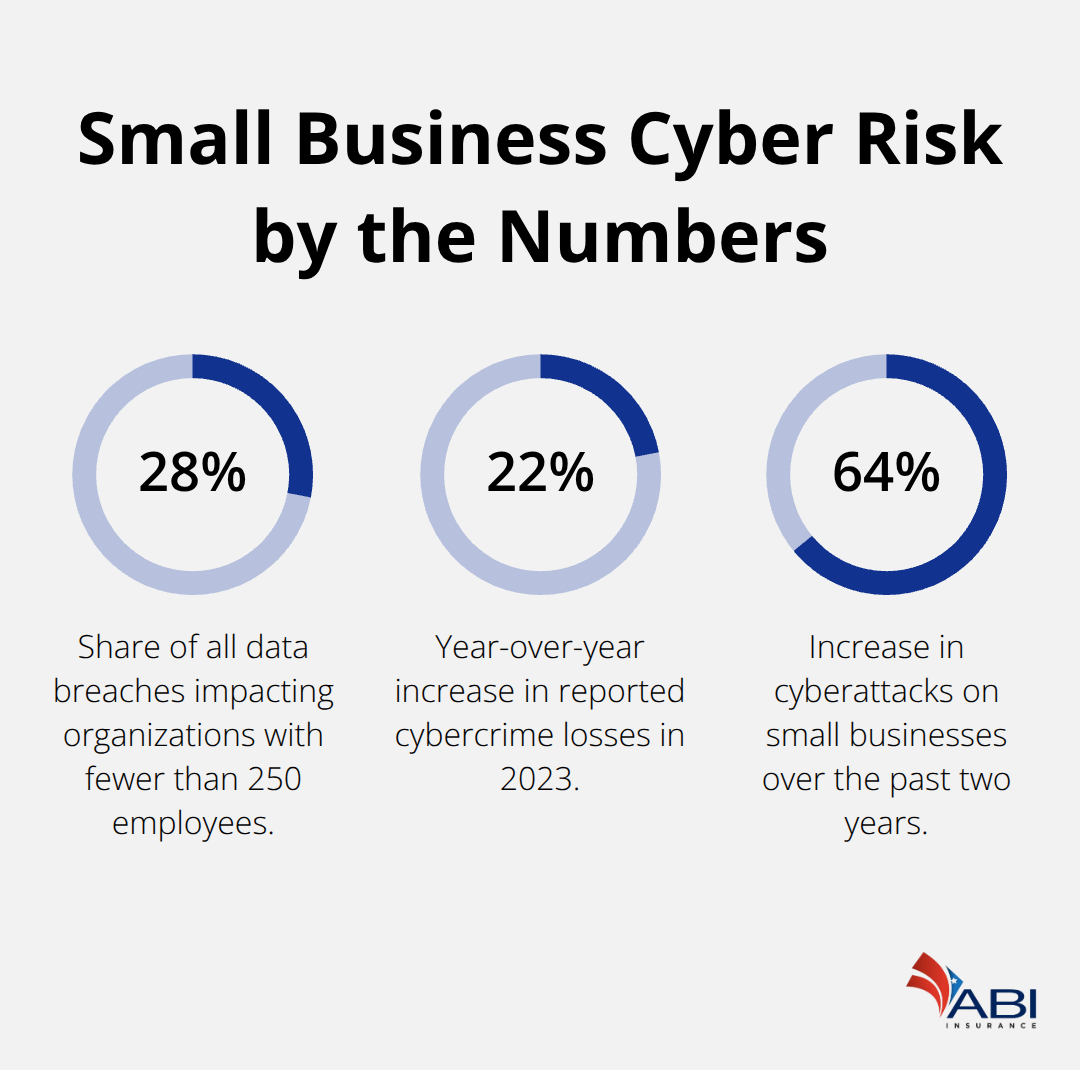
Cyberattacks on small businesses have increased 64% over the past two years, and the average cost of a data breach continues to climb. Most small business owners assume cyber threats won’t affect them, but that assumption is dangerous and expensive.
At ABI Insurance, we know that affordable cyber liability insurance doesn’t have to mean weak protection. This guide shows you how to get solid coverage without breaking your budget.
Why Planning for Cyber Threats Is No Longer Optional
Cyberattacks Target Small Businesses at Alarming Rates
The numbers tell a story that’s hard to ignore. Small and medium-sized businesses face cyberattacks with alarming regularity. About 28% of all data breaches affect organizations with fewer than 250 employees, according to the Verizon Data Breach Investigations Report. Meanwhile, the FBI’s Internet Crime Complaint Center logged over 880,000 cybercrime complaints in 2023 alone, with losses exceeding $12.5 billion. That’s a 22% jump from the year before. The threat isn’t abstract or distant anymore. It’s happening to businesses just like yours, in your industry, possibly in your neighborhood.
Ransomware remains the leading attack vector, meaning cybercriminals actively target companies to lock up their systems and demand payment. If you operate in healthcare or finance, or handle customer payment information, regulators are watching, too. HIPAA violations can cost you up to $1.5 million annually in penalties for willful neglect, and GDPR fines apply if you store data from EU residents. These aren’t theoretical risks. They’re enforcement actions happening right now.
When a data breach happens, the financial damage extends far beyond the initial attack. The cost of a data breach includes forensic investigation, customer notification, credit monitoring, legal defense, regulatory fines, and business interruption. It takes an average of 280 days to identify and contain a breach, meaning your business loses money every single day the incident remains undetected.
Small businesses without cyber insurance often can’t absorb those costs. A single breach can force closure. Even if your business survives, the reputational damage lingers. Customers lose trust. Employees worry about their personal information. The indirect costs-lost productivity, damaged relationships, reduced revenue-often exceed the direct expenses. Cyber liability insurance shifts this financial burden to an insurer, covering both the immediate response costs and the longer-term liability claims. Without it, you’re betting your entire company on the assumption that you won’t be targeted.
Regulators Enforce Compliance Requirements Across Industries
Regulatory requirements vary by industry, but the trend is unmistakable: governments and payment networks mandate stronger data protection. If you accept credit cards, PCI DSS compliance is non-negotiable, and card brands like Visa and Mastercard assess penalties after breaches involving cardholder data. If you work in healthcare, HIPAA applies. If you serve EU customers, GDPR applies. If you handle personal information, state privacy laws apply.
The Identity Theft Resource Center documented 3,205 publicly reported data breaches in 2023 affecting about 353 million individuals, with healthcare reporting the most incidents. That volume of breaches means regulators actively enforce compliance and investigate failures. Cyber liability insurance covers regulatory defense costs and fines, protecting your balance sheet during an investigation. It also funds the incident response services — forensic experts, legal counsel, and breach notification specialists — that help you navigate compliance obligations correctly. Getting those details wrong costs more money and damages your credibility.
Understanding what cyber liability covers becomes your next priority, since not all policies protect you equally against these threats.
What Your Cyber Policy Covers
Cyber liability policies come in different shapes and sizes, and what one insurer covers might leave you exposed with another. Standard policies protect against first-party costs like forensic investigations, breach notification, credit monitoring, data restoration, and business interruption when systems go down. They also cover third-party liability, meaning legal defense costs and settlements if customers or regulators sue you after a breach.
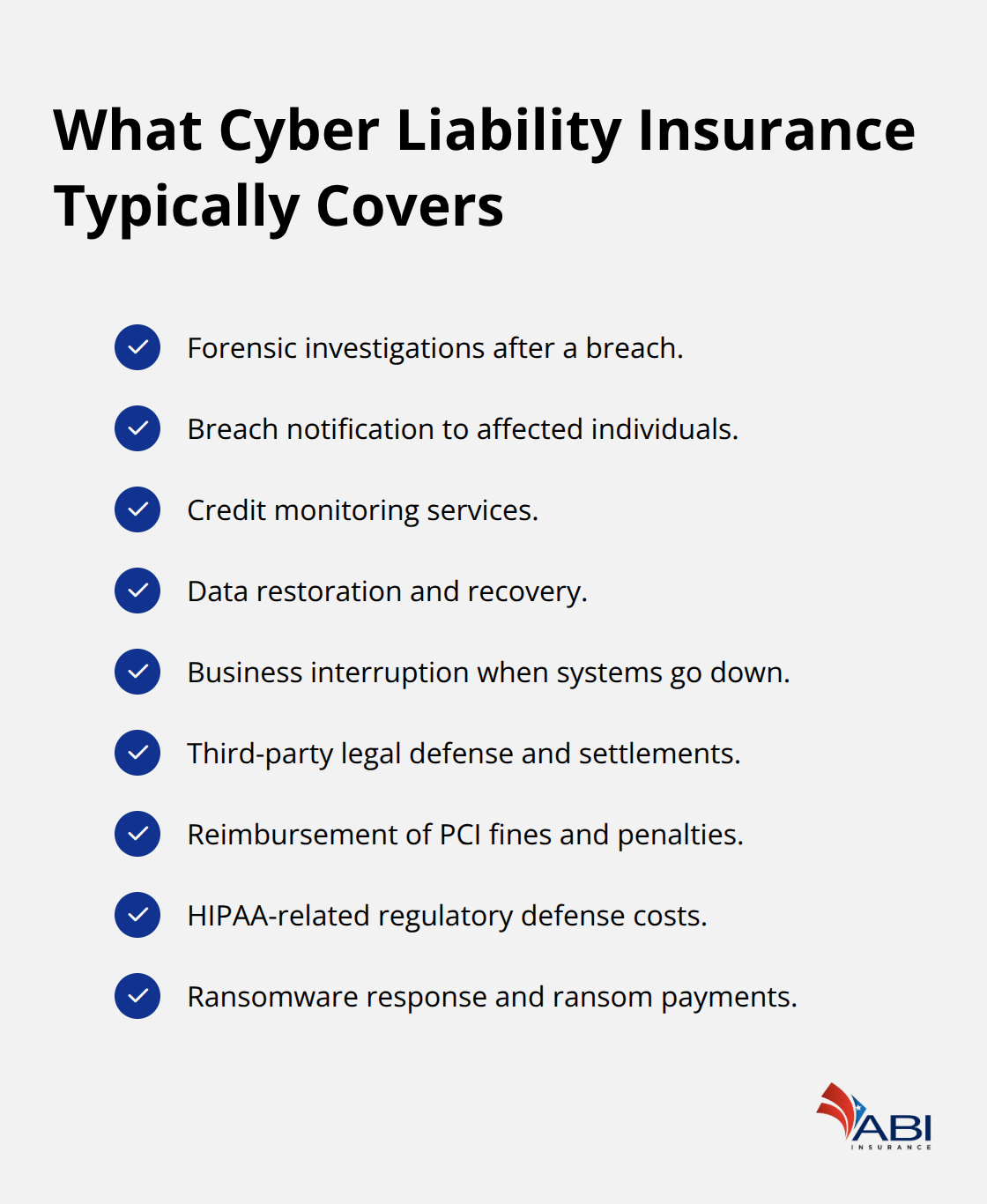
If you handle payment card data, most policies reimburse PCI fines and penalties. If you store health information, HIPAA defense costs are typically included. Ransomware coverage pays for incident response, and ransom demands when criminals lock your systems.
The Specifics Matter More Than You Think
A $1 million policy limit sounds adequate until a real breach hits, and you realize your forensic investigation alone costs $300,000, notification and credit monitoring run another $400,000, and you still have business interruption losses and legal fees ahead. That’s why small businesses with less than 50 employees typically need at least $1 million in coverage. Cyber liability insurance costs start around $60 per month for small business owners, with annual premiums ranging from $700 to over $8,000. The actual price depends on your industry risk profile, annual revenue, the deductible you choose, and your security controls.
Exclusions Create Real Protection Gaps
Exclusions are where policies fail small business owners. Social engineering losses from phishing and spear-phishing attacks are frequently excluded under standard policies and require a separate endorsement with its own limit. Employment-related claims, discrimination suits, and directors and officers liability don’t qualify for cyber coverage and need different policies. If you use third-party software or cloud services and their systems fail, that’s typically excluded unless you purchase dependent system coverage. Criminal proceedings initiated against you personally won’t be covered. Known vulnerabilities you ignored before the breach occurred create coverage voids. Intentional misconduct voids coverage entirely. Many insurers have also tightened ransomware protections in recent years, so you must verify that ransomware response and payments are included in your specific policy language. Unauthorized social engineering fund transfers represent another gap that requires the cyber crime endorsement. These exclusions matter because they’re exactly where breaches happen. Phishing remains the leading attack vector according to Verizon’s Data Breach Investigations Report. Your policy must explicitly cover your actual vulnerabilities, or it becomes useless when you need it most.
Align Coverage to Your Industry and Data Volume
The right coverage amount depends entirely on three factors: your industry, the volume of sensitive data you store, and your revenue size. A law firm or CPA handling client financial records needs substantially higher limits than a beauty salon. High-risk sectors like healthcare, finance, and legal services should target $2 million to $5 million in limits because their breach costs run higher and regulatory penalties apply immediately. Small retail or service businesses might function adequately with $1 million. Your deductible directly affects your premium, so increasing it from $5,000 to $10,000 can save you 15 to 20% annually. That savings makes sense only if you can absorb that deductible out of cash flow when a breach occurs. Choose a deductible you’d be comfortable paying without triggering a business crisis.
Lower Your Costs Through Strategic Choices
Bundling cyber coverage with general liability, commercial property, or a business owner’s policy typically saves you about 5% on premiums overall. That’s genuine money back. Standalone cyber policies let you customize limits and optional enhancements specifically to your industry and risk profile, which often costs less than bundled policies for businesses with straightforward cyber needs. Underwriters increasingly reward strong security controls, particularly multifactor authentication on all remote access and email accounts. If you implement MFA, endpoint detection and response software, and regular vulnerability assessments, insurers will price your policy lower because your actual breach risk is demonstrably lower. That’s not theoretical-that’s how modern cyber underwriting works. Your security investments directly reduce your insurance costs, which means the most affordable protection comes from combining smart coverage choices with real security measures. The next section shows you exactly how to find competitive rates and build a protection strategy that fits your budget.
How to Cut Your Cyber Insurance Costs Without Sacrificing Protection
Bundle Cyber Coverage with Existing Business Policies
Combining cyber liability with your existing business policies usually reduces premiums. Most insurers offer about a 5% discount when you add cyber to general liability, commercial property, or a business owner’s policy. A business paying $600 annually for standalone cyber coverage drops to $570 when bundled. The savings compound across multiple policies. If you already insure your building, equipment, and liability exposure, adding cyber to that package costs less than purchasing it separately.
However, bundling only makes sense if the combined package covers your specific cyber risks. Some bundled policies water down cyber limits or exclude critical protections like ransomware response or social engineering coverage. Before accepting a bundled quote, verify that the cyber component includes data breach response, business interruption, regulatory defense, and ransomware coverage at limits appropriate for your industry. When evaluating quotes, focus on coverage scope and endorsements, not just the bottom-line premium. If the bundled option excludes essential protections, a standalone cyber policy customized to your actual exposures often costs less in the long run because you avoid paying for coverage you don’t need while getting exactly what you do.
Leverage Security Controls to Lower Premiums
Security controls represent the single most powerful lever for reducing your premiums, and underwriters now price policies based on your actual security posture rather than industry averages. Implementing multifactor authentication on all remote access, email, and privileged accounts is mandatory for most carriers. Adding endpoint detection and response software typically saves about 5 to 10% because it demonstrates your organization actively monitors threats.
Regular vulnerability assessments and documented patch management could lower costs. A business that invests $2,000 annually in these security measures often qualifies for premiums 20 to 30% lower than competitors with basic security, meaning the security investment pays for itself through insurance savings alone. Work with an independent agent who understands how different underwriters weigh security controls in their pricing models.
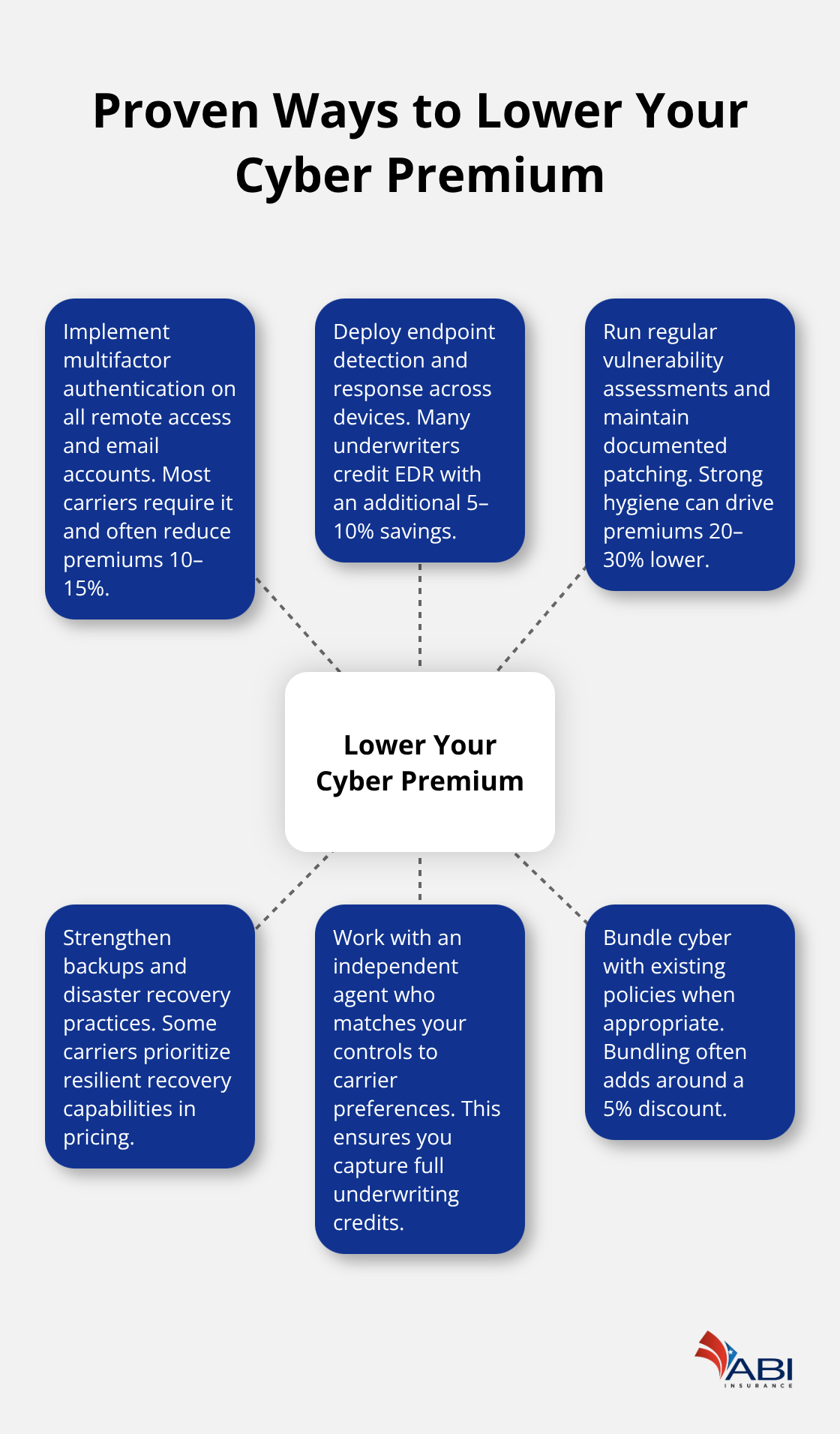
Some carriers heavily reward MFA implementation while others prioritize backup and disaster recovery practices. An agent familiar with multiple carriers can match your security investments to insurers who credit them in their underwriting, ensuring you capture the full premium reduction your controls deserve.
Shop with an Independent Agent for Competitive Rates
Cyber insurance pricing varies dramatically based on how each underwriter assesses your specific risk profile. A business with $500,000 annual revenue in retail might receive quotes ranging from $300 to $800 annually for identical coverage limits from different carriers, depending on whether the underwriter weights your industry as high-risk or moderate risk.
An independent agent runs detailed applications with multiple underwriters simultaneously, capturing nuances like your specific data handling practices, customer base location, and regulatory exposure that online tools overlook. This detailed underwriting often reveals 15 to 25% savings compared to initial online quotes because agents can articulate your risk profile in language underwriters reward. Request quotes from an independent agent and ask which security controls would most significantly reduce your premium.
Final Thoughts
Affordable cyber liability insurance protects your business without draining your budget, but only if you match your policy to your actual risk exposure and implement security controls that underwriters reward with lower premiums. Small businesses under 50 employees typically need $1 million in coverage with a $10,000 deductible, costing around $1,740 annually-an investment that covers forensic investigations, breach notification, regulatory defense, and business interruption when cyberattacks strike. Without this coverage, a single breach could force many small businesses to close permanently.
Start by documenting what sensitive data your business stores and who has access to it. Healthcare providers, law firms, and financial services handle higher-risk information requiring $2 million to $5 million in limits, while retail and service businesses often function adequately with $1 million. Multifactor authentication on all remote access and email accounts is mandatory for most underwriters and typically reduces premiums by 10 to 15%, while endpoint detection and response software saves another 5 to 10%. These investments pay for themselves through insurance savings while simultaneously reducing your actual breach risk.
Contact an independent insurance agent who represents multiple carriers and understands how different underwriters price cyber risk. We at ABI Insurance have more than 40 years of experience helping Portland-area businesses and organizations across the Western U.S. find personalized coverage solutions that fit their budgets and protect their assets. Request quotes from at least three different carriers, ask specifically which security measures would lower your premium most significantly, and verify that ransomware coverage and social engineering protection are explicitly included in your policy language.


 Earthquake Deductible Options: Choosing the Right Level of Risk









