


Earthquake insurance is one of the most misunderstood products homeowners buy. Most people don’t realize that earthquake deductible options work completely differently than standard homeowners insurance deductibles.
At ABI Insurance, we help Oregon and Washington residents navigate these choices every day. The right deductible level can mean the difference between manageable costs and financial hardship after a major earthquake.
How Earthquake Deductibles Actually Work
Earthquake deductibles operate on a percentage-based system rather than the fixed dollar amounts you encounter with standard homeowners policies. This distinction matters significantly. According to the National Association of Insurance Commissioners, percentage-based earthquake deductibles typically range from 10% to 20% of your home’s insured value. For a $200,000 home with a 10% deductible, you pay $20,000 out of pocket before insurance covers anything.
In Oregon and Washington, where earthquake risk is significant but less frequently discussed than in California, you find similar percentage-based structures through standard insurers. The deductible applies per item or per event, meaning if an earthquake damages your foundation, roof, and interior walls simultaneously, the deductible applies once to that single event, not to each component. However, aftershocks occurring more than 72 hours after the initial earthquake can trigger a separate claim with a second deductible, according to NAIC guidance. This timing detail can substantially increase your total out-of-pocket costs during an extended seismic event.
How Your Deductible Choice Affects Premium Costs
Lower deductibles command higher premiums because insurers face greater payout obligations. A 5% deductible typically costs 40% to 60% more in annual premiums than a 15% deductible for the same home. For homeowners in high-risk zones near the Cascadia Subduction Zone or other fault lines, this premium difference can range from $300 and up annually depending on your home’s age, construction type, and location. Retrofitting — bolting the foundation, bracing chimneys, and securing water heaters — can reduce premiums by up to 15% according to the California Department of Insurance, though this requires documentation and verification.
Lower deductibles make sense if you lack substantial savings to cover earthquake damage; higher deductibles work only if you have genuinely calculated your ability to pay $30,000, $50,000, or more immediately after a disaster. Many Oregon and Washington homeowners underestimate their repair costs. The USGS indicates that 42 states face earthquake risk, yet only 11% of American homeowners carry earthquake coverage, suggesting widespread underestimation of both risk and financial capacity.
Seismic Exposure in Oregon and Washington
The Cascadia Subduction Zone poses the most significant earthquake threat to Oregon and Washington residents. Scientists estimate a 10% to 15% probability of a magnitude 9.0 earthquake in the next 50 years. Smaller but damaging earthquakes occur far more frequently. The region experiences hundreds annually, though most go unnoticed. Washington state had approximately 11.3% earthquake insurance penetration in 2017 according to NAIC data, meaning nearly 9 out of 10 homeowners remained uninsured. Oregon’s penetration rates sit similarly low.
Unlike California’s mandatory earthquake disclosure requirements, Oregon and Washington impose fewer insurance regulations, leaving many residents unaware they need separate policies. Your choice of deductible directly reflects your confidence in accessing emergency funds. Federal disaster loans after earthquakes typically carry interest rates around 3% to 4%, but eligibility and approval times remain unpredictable. FEMA grants apply only to those ineligible for loans and provide minimal coverage. Choosing a deductible level you can actually afford means the difference between using insurance proceeds immediately and waiting months for federal assistance that may never fully materialize.
The financial stakes of your deductible decision extend beyond the immediate claim payout. They shape your entire post-earthquake recovery timeline and your ability to rebuild without depending on uncertain government aid.
Comparing Deductible Options: What Fits Your Budget
The Reality of Out-of-Pocket Costs
Can you pay your earthquake deductible out of pocket immediately after an earthquake? Not eventually, not after a loan approval, but right now. A 5% deductible on a $300,000 home means $15,000 cash before your insurance pays anything. A 15% deductible on the same home means $45,000. These numbers represent the difference between financial recovery and financial catastrophe for most Oregon and Washington homeowners. The National Association of Insurance Commissioners reports that earthquake deductibles range from 5% to 25% of your home’s insured value, giving you control over this decision.
The premium difference between these extremes matters, but not as much as whether you can actually afford the deductible when damage occurs. Many homeowners choose low deductibles they cannot actually cover, betting that an earthquake never happens. This approach fails the moment the ground shakes. Conversely, homeowners with substantial savings often carry high deductibles unnecessarily, paying excess premiums for years when a lower deductible would serve them better.
Calculate Your Three Critical Numbers
The practical calculation requires knowing three numbers: your home’s rebuild cost, your liquid savings available for emergencies, and your monthly cash flow. If you have $50,000 in accessible savings and a $300,000 home, a 10% earthquake deductible ($30,000) leaves you vulnerable but manageable.

A 20% deductible ($60,000) exceeds your emergency fund entirely, forcing reliance on credit or federal disaster loans. A homeowner who invests $3,000 to $5,000 in foundation bolting, chimney bracing, and water heater securing might lower premiums enough to justify choosing a lower deductible. Federal disaster loans after earthquakes carry interest rates around 3% to 4%, but waiting for loan approval takes weeks or months while contractors demand deposits immediately.
Premium Differences Over Time
Homeowners in high-risk zones near the Cascadia Subduction Zone face annual premium differences ranging from $300 to $800 between a 5% and 15% deductible, depending on home age and construction type. Over a 10-year period, this difference totals $3,000 to $8,000. If your home suffers a $75,000 earthquake loss, paying a $15,000 deductible (5%) versus a $45,000 deductible (15%) means you keep $30,000 more of your insurance payout.
Your deductible choice directly determines whether you pay contractors from insurance proceeds or from borrowed money at interest. The math only works in favor of high deductibles if you never file a claim, which remains unknowable. The lowest deductible you can afford to pay within 48 hours of a major earthquake protects your financial stability when it matters most.
Moving Forward With Your Coverage Assessment
Understanding your budget constraints and financial capacity sets the foundation for the next critical step: evaluating your home’s specific vulnerability and location to determine whether your chosen deductible level aligns with your actual earthquake risk exposure.
Assessing Your Home’s Earthquake Exposure and Financial Readiness
Determine Your Home’s Seismic Vulnerability
Your home’s earthquake risk depends on three measurable factors: proximity to fault lines, soil composition, and building construction. The USGS Earthquake Hazards Program provides free online tools to determine your specific location’s seismic hazard level and soil type. Homes built before 1980 on soft soil or sand face substantially higher damage potential than newer homes on bedrock. Older masonry or unreinforced concrete block construction amplifies vulnerability dramatically.
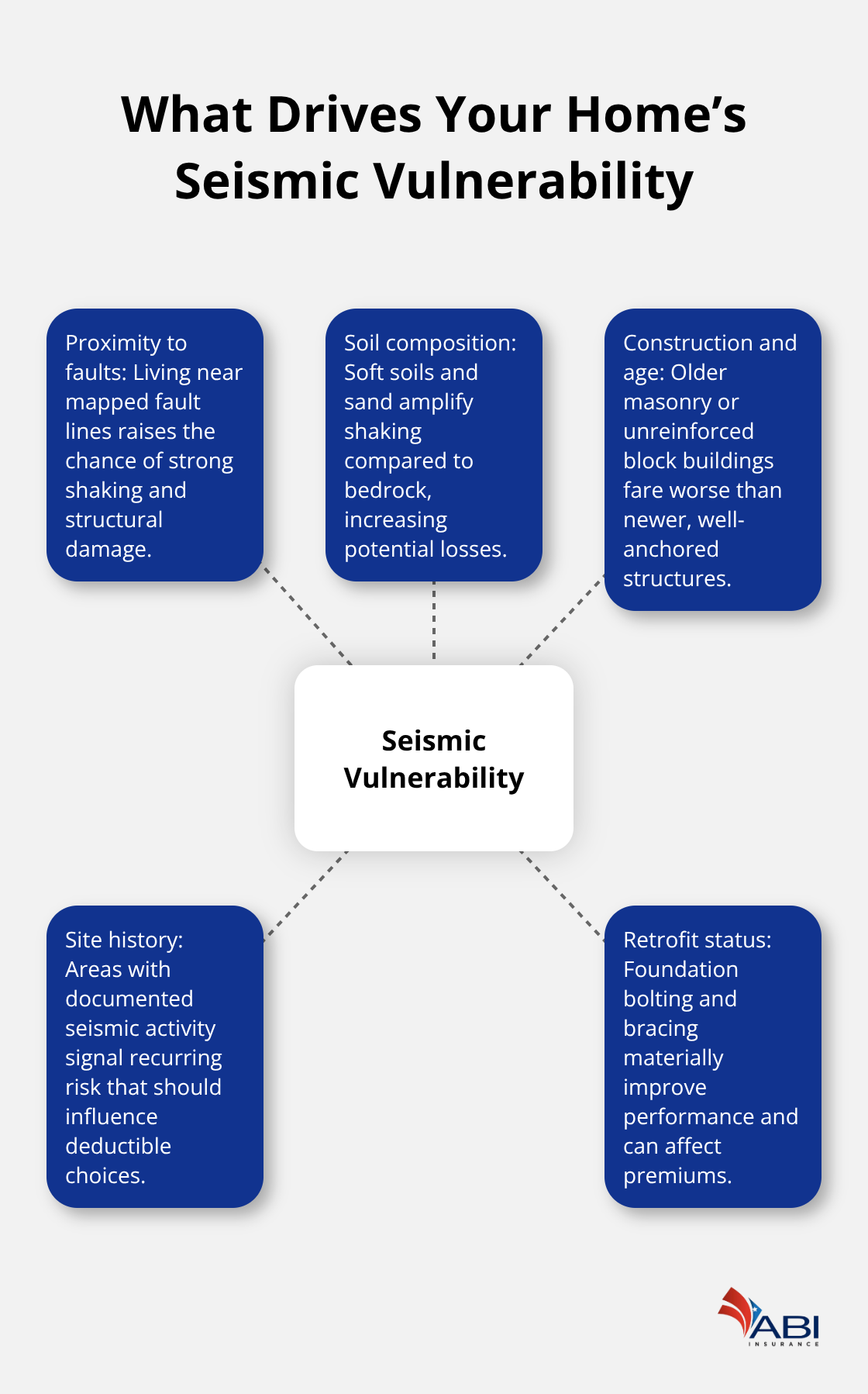
If your home sits within five miles of a mapped fault line or in an area with historical seismic activity, your deductible choice becomes less theoretical and more urgent.
Oregon and Washington residents often underestimate proximity risk because major earthquakes happen infrequently, yet the Cascadia Subduction Zone threat remains constant. Homes with cripple walls, raised foundations without proper bolting, or unbraced water heaters and chimneys sustain disproportionate damage. Before selecting a deductible level, verify whether your home has foundation bolting and bracing completed.
Connect Retrofitting to Your Deductible Strategy
A home that needs $5,000 in foundation work might justify a lower deductible if retrofitting reduces annual premiums enough to recoup that investment within three to four years. Foundation bolting, chimney bracing, and water heater securing represent the most cost-effective retrofit actions for earthquake protection.
Calculate Your Accessible Emergency Funds
Your ability to cover repair costs requires honest calculation of accessible funds minus committed obligations. Calculate your liquid emergency savings (excluding retirement accounts, college funds, and investment portfolios). Subtract three months of living expenses from that total. The remaining amount represents what you can deploy within 48 hours after an earthquake. If that figure is $20,000, a 10 percent deductible on a $300,000 home ($30,000) creates genuine hardship. A 5 percent deductible ($15,000) fits within your capacity. Conversely, if you maintain $80,000 in accessible emergency funds, a 15 percent deductible becomes manageable without financial strain.
Identify Coverage Gaps in Your Current Policies
Your homeowners policy covers fire damage from earthquakes even without earthquake insurance, according to California law requirements that apply broadly. However, it does not cover ground shaking damage, foundation failure, or structural collapse. Personal property coverage through your homeowners policy also excludes earthquake damage. If you own expensive items like art collections, wine cellars, or high-end electronics, earthquake insurance becomes essential rather than optional.
Review your homeowners policy declarations page to confirm coverage limits for dwelling and contents, then determine what percentage of your total home value remains unprotected without earthquake insurance.
Final Thoughts
Your earthquake deductible options reflect your financial reality, not your earthquake risk alone. The right deductible level sits at the intersection of what you can afford to pay immediately, what premium savings matter to your annual budget, and what coverage gaps exist in your current policies. A 5% deductible protects your financial stability if you maintain substantial emergency savings, while a 15% or 20% deductible works only if you genuinely have $40,000 to $60,000 accessible within 48 hours of a major earthquake.
Start with your liquid emergency funds minus three months of living expenses. That number determines your maximum comfortable deductible. Contact your insurance agent to compare premium differences between deductible levels for your specific home, and review your homeowners policy declarations page to identify what earthquake damage remains uninsured. If retrofitting reduces premiums by 15%, the math may justify investing in foundation bolting and chimney bracing now.
We at ABI Insurance help Oregon and Washington homeowners evaluate earthquake deductible options based on their actual financial capacity rather than theoretical risk. Contact us to discuss your earthquake insurance needs and ensure your coverage protects what matters most.


 Best Earthquake Insurance Providers: Finding Real-World Coverage









