


Earthquakes strike without warning, and standard homeowners insurance won’t cover the damage. We at ABI Insurance know that finding the best earthquake insurance providers requires understanding of what protects your property.
This guide walks you through financial stability, coverage options, and customer service records that separate reliable providers from the rest. You’ll learn exactly what to compare and how to select coverage that matches your real risk.
Financial strength determines claim payment reliability
When you compare earthquake insurance, financial strength ratings from AM Best become your most reliable indicator. A carrier rated A+ or better demonstrates the ability to absorb catastrophic losses without delaying claims. This financial stability directly affects whether you receive payment weeks or months after a disaster.
Coverage flexibility determines how well policies fit your situation
Most earthquake policies cover dwelling protection, other structures, personal property, and loss of use, but the specific limits and exclusions vary dramatically between carriers. Some carriers like Liberty Mutual offer parametric earthquake coverage tied to sensor-based payouts, meaning you receive funds based on earthquake magnitude and location rather than damage assessment. This approach accelerates payouts significantly.
Deductible options matter more than most buyers realize. GeoVera Holdings and Palomar range from 2.5% to 25% of dwelling limit. Lower deductibles mean higher premiums but less out-of-pocket cost after a quake.
Customer service speed affects your recovery timeline
Your customer service experience impacts how quickly you resolve claims after a disaster. Carriers with strong online claim filing systems, local adjusters, and 24/7 support lines reduce stress during the most chaotic moments. The ability to file claims online or through mobile apps rather than waiting for an adjuster to visit can mean the difference between starting repairs in days versus weeks.
These differences in financial strength, coverage options, and service capabilities shape the protection after an earthquake. The next section walks you through the specific features you should compare when evaluating providers for your property and risk profile.
Key Features to Compare When Choosing Earthquake Insurance
Deductibles determine your out-of-pocket exposure
Earthquake deductibles work nothing like your homeowners coverage. Most carriers use a percentage of your dwelling limit rather than a fixed dollar amount, meaning a $500,000 home with a 15% deductible costs you $75,000 out of pocket before insurance pays anything. GeoVera Holdings and Palomar range from 2.5% to 25%. This percentage structure means your deductible grows as your home value increases, so you must understand your exact dwelling limit before comparing premiums.
A lower deductible percentage feels safer but raises your annual premium significantly. For a $500,000 home, moving from 15% to 10% deductible typically adds $200 to $400 annually, depending on your location and construction type. Higher deductibles save money monthly but expose you to substantial costs if an earthquake strikes. Most homeowners in moderate-risk areas choose 15% or 20% deductibles as a practical middle ground that balances affordability with manageable out-of-pocket exposure.
Coverage limits and exclusions reveal protection gaps
Coverage limits and exclusions create the real gaps in earthquake protection. Some carriers may offer higher limits or lower caps. Building code upgrade coverage, pays the difference between repairing to old standards versus current building codes.Most carriers exclude damage from fire, landslides unrelated to earthquakes, and expensive items like jewelry or art without additional riders. You should review your specific policy to identify what falls outside standard coverage.
Premium costs reflect your property’s actual risk profile
Premium costs depend on factors such as how your home is constructed and the type of soil beneath it. A newer wood-frame home on stable soil in a low-risk zone pays dramatically less than an older masonry structure near a major fault. Retrofit discounts, particularly from carriers emphasizing engineering-based underwriting, can reduce premiums by up to 15% if your home has proper seismic bracing.
When you compare quotes across carriers, adjust deductibles to the same percentage and verify you’re comparing identical coverage limits for dwelling, personal property, and loss of use. This approach ensures premiums reflect actual protection differences rather than coverage variations.
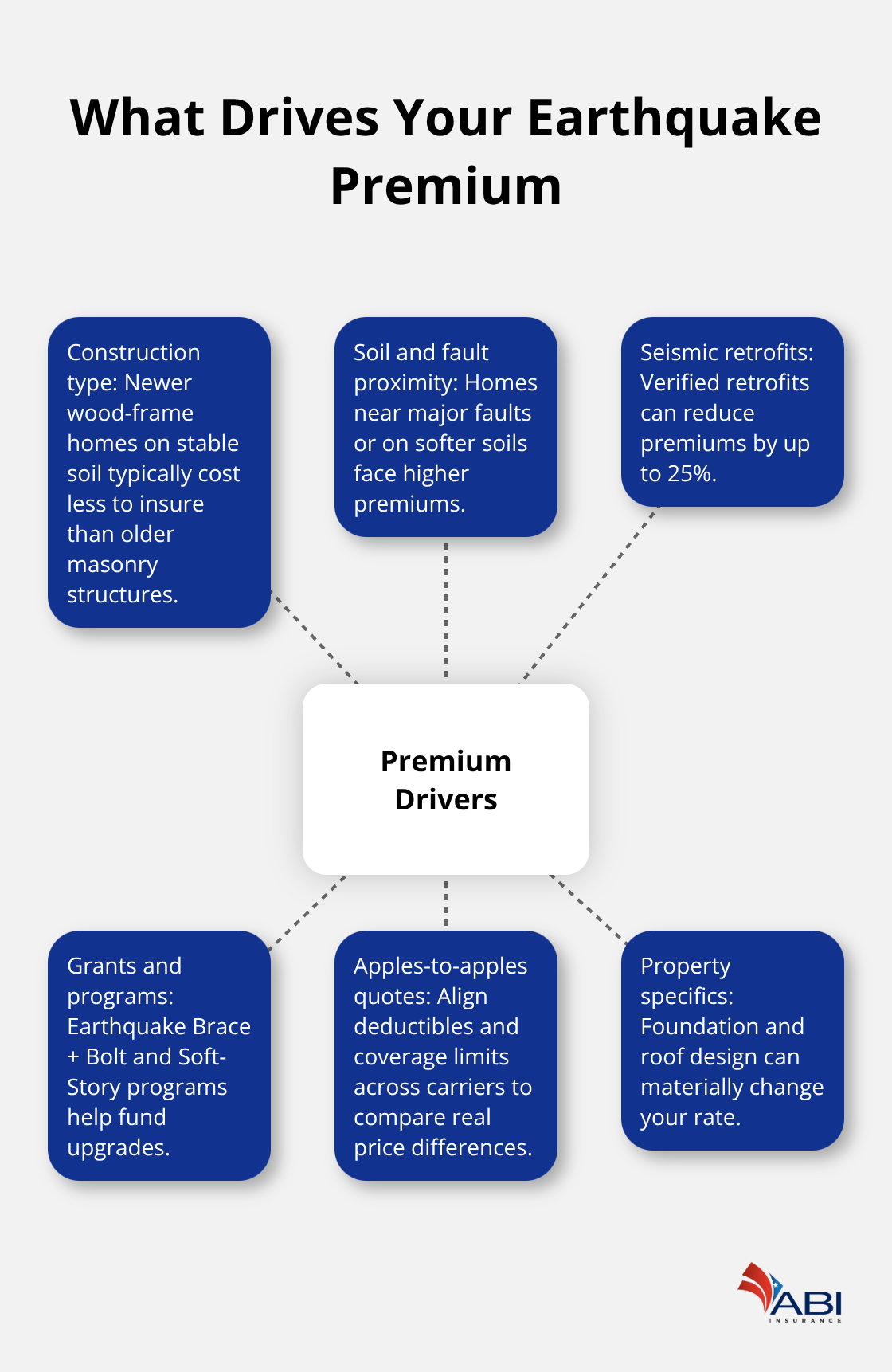
Your specific property characteristics-not just your home’s age-drive what you’ll pay. Foundation type and roof design matter as much as overall age, so carriers that underwrite based on these details may offer better rates for homes with favorable features. Understanding these cost drivers helps you identify which carriers offer the best value for your particular situation and risk profile.
Selecting Coverage That Matches Your Real Risk
Calculate your actual replacement cost
Start with your property’s real reconstruction cost, not its market value. A $600,000 home in Portland may cost $450,000 to rebuild after an earthquake because land value makes up the difference. Contact your homeowners insurer or a local contractor to determine realistic reconstruction costs for your specific structure. This number becomes your dwelling limit baseline.
Assess your location’s seismic exposure
Identify your location’s fault proximity and soil type using U.S. Geological Survey earthquake hazard maps. Homes within five miles of major faults like the Cascadia Subduction Zone in Oregon and Washington face substantially higher premiums and earthquake risk than properties in lower-hazard zones. Your ZIP code drives premium calculations more than almost any other factor, so understanding your exact seismic exposure prevents overpaying for unnecessary coverage or underinsuring against genuine risk.
Evaluate your home’s structural characteristics
Foundation type matters enormously. Homes with concrete slab or bolted foundations withstand earthquakes far better than those on raised wooden foundations without bracing. If you’ve completed seismic retrofitting, document this work immediately because carriers offer up to 15% premium discounts for verified retrofits.
Compare coverage details across carriers
Review your homeowners policy’s earthquake exclusions in detail. Standard policies exclude all earthquake damage, meaning you own zero protection without a separate earthquake policy. Examine loss of use coverage closely because this protection pays for temporary housing while repairs proceed.
Get quotes and purchase immediately
Obtain quotes using identical dwelling limits and deductible percentages to ensure real premium comparisons. Carriers serving Oregon and Washington require quotes from agents. Act now rather than waiting for renewal time. You can add earthquake coverage to existing policies immediately, and carriers issue policies within days, meaning your property gains protection before the next seismic event strikes.
Final Thoughts
The best earthquake insurance providers combine financial strength to pay claims without delay, coverage options that match your actual property risk, and responsive service when you need it most. Palomar Holding and other carriers demonstrate this combination through substantial reserves, flexible deductible structures, and documented claims performance. Your task involves identifying which carrier aligns with your specific location, home construction, and financial situation.
Start by calculating your home’s true reconstruction cost, not its market value, then determine your seismic exposure using USGS hazard maps and your ZIP code’s fault proximity. Document any seismic retrofits you’ve completed because carriers offer up to 15% premium discounts for verified improvements, and request sample policies from at least three carriers to compare dwelling limits, personal property caps, loss of use coverage, and emergency repairs provisions side by side using identical deductible percentages. The most common mistake homeowners make is waiting for renewal time to add earthquake coverage when you can purchase policies immediately and carriers issue coverage within days.
Contact ABI Insurance to discuss your specific property risk and find coverage that protects your assets, backed by more than 40 years of experience serving families and businesses across the Portland metro area and Western U.S. Earthquakes strike without warning. Standard homeowners insurance provides zero earthquake protection, so act now to secure the protection your home deserves.


 Water Leak Detection Systems









